
Close Menu
    Facebook X (Twitter) Instagram
    SciTechDaily
    • Biology
    • Chemistry
    • Earth
    • Health
    • Physics
    • Science
    • Space
    • Technology
    Facebook X (Twitter) Pinterest YouTube RSS
    SciTechDaily
    Home»Earth»Antarctic Ice Shelves Rapidly Thinning, Study Reveals 18 Percent Decrease in Thickness
    Earth

    Antarctic Ice Shelves Rapidly Thinning, Study Reveals 18 Percent Decrease in Thickness

    By Mario Aguilera, UC San DiegoMarch 27, 20154 Comments4 Mins Read
    Facebook Twitter Pinterest Telegram LinkedIn WhatsApp Email Reddit
    Share
    Facebook Twitter LinkedIn Pinterest Telegram Email Reddit
    Study Shows Antarctic Ice Shelves Rapidly Thinning
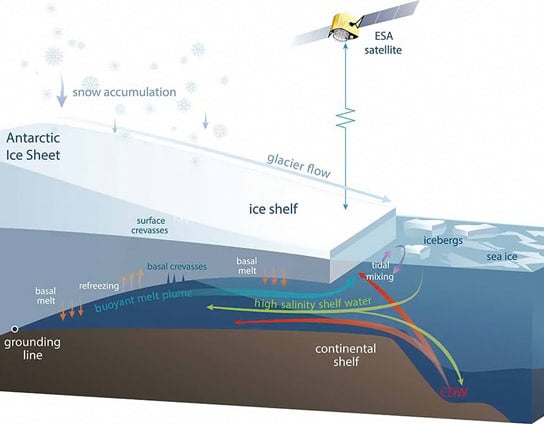
    Schematic diagram of an Antarctic ice shelf showing the processes causing the volume changes measured by satellites. Ice is added to the ice shelf by glaciers flowing off the continent and by snowfall that compresses to form ice. Ice is lost when icebergs break off the ice front, and by melting in some regions as warm water flows into the ocean cavity under the ice shelf. Under some ice shelves, cold and fresh meltwater rises to a point where it refreezes onto the ice shelf. Credit: Scripps Institution of Oceanography, UC San Diego

    New research shows that the Antarctic ice shelves are rapidly thinning, revealing an eighteen percent decrease in thickness over the course of roughly 20 years.

    A new study led by Scripps Institution of Oceanography at UC San Diego researchers has revealed that the thickness of Antarctica’s floating ice shelves has recently decreased by as much as 18 percent in certain areas over nearly two decades, providing new insights on how the Antarctic ice sheet is responding to climate change.

    Data from nearly two decades of satellite missions have shown that the ice volume decline is accelerating, according to a study published on March 26, 2015, in the journal Science and supported by NASA. Scripps graduate student Fernando Paolo, Scripps glaciologist Helen Amanda Fricker, and oceanographer Laurie Padman of Earth & Space Research (a non-profit institute specializing in oceanography research) constructed a new high-resolution record of ice shelf thickness based on satellite radar altimetry missions of the European Space Agency from 1994 to 2012.

    Merging data from three overlapping missions, the researchers identified changes in ice thickness that took place over more than a decade, an advancement over studying data from single missions that only provide snapshots of trends.

    Total ice shelf volume (mean thickness multiplied by ice shelf area) across Antarctica changed very little from 1994 to 2003, then declined rapidly, the study shows. West Antarctic ice shelves lost ice throughout the entire observation period, with accelerated loss in the most recent decade. Earlier gains in East Antarctic ice shelf volume ceased after about 2003, the study showed. Some ice shelves lost up to 18 percent of their volume from 1994 to 2012.

    New Research Reveals Antarctic Ice Shelves Rapidly Thinning
    Eighteen years of change in thickness and volume of Antarctic ice shelves. Rates of thickness change (m/decade) are color-coded from -25 (thinning) to +10 (thickening). Circles represent the percentage of thickness lost (red) or gained (blue) in 18 years. The central circle demarcates the area not surveyed by the satellites (south of 81.5ºS). Background is the Landsat Image Mosaic of Antarctica (LIMA). Credit: Scripps Institution of Oceanography, UC San Diego

    “Eighteen percent over the course of 18 years is really a substantial change,” said Paolo. “Overall, we show not only the total ice shelf volume is decreasing, but we see an acceleration in the last decade.”

    While melting ice shelves do not contribute directly to sea-level rise, the researchers indicate that there is an important indirect effect.

    “The ice shelves buttress the flow from grounded ice into the ocean, and that flow impacts sea-level rise, so that’s a key concern from our new study,” said Fricker.

    Under current rates of thinning, the researchers estimate the ice shelves restraining the unstable sector of West Antarctica could lose half their volume within the next 200 years.

    “This work demonstrates the power of satellite observations to understand change in the great polar ice sheets,” said Thomas Wagner, Program Manager for Cryospheric Sciences at NASA Headquarters. “And with data spanning decades, we can understand some of the most important changes and their implications for sea-level rise.”

    Fricker said future studies will concentrate on the causes behind changes in ice shelf volume, including the effects of the atmosphere and ocean.

    “We’re looking into connections between El Niño events in the tropical Pacific and changes in the Antarctic ice sheet,” said Paolo. “It’s very far apart but we know that these teleconnections exist. That may ultimately allow us to improve our models for predicting future ice loss.”

    Reference: “Volume loss from Antarctic ice shelves is accelerating” by Fernando S. Paolo, Helen A. Fricker and Laurie Padman, 26 March 2015, Science.
    DOI: 10.1126/science.aaa0940


    Never miss a breakthrough: Join the SciTechDaily newsletter.
    Follow us on Google and Google News.

    Antarctica Climate Science Environmental Science Ice Melt Oceanography UCSD
    Share. Facebook Twitter Pinterest LinkedIn Email Reddit

    Related Articles

    New NASA Study Brings Antarctic Ice Loss Into Sharper Focus

    2015 El Niño Appears Likely to Equal the Event of 1997-98

    NASA’s Oceans Melting Greenland Mission Maps Greenland’s Coastline

    Study Shows Greenland’s Undercut Glaciers Melting Faster than Thought

    Antarctica’s Larsen B Ice Shelf Will Disintegrate Before the End of the Decade

    New Threat to East Antarctic Ice

    NASA Data Reveal New Insight Into the Hidden Movements of the Greenland Ice Sheet

    2014 – The Highest Global Mean Sea Surface Temperatures Ever Recorded

    Satellite Records Show Antarctic Sea Ice Reaches New Record Maximum

    4 Comments

    1. a p garcia on March 28, 2015 8:33 am

      The place is supposedly melting yet ICEBREAKERS are still needed to rescue people who say the place is melting.

      Reply
      • nakedChimp on March 31, 2015 6:11 am

        that’s a funny way of telling others that you’re stupid.. 🙂

        Reply
      • Hannibal on April 6, 2015 2:25 am

        There are thousands of peer-reviewed studies of global warming and how human activity is accelerating it. Are you perhaps completely insane or just really, really stupid?

        Reply
    2. Madanagopal.V.C. on April 5, 2015 8:13 am

      The great ice ages our Earth had undergone is a cyclic process. By our carbon footprint we nations on the Earth contribute for the global warming sooner than ever by making the ice melt even on Himalayas. But one thing we should understand is that these carbon cycle is automatic even in the absence of mankind. We only speed up the cycle. Thank You.

      Reply
    Leave A Reply Cancel Reply

    • Facebook
    • Twitter
    • Pinterest
    • YouTube

    Don't Miss a Discovery

    Subscribe for the Latest in Science & Tech!

    Trending News

    Even Occasional Binge Drinking May Triple Liver Damage Risk

    Liftoff! NASA’s Artemis II Launch Sends Astronauts Around the Moon for First Time in 50 Years

    Scientists Discover New Way To Eliminate “Zombie Cells” Driving Aging

    This New Quantum Theory Could Change Everything We Know About the Big Bang

    This One Vitamin May Help Protect Your Brain From Dementia Years Later

    Stopping Weight-Loss Drugs Like Ozempic Can Quickly Erase Heart Benefits

    A 500-Million-Year-Old Surprise Is Forcing Scientists to Rethink Spider Evolution

    Coffee and Blood Pressure: What You Need To Know Before Your Next Cup

    Follow SciTechDaily
    • Facebook
    • Twitter
    • YouTube
    • Pinterest
    • Newsletter
    • RSS
    SciTech News
    • Biology News
    • Chemistry News
    • Earth News
    • Health News
    • Physics News
    • Science News
    • Space News
    • Technology News
    Recent Posts
    • A Fiery Finale: How NASA’s Artemis II Moon Mission Returns to Earth
    • NASA Artemis II Skips Burn As Astronaut Captures Stunning View of Earth
    • NASA’s Artemis II: Humans Just Left Earth Orbit for the First Time Since 1972
    • What Causes Chronic Pain? Scientists Identify Key Culprit in the Brain
    • Semaglutide Shows Surprising Mental Health Benefits in Massive 100,000-Person Study
    Copyright © 1998 - 2026 SciTechDaily. All Rights Reserved.
    • Science News
    • About
    • Contact
    • Editorial Board
    • Privacy Policy
    • Terms of Use

    Type above and press Enter to search. Press Esc to cancel.