
Close Menu
    Facebook X (Twitter) Instagram
    SciTechDaily
    • Biology
    • Chemistry
    • Earth
    • Health
    • Physics
    • Science
    • Space
    • Technology
    Facebook X (Twitter) Pinterest YouTube RSS
    SciTechDaily
    Home»Space»Two Scientists Have Figured Out What Caused Saturn’s Tilt
    Space

    Two Scientists Have Figured Out What Caused Saturn’s Tilt

    By CNRSFebruary 2, 20214 Comments3 Mins Read
    Facebook Twitter Pinterest Telegram LinkedIn WhatsApp Email Reddit
    Share
    Facebook Twitter LinkedIn Pinterest Telegram Email Reddit
    Saturn's Tilt Moons
    Artist’s impression of the migration of Titan and the tilt of Saturn. Credit: © Coline SAILLENFEST / IMCCE

    Saturn’s Moons, Led by Titan, Are Slowly Tilting the Planet

    Two scientists from CNRS and Sorbonne University working at the Institute of Celestial Mechanics and Ephemeris Calculation (Paris Observatory – PSL/CNRS) have just shown that the influence of Saturn’s satellites can explain the tilt of the rotation axis of the gas giant. Their work, published on January 18, 2021, in the journal Nature Astronomy, also predicts that the tilt will increase even further over the next few billion years.

    Rather like David versus Goliath, it appears that Saturn’s tilt may in fact be caused by its moons. This is the conclusion of recent work carried out by scientists from the CNRS, Sorbonne University and the University of Pisa, which shows that the current tilt of Saturn’s rotation axis is caused by the migration of its satellites, and especially by that of its largest moon, Titan.

    Recent observations have shown that Titan and the other moons are gradually moving away from Saturn much faster than astronomers had previously estimated. By incorporating this increased migration rate into their calculations, the researchers concluded that this process affects the inclination of Saturn’s rotation axis: as its satellites move further away, the planet tilts more and more.
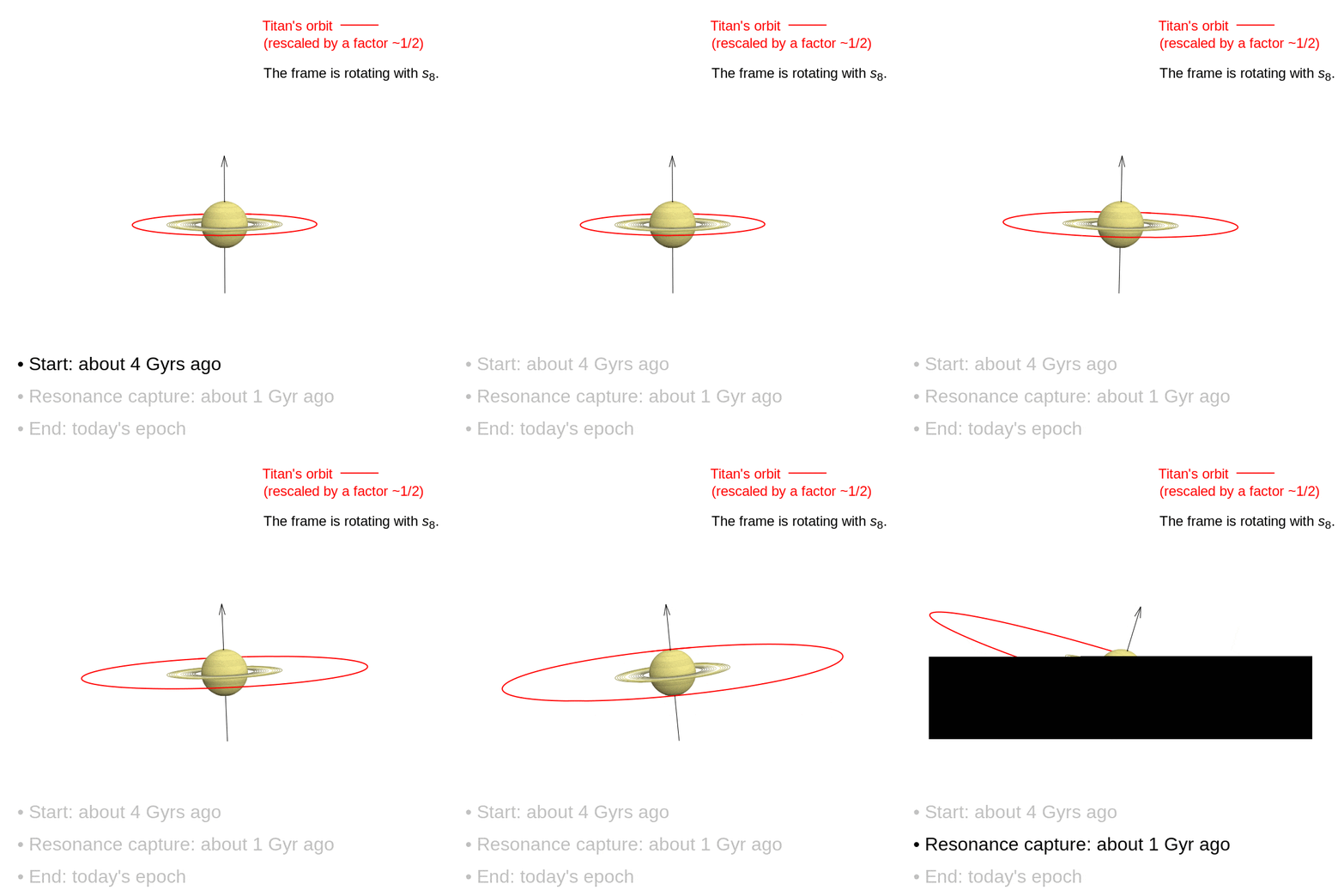
    Titan Saturn Resonance
    A schematic animation showing Titan’s migration and Saturn entering into resonance. The frame is rotating, so the axis stops moving when resonance is achieved. Credit: © Melaine SAILLENFEST / IMCCE

    The decisive event that tilted Saturn is thought to have occurred relatively recently. For over three billion years after its formation, Saturn’s rotation axis remained only slightly tilted. It was only roughly a billion years ago that the gradual motion of its satellites triggered a resonance phenomenon that continues today: Saturn’s axis interacted with the path of the planet Neptune and gradually tilted until it reached the inclination of 27° observed today.

    These findings call into question previous scenarios. Astronomers were already in agreement about the existence of this resonance. However, they believed that it had occurred very early on, over four billion years ago, due to a change in Neptune’s orbit. Since that time, Saturn’s axis was thought to have been stable. In fact, Saturn’s axis is still tilting, and what we see today is merely a transitional stage in this shift. Over the next few billion years, the inclination of Saturn’s axis could more than double.

    The research team had already reached similar conclusions about the planet Jupiter, which is expected to undergo comparable tilting due to the migration of its four main moons and to resonance with the orbit of Uranus: over the next five billion years, the inclination of Jupiter’s axis could increase from 3° to more than 30°.

    Reference: “The large obliquity of Saturn explained by the fast migration of Titan” by Melaine Saillenfest, Giacomo Lari and Gwenaël Boué, 18 January 2021, Nature Astronomy.
    DOI: 10.1038/s41550-020-01284-x

    Never miss a breakthrough: Join the SciTechDaily newsletter.
    Follow us on Google and Google News.

    Astronomy Astrophysics CNRS Moons Planets Popular Saturn
    Share. Facebook Twitter Pinterest LinkedIn Email Reddit

    Related Articles

    NASA’s Webb Just Revealed Something Astonishing in Saturn’s Atmosphere

    How Old Are Saturn’s Rings? Cosmic Dust Analyzer Reveals They Are Far Younger Than Once Thought

    Chrysalis: Saturn’s Ancient, Missing Moon

    Ripples in Saturn’s Rings Reveals “Fuzzy” Nature of Gas Giant’s Core

    Possible Signs of Alien Life? Methane in the Plumes of Saturn’s Moon Enceladus

    Worlds With Underground Oceans – Like Europa, Titan, and Enceladus – May Be More Conducive to Supporting Life Than Earth

    NASA Discovers “Very Weird” Molecule in Titan’s Atmosphere

    Volcanic Impact on Jupiter’s Moon Io Shown Directly for the First Time

    If It Wasn’t for Jupiter, Venus Might Be Habitable Today

    4 Comments

    1. Carvan Thipe on February 2, 2021 6:52 am

      I would like to help in naming discovered Saturn moons 1 mini Rigel (named after the main galaxial celestial ) The influence of Saturn tilt might have connection with recent storms even affecting SA

      Reply
    2. Zack the Physicist on February 2, 2021 8:01 am

      Right, similar phenomenon likely explains that bizarre 98 deg tilt of Uranus. What will happens in the next a few giga years? Do we get a rogue Titan at large in our Solar System or …? 🙂

      Reply
    3. Joe Milosch on February 2, 2021 11:22 pm

      Its like the wind down phase of the toy top I spun as a child, only it happens slowly by human standards. Saturn’s spin state is in a cosmic slowdown.

      Reply
    4. Enginerd. on February 3, 2021 9:05 am

      “Two Scientists THINK They Have Figured Out What Caused Saturn’s Tilt”

      Fixed it for you.

      Reply
    Leave A Reply Cancel Reply

    • Facebook
    • Twitter
    • Pinterest
    • YouTube

    Don't Miss a Discovery

    Subscribe for the Latest in Science & Tech!

    Trending News

    Researchers Warn Widely Prescribed Blood Pressure Drugs Could Be Harming Diabetic Kidneys

    James Webb Spots Something Strange Between Day and Night on an Alien Planet

    How Ancient People Moved a 6-Ton Stone 700 Kilometers to Stonehenge

    The Unexpected Gut Health Risk of Cutting Out Sugar

    Popular Weight-Loss Drugs Like Ozempic Linked to Lower Breast Cancer Risk

    AI Learned the Rules of the Universe and That Became a Problem

    Scientists Found a Hidden Brain Signal That Predicts Social Behavior

    Even GPT-5 Failed This Human Attention Test

    Follow SciTechDaily
    • Facebook
    • Twitter
    • YouTube
    • Pinterest
    • Newsletter
    • RSS
    SciTech News
    • Biology News
    • Chemistry News
    • Earth News
    • Health News
    • Physics News
    • Science News
    • Space News
    • Technology News
    Recent Posts
    • Hidden Damage From Youth May Explode Into Disease Later in Life
    • Scientists Say a New Universe Could Form Inside a Dying Star
    • Climate Models May Be Wrong About How Trees Store Carbon
    • Scientists Discovered a Fly That Sheds Its Wings and Sacrifices Its Sight
    • Researchers Capture the First Atomic-Level Images of a Critical Human DNA Repair Enzyme
    Copyright © 1998 - 2026 SciTechDaily. All Rights Reserved.
    • Science News
    • About
    • Contact
    • Editorial Board
    • Privacy Policy
    • Terms of Use

    Type above and press Enter to search. Press Esc to cancel.