
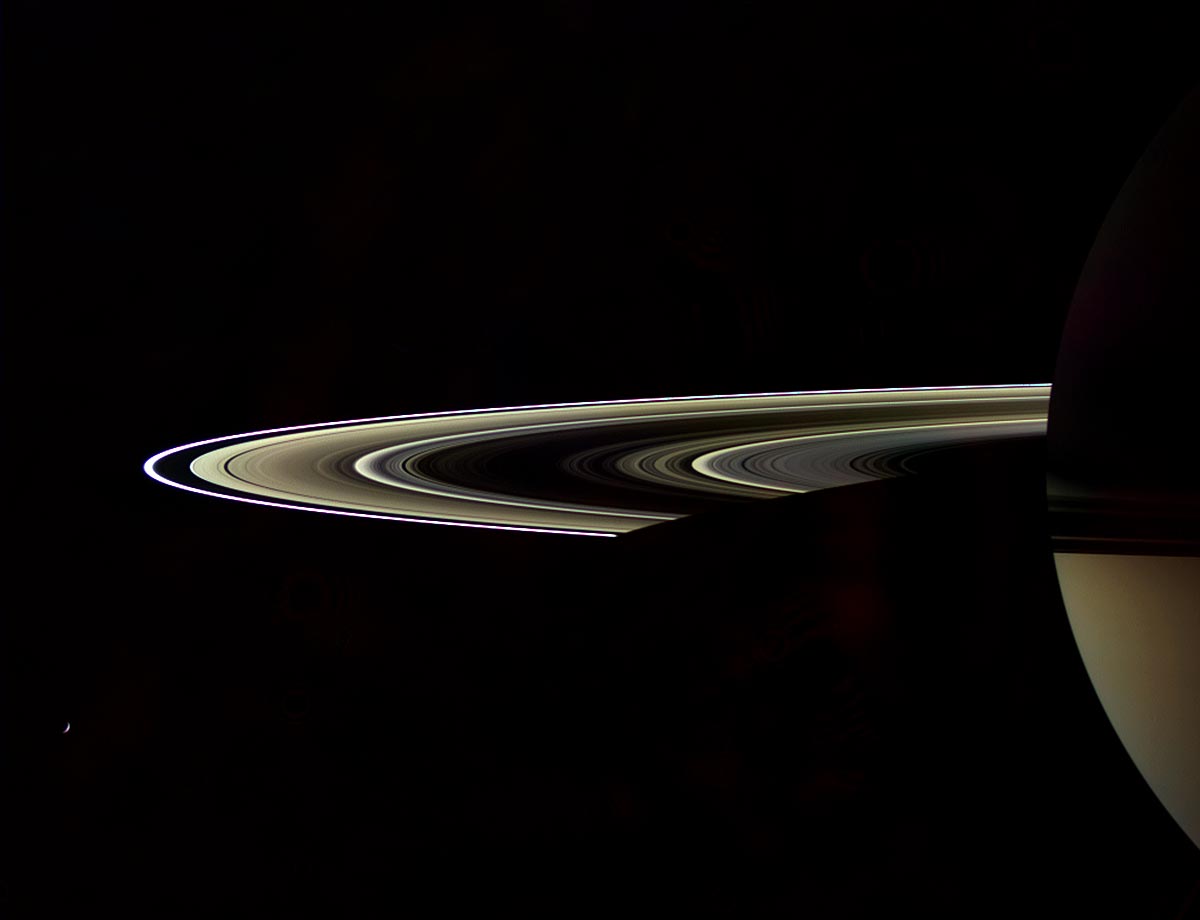
CU Boulder study reveals that Saturn’s rings are much younger than the planet itself at around 400 million years old, but their origin remains a mystery.
A new study has found that Saturn’s rings are likely no more than 400 million years old, much younger than the planet itself, which is about 4.5 billion years old. The research team analyzed dust accumulation on the rings using data from the Cosmic Dust Analyzer aboard NASA’s Cassini spacecraft, concluding that the rings have been gathering dust for only a few hundred million years. However, the origin of Saturn’s rings remains unknown, and previous research suggests they might be gradually vanishing due to ice raining down onto the planet.
A new study led by physicist Sascha Kempf from the University of Colorado at Boulder has delivered the strongest evidence yet that Saturn’s rings are remarkably young—potentially answering a question that has boggled scientists for well over a century.
The research, published on May 12 in the journal Science Advances, pegs the age of Saturn’s rings at no more than 400 million years old. That makes the rings much younger than Saturn itself, which is about 4.5 billion years old.
“In a way, we’ve gotten closure on a question that started with James Clerk Maxwell,” said Kempf, associate professor in the Laboratory for Atmospheric and Space Physics (LASP) at CU Boulder.
The researchers arrived at that closure by studying what might seem like an unusual subject: dust.
Kempf explained that tiny grains of rocky material wash through Earth’s solar system on an almost constant basis. In some cases, this flux can leave behind a thin layer of dust on planetary bodies, including on the ice that makes up Saturn’s rings.
In the new study, he and his colleagues set out to put a date on Saturn’s rings by studying how rapidly this layer of dust builds up—a bit like telling how old a house is by running your finger along its surfaces.
“Think about the rings like the carpet in your house,” Kempf said. “If you have a clean carpet laid out, you just have to wait. Dust will settle on your carpet. The same is true for the rings.”
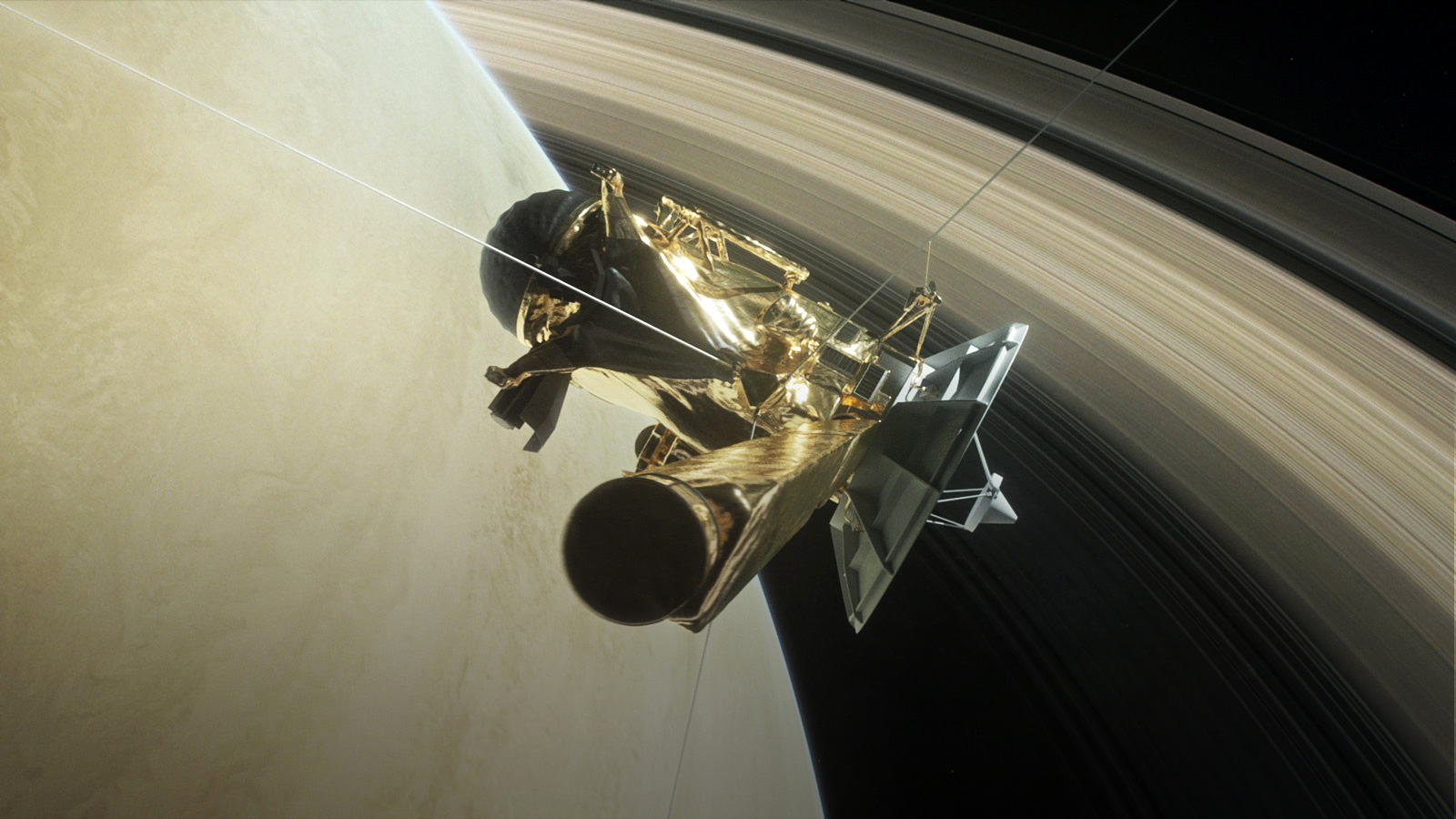
It was an arduous process: From 2004 to 2017, the team used an instrument called the Cosmic Dust Analyzer aboard NASA’s late Cassini spacecraft to analyze specks of dust flying around Saturn. Over those 13 years, the researchers collected just 163 grains that had originated from beyond the planet’s close neighborhood. But it was enough. Based on their calculations, Saturn’s rings have likely been gathering dust for only a few hundred million years.
The planet’s rings, in other words, are new phenomena, arising (and potentially even disappearing) in what amounts to a blink of an eye in cosmic terms.
“We know approximately how old the rings are, but it doesn’t solve any of our other problems,” Kempf said. “We still don’t know how these rings formed in the first place.”
From Galileo to Cassini
Researchers have been captivated by these seemingly translucent rings for more than 400 years. In 1610, Italian astronomer Galileo Galilei first observed the features through a telescope, although he didn’t know what they were. (Galileo’s original drawings make the rings look a bit like the handles on a water jug). In the 1800s, Maxwell, a scientist from Scotland, concluded that Saturn’s rings couldn’t be solid but were, instead, made up of many individual pieces.
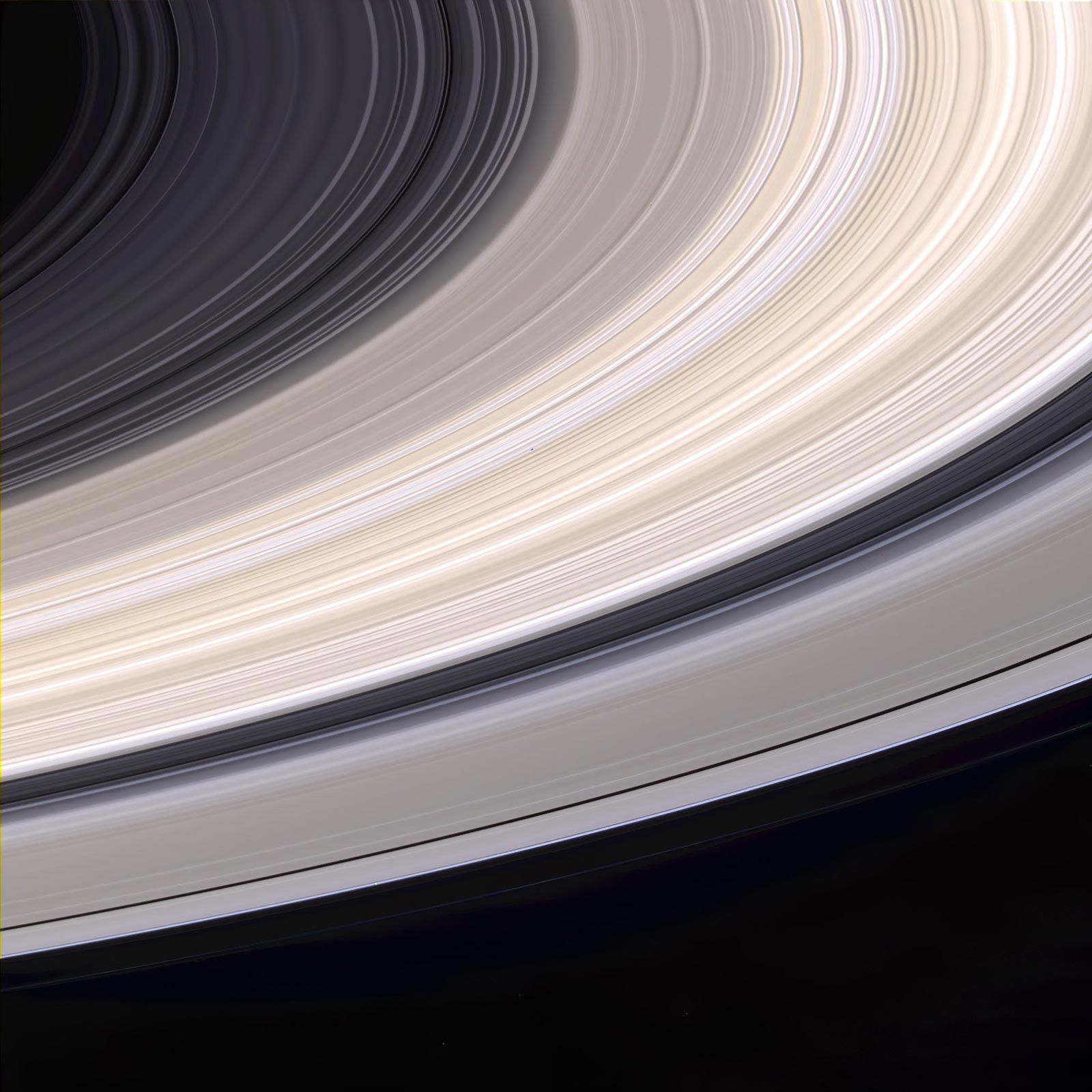
Today, scientists know that Saturn hosts seven rings comprised of countless chunks of ice, most no bigger than a boulder on Earth. Altogether, this ice weighs about half as much as Saturn’s moon Mimas and stretches nearly 175,000 miles from the planet’s surface.

Kempf added that for most of the 20th Century, scientists assumed that the rings likely formed at the same time as Saturn.
But that idea raised a few issues—namely, Saturn’s rings are sparkling clean. Observations suggest that these features are made up of roughly 98% pure water ice by volume, with only a tiny amount of rocky matter.
“It’s almost impossible to end up with something so clean,” Kempf said.
Cassini offered an opportunity to put a definitive age on Saturn’s rings. The spacecraft first arrived at Saturn in 2004 and collected data until it purposefully crashed into the planet’s atmosphere in 2017. The Cosmic Dust Analyzer, which was shaped a bit like a bucket, scooped up small particles as they whizzed by.
Engineers and scientists at LASP designed and built a much more sophisticated dust analyzer for NASA’s upcoming Europa Clipper mission, which is scheduled to launch in 2024.
The team estimated that this interplanetary grime would contribute far less than a gram of dust to each square foot of Saturn’s rings every year—a light sprinkle, but enough to add up over time. Previous studies had also suggested that the rings could be young but didn’t include definitive measures of dust accumulation.
Stroke of luck
The rings might already be vanishing. In previous research, NASA scientists reported that the ice is slowly raining down onto the planet and could disappear entirely in another 100 million years.
That these ephemeral features existed at a time when Galileo and the Cassini spacecraft could observe them seems almost too good to be true, Kempf said—and it begs an explanation for how the rings appeared in the first place. Some scientists, for example, have posited that Saturn’s rings may have formed when the planet’s gravity tore apart one of its moons.
“If the rings are short-lived and dynamical, why are we seeing them now?” he said. “It’s too much luck.”
Reference: “Micrometeoroid infall onto Saturn’s rings constrains their age to no more than a few hundred million years” by Sascha Kempf, Nicolas Altobelli, Jürgen Schmidt, Jeffrey N. Cuzzi, Paul R. Estrada and Ralf Srama, 12 May 2023, Science Advances.
DOI: 10.1126/sciadv.adf8537
Co-authors on the new study include Nicolas Altobelli of the European Space Agency; Jürgen Schmidt of the Freie Universität Berlin; Jeffrey Cuzzi and Paul Estrada of the NASA Ames Research Center; and Ralf Srama of the Universität Stuttgart.
Never miss a breakthrough: Join the SciTechDaily newsletter.
Follow us on Google and Google News.
3 Comments
“We still don’t know how these rings formed in the first place.”
Most likely from its active moons, I would say, thus it may not be as temporary as supposed.
There’s an overwhelming potential for overlap with the concept of “dark photons” here. Dark photons could be a feedback loop effect adding to the original dish currents in the ice-dominated target.
Reminds me of weather radar. It picks up details of clouds and precipitation because that is a lot easier that picking up cloud condensation details. Also worth mention is Enciladus is in recent news, apparently for acting like a great source of pre-condensed ring material.