
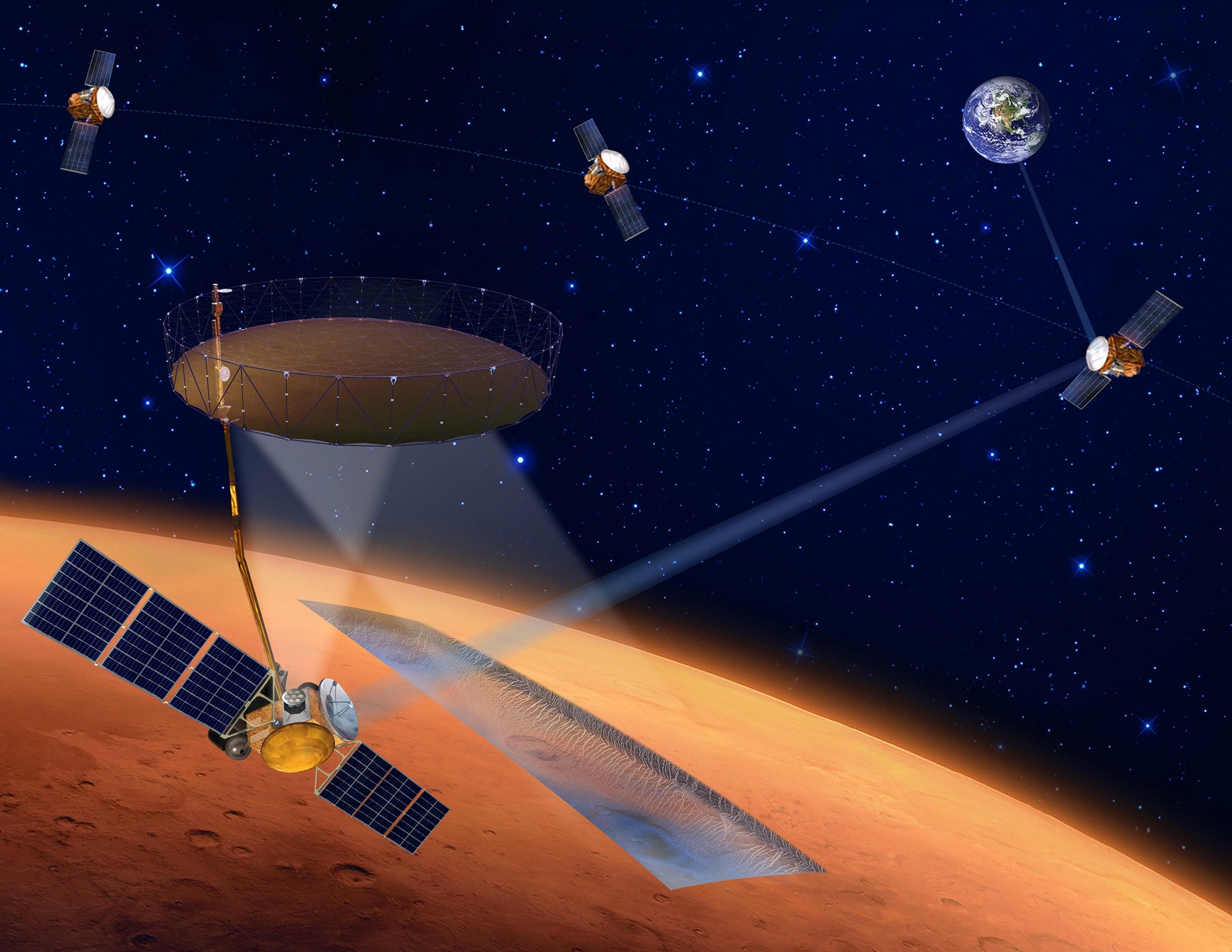
NASA and global partners are working on a Mars Ice Mapper mission to locate shallow water ice for future crewed exploration.
NASA and three international partners have signed a statement of intent to advance a possible robotic Mars ice mapping mission, which could help identify abundant, accessible ice for future candidate landing sites on the Red Planet. The agencies have agreed to establish a joint concept team to assess mission potential, as well as partnership opportunities.
Under the statement, NASA, the Italian Space Agency (ASI), the Canadian Space Agency (CSA), and the Japan Aerospace Exploration Agency (JAXA) announced their intention to develop a mission plan and define their potential roles and responsibilities. If the concept moves forward, the mission could be ready to launch as early as 2026.
The international Mars Ice Mapper mission would detect the location, depth, spatial extent, and abundance of near-surface ice deposits, which would enable the science community to interpret a more detailed volatile history of Mars. The radar-carrying orbiter would also help identify properties of the dust, loose rocky material – known as regolith – and rock layers that might impact the ability to access ice.
Supporting Long-Term Human Presence and Scientific Discovery
The ice-mapping mission could help the agency identify potential science objectives for initial human missions to Mars, which are expected to be designed for about 30 days of exploration on the surface. For example, identifying and characterizing accessible water ice could lead to human-tended science, such as ice coring to support the search for life. Mars Ice Mapper also could provide a map of water-ice resources for later human missions with longer surface expeditions, as well as help meet exploration engineering constraints, such as avoidance of rock and terrain hazards. Mapping shallow water ice could also support supplemental high-value science objectives related to Martian climatology and geology.
“This innovative partnership model for Mars Ice Mapper combines our global experience and allows for cost sharing across the board to make this mission more feasible for all interested parties,” said Jim Watzin, NASA’s senior advisor for agency architectures and mission alignment. “Human and robotic exploration go hand in hand, with the latter helping pave the way for smarter, safer human missions farther into the solar system. Together, we can help prepare humanity for our next giant leap – the first human mission to Mars.”
As the mission concept evolves, there may be opportunities for other space agencies and commercial partners to join the mission.
Beyond promoting scientific observations while the orbiter completes its reconnaissance work, the agency partners will explore mission-enabling rideshare opportunities as part of their next phase of study. All science data from the mission would be made available to the international science community for both planetary science and Mars reconnaissance.
This approach is similar to what NASA is doing at the Moon under the Artemis program – sending astronauts to lunar South Pole, where ice is trapped in the permanently shadowed regions of the pole.
Water Ice: Vital for Sustainability and Astrobiology
Access to water ice would also be central to scientific investigations on the surface of Mars that are led by future human explorers. Such explorers may one day core, sample, and analyze the ice to better understand the record of climatic and geologic change on Mars and its astrobiological potential, which could be revealed through signs of preserved ancient microbial life or even the possibility of living organisms, if Mars ever harbored life.
Ice is also a critical natural resource that could eventually supply hydrogen and oxygen for fuel. These elements could also provide resources for backup life support, civil engineering, mining, manufacturing, and, eventually, agriculture on Mars. Transporting water from Earth to deep space is extremely costly, so a local resource is essential to sustainable surface exploration.
“In addition to supporting plans for future human missions to Mars, learning more about subsurface ice will bring significant opportunities for scientific discovery,” said Eric Ianson, NASA Planetary Science Division Deputy Director and Mars Exploration Program Director. “Mapping near-surface water ice would reveal an as-yet hidden part of the Martian hydrosphere and the layering above it, which can help uncover the history of environmental change on Mars and lead to our ability to answer fundamental questions about whether Mars was ever home to microbial life or still might be today.”
The Red Planet is providing great research return for robotic exploration and the search for ancient life in our solar system. This latest news comes ahead of the agency’s Perseverance rover landing on Mars, which is scheduled to take place on February 18, following a seven-month journey in space. NASA and the European Space Agency (ESA) also recently announced they are moving forward with the Mars Sample Return mission.
Never miss a breakthrough: Join the SciTechDaily newsletter.
Follow us on Google and Google News.