
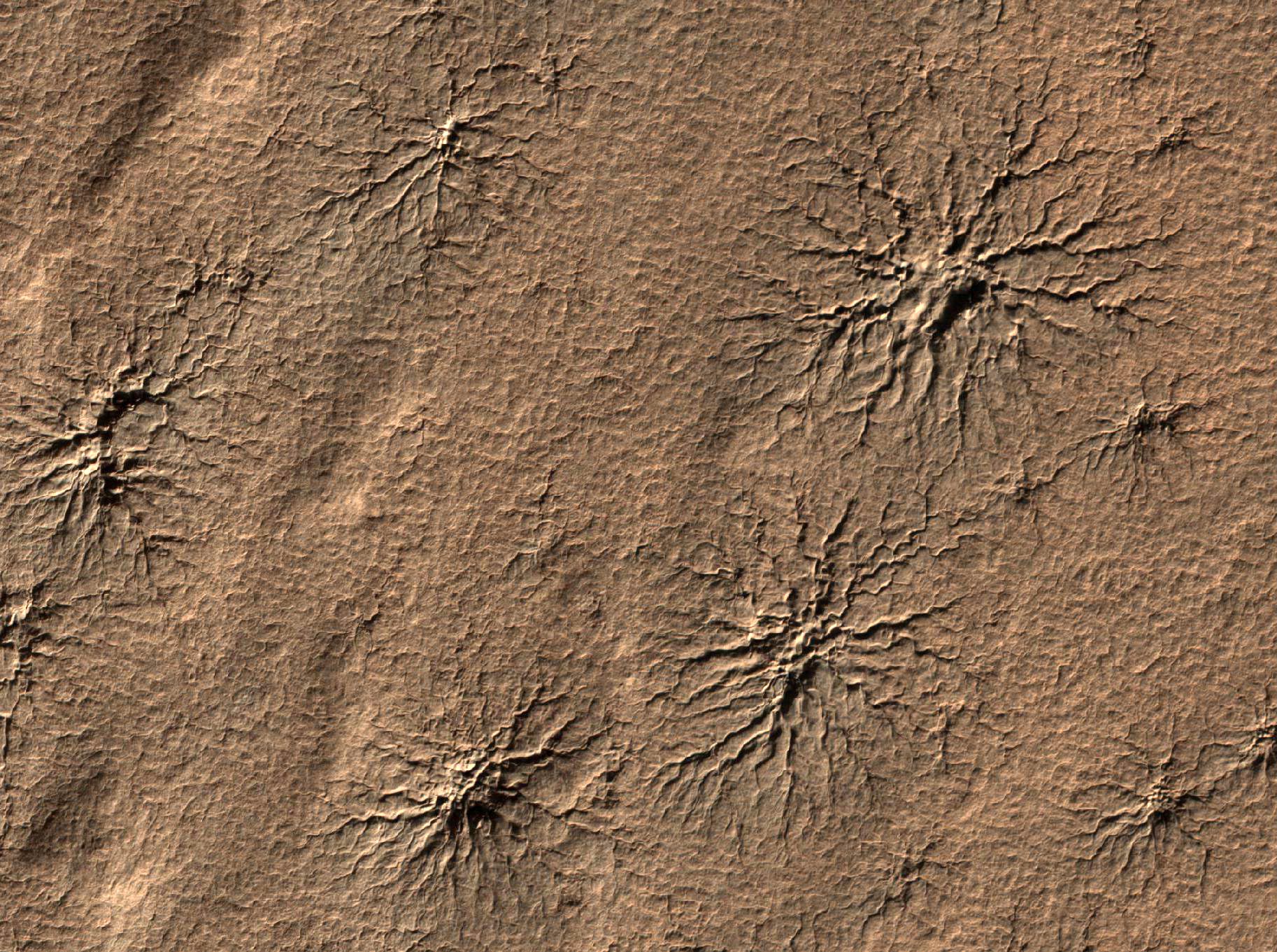
Tests on Earth appear to confirm how the Red Planet’s spider-shaped geologic formations are carved by carbon dioxide.
Scientists have recreated Martian conditions in a lab to study unique, spider-like geologic features found on Mars, originally identified in 2003. These features, formed by sunlight heating soil under ice, have led to breakthrough experiments that emulate Martian atmospheres and explore soil ejection processes.
Mysterious Martian Features: The Discovery of “Spiders”
Since discovering them in 2003 via images from orbiters, scientists have marveled at spider-like shapes sprawled across the southern hemisphere of Mars. No one is entirely sure how these geologic features are created. Each branched formation can stretch more than a half-mile (1 kilometer) from end to end and include hundreds of spindly “legs.” Called araneiform terrain, these features are often found in clusters, giving the surface a wrinkled appearance.
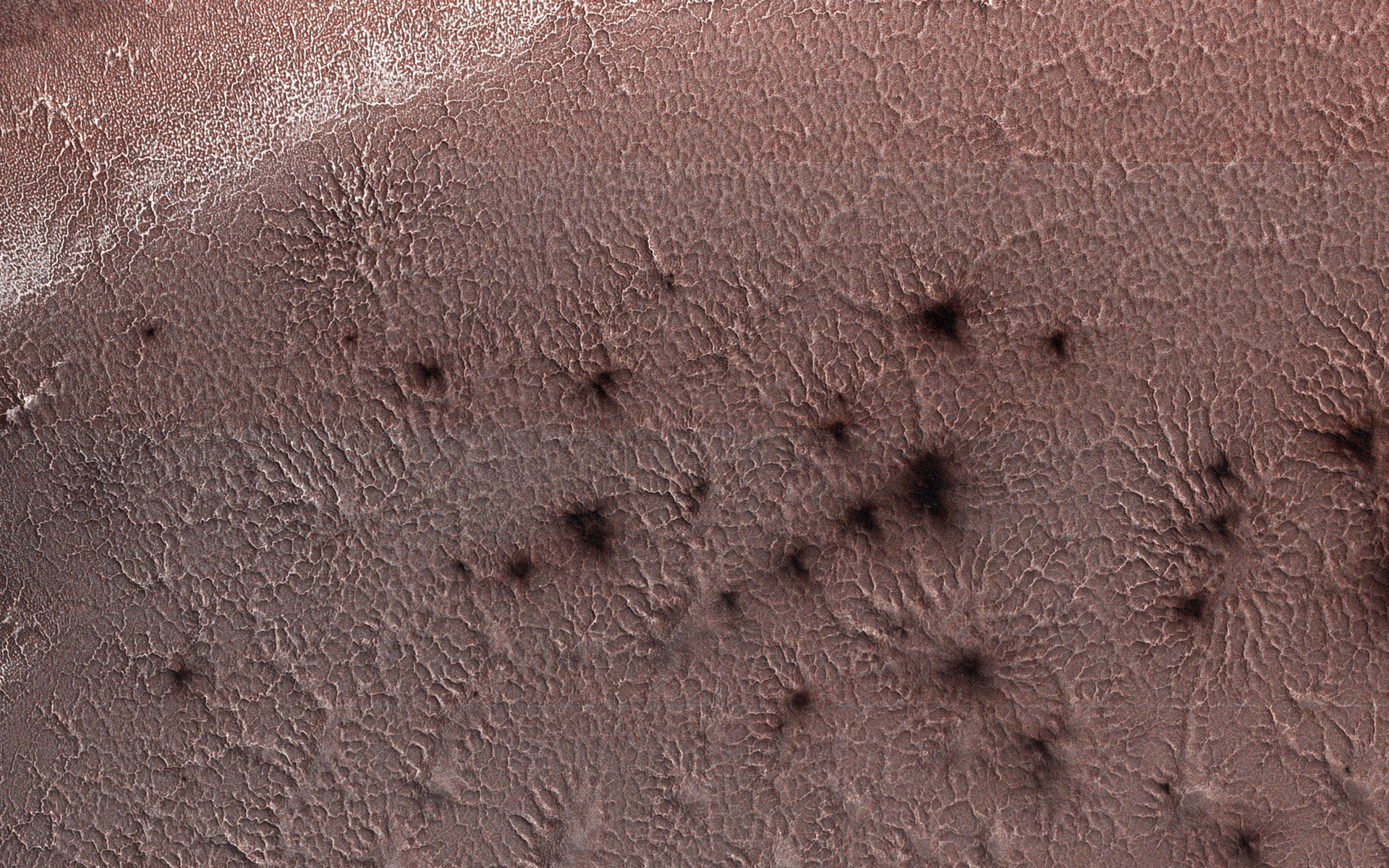
The leading theory is that the spiders are created by processes involving carbon dioxide ice, which doesn’t occur naturally on Earth. Thanks to experiments detailed in a new paper published in The Planetary Science Journal, scientists have, for the first time, re-created those formation processes in simulated Martian temperatures and air pressure.
Laboratory Breakthroughs in Simulating Martian Conditions
“The spiders are strange, beautiful geologic features in their own right,” said Lauren Mc Keown of NASA’s Jet Propulsion Laboratory in Southern California. “These experiments will help tune our models for how they form.”
The study confirms several formation processes described by what’s called the Kieffer model: Sunlight heats the soil when it shines through transparent slabs of carbon dioxide ice that built up on the Martian surface each winter. Being darker than the ice above it, the soil absorbs the heat and causes the ice closest to it to turn directly into carbon dioxide gas — without turning to liquid first — in a process called sublimation (the same process that sends clouds of “smoke” billowing up from dry ice).

As the gas builds in pressure, the Martian ice cracks, allowing the gas to escape. As it seeps upward, the gas takes with it a stream of dark dust and sand from the soil that lands on the surface of the ice.
When winter turns to spring and the remaining ice sublimates, according to the theory, the spiderlike scars from those small eruptions are what’s left behind.
Re-Creating Mars in the Lab
For Mc Keown and her co-authors, the hardest part of conducting these experiments was re-creating conditions found on the Martian polar surface: extremely low air pressure and temperatures as low as minus 301 degrees Fahrenheit (minus 185 degrees Celsius). To do that, Mc Keown used a liquid-nitrogen-cooled test chamber at JPL, the Dirty Under-vacuum Simulation Testbed for Icy Environments, or DUSTIE.
“I love DUSTIE. It’s historic,” Mc Keown said, noting that the wine barrel-size chamber was used to test a prototype of a rasping tool designed for NASA’s Mars Phoenix lander. The tool was used to break water ice, which the spacecraft scooped up and analyzed near the planet’s north pole.

For this experiment, the researchers chilled Martian soil simulant in a container submerged within a liquid nitrogen bath. They placed it in the DUSTIE chamber, where the air pressure was reduced to be similar to that of Mars’ southern hemisphere. Carbon dioxide gas then flowed into the chamber and condensed from gas to ice over the course of three to five hours. It took many tries before Mc Keown found just the right conditions for the ice to become thick and translucent enough for the experiments to work.
Once they got ice with the right properties, they placed a heater inside the chamber below the simulant to warm it up and crack the ice. Mc Keown was ecstatic when she finally saw a plume of carbon dioxide gas erupting from within the powdery simulant.
This video shows Martian soil simulant erupting in a plume during a JPL lab experiment that was designed to replicate the process believed to form Martian features called “spiders.” When a researcher who had tried for years to re-create these conditions spotted this plume, she was ecstatic. Credit: NASA/JPL-Caltech
“It was late on a Friday evening and the lab manager burst in after hearing me shrieking,” said Mc Keown, who had been working to make a plume like this for five years. “She thought there had been an accident.”
The dark plumes opened holes in the simulant as they streamed out, spewing simulant for as long as 10 minutes before all the pressurized gas was expelled.
Discoveries and Surprises in Simulated Martian Terrain
The experiments included a surprise that wasn’t reflected in the Kieffer model: Ice formed between the grains of the simulant, then cracked it open. This alternative process might explain why spiders have a more “cracked” appearance. Whether this happens or not seems dependent on the size of soil grains and how embedded water ice is underground.
“It’s one of those details that show that nature is a little messier than the textbook image,” said Serina Diniega of JPL, a co-author of the paper.
The Future of Martian Spiders: Plume Testing
Now that the conditions have been found for plumes to form, the next step is to try the same experiments with simulated sunlight from above, rather than using a heater below. That could help scientists narrow down the range of conditions under which the plumes and ejection of soil might occur.
There are still many questions about the spiders that can’t be answered in a lab. Why have they formed in some places on Mars but not others? Since they appear to result from seasonal changes that are still occurring, why don’t they seem to be growing in number or size over time? It’s possible that they’re left over from long ago, when the climate was different on Mars— and could therefore provide a unique window into the planet’s past.
For the time being, lab experiments will be as close to the spiders as scientists can get. Both the Curiosity and Perseverance rovers are exploring the Red Planet far from the southern hemisphere, which is where these formations appear (and where no spacecraft has ever landed). The Phoenix mission, which landed in the northern hemisphere, lasted only a few months before succumbing to the intense polar cold and limited sunlight.
Reference: “A Lab-scale Investigation of the Mars Kieffer Model” by Lauren E. Mc Keown, Michael J. Poston, Serina Diniega, Ganna Portyankina, Candice J. Hansen, Klaus-Michael Aye, Elizabeth M. Carey, Jennifer E. C. Scully, Sylvain Piqueux, Lori R. Shiraishi and Sarah N. Cruz, 11 September 2024, The Planetary Science Journal.
DOI: 10.3847/PSJ/ad67c8
Never miss a breakthrough: Join the SciTechDaily newsletter.
Follow us on Google and Google News.