
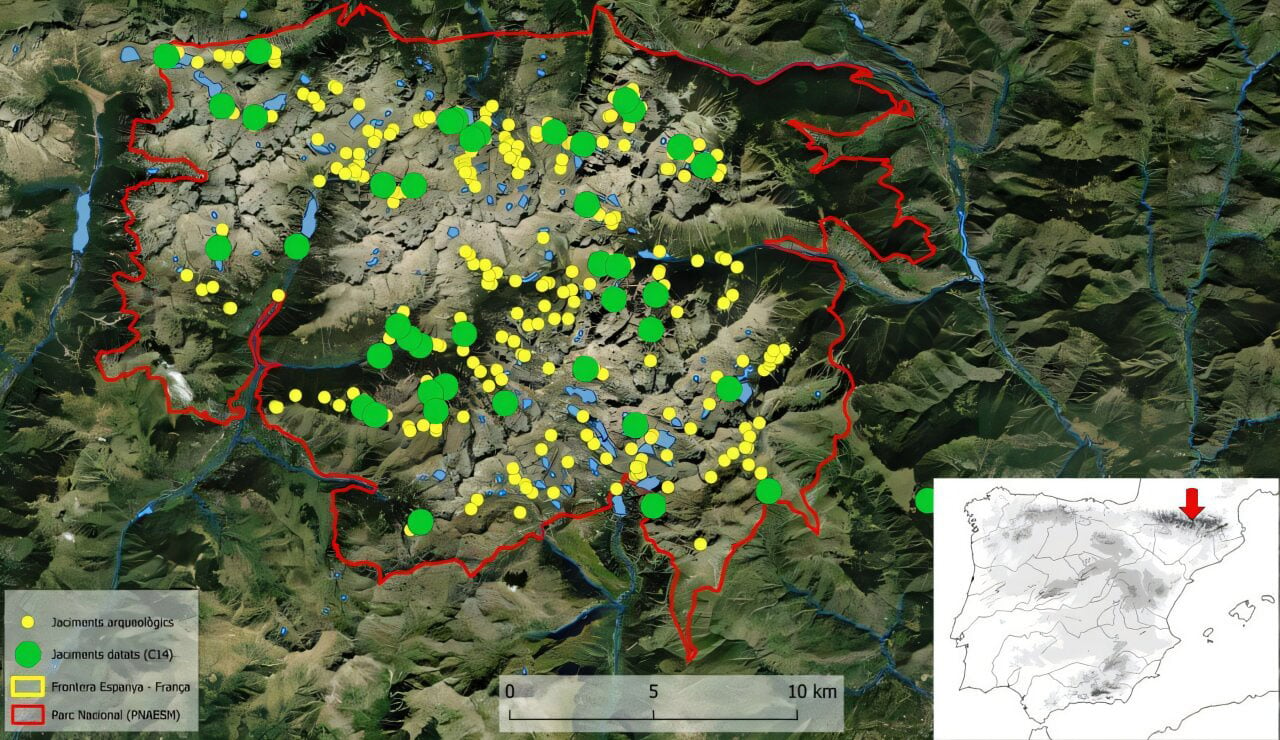
Carbon-14 dates show that people repeatedly occupied high Pyrenean landscapes throughout the Holocene.
The high Pyrenees may look like one of Europe’s last untouched wildernesses, but archaeologists are finding a very different story. For thousands of years, people repeatedly climbed into these rugged landscapes, leaving behind shelters, structures, and traces of activity that stretch across much of the Holocene.
Now, researchers at the Universitat Autònoma de Barcelona (UAB) have assembled those traces into a new chronological framework. Their open-access carbon-14 database documents human activity in Aigüestortes i Estany de Sant Maurici National Park (PNAESM), a high-mountain region of the Spanish Pyrenees where archaeological surveys have identified 380 sites.
The database brings together 124 radiocarbon dates from 45 sites and, according to Ermengol Gassiot, director of UAB’s High Mountain Archaeology Group (GAAM), represents “the first openly published systematic series of absolute dates of a high-mountain area of the Pyrenees.”
Published alongside a study in ArcheoLogica Data, the resource includes laboratory reports, details about the dated materials and archaeological contexts, and the code used in the analyses. By making the full dataset openly available and reproducible, the researchers can reconstruct when people were using the mountains—and reveal just how persistent that presence was over the past 10,000 years.
Dates reveal long occupation
The results confirm that people were present above 2,000 meters for more than 10,000 years. Three excavated sites show continuous dating sequences that span several millennia. The oldest is the Obagues de Ratera rock shelter, at 2,320 meters, where the first occupation occurred 10,000 years ago. It is followed by Cova del Sardo (1,780 m), where human occupation dates back 7,500 years, and the Portarró rock shelter (2,280 m), with occupations dating back 7,300 years.
The study notes that the Obagues de Ratera rock shelter was used during the Mesolithic, the shift from the Mesolithic to the Neolithic, across the Neolithic, the Chalcolithic, the Early and Middle Bronze Age, the beginning of the Iron Age, the High Middle Ages (Visigothic period), and the 19th and 20th centuries.
“This is an exceptional temporal sequence that very few sites in Catalonia have, not only in the high mountains,” says Guillem Salvador, coauthor of the research. Excavations at the rock shelter show that soon after the last glacial period, as the climate gradually warmed and small cirque glaciers still existed in the area, small groups of hunter-gatherers were already visiting alpine zones in the mountain range.
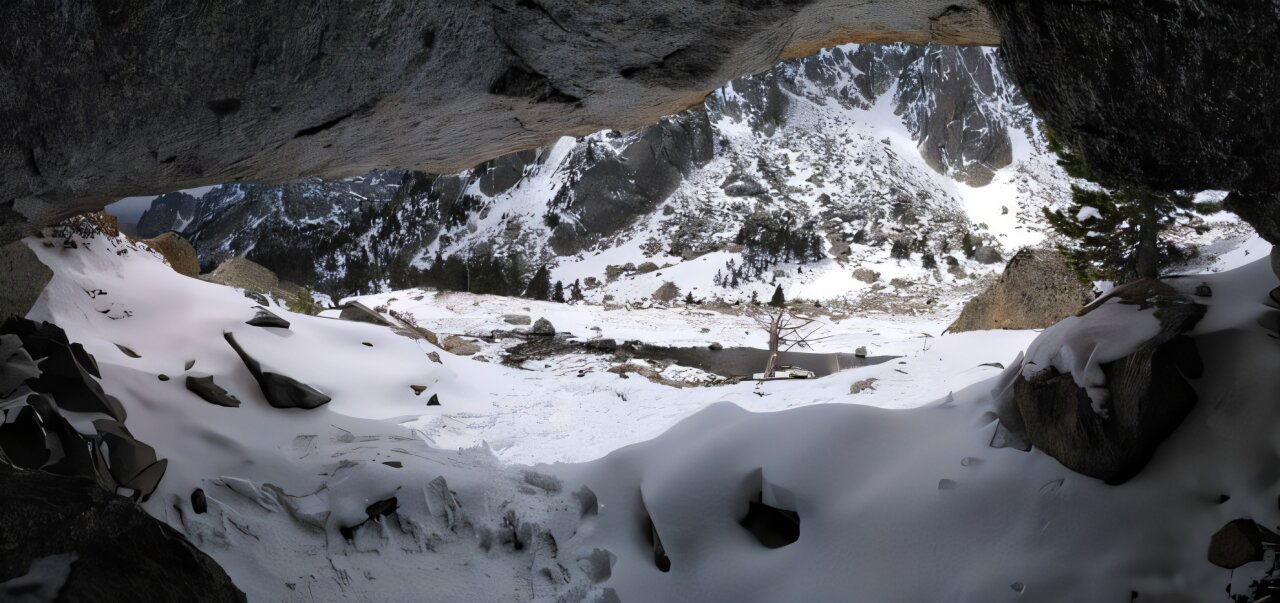
The analyses identify periods when human activity in high mountain areas became especially intense, including the end of the Neolithic (5,300 to 4,500 years ago), late antiquity, and the start of the medieval period. They also date the first architectural remains to prehistory. At the Portarró rock shelter, archaeological excavations documented structures made with a dry stone base and wood that date back 5,000 years. This is currently the oldest-known example of stone architecture in the Pyrenees.
“The data allows us to track this information and shows a highly relevant fact: the sites located in high-mountain areas, places which for us would be inaccessible and inhospitable, often present long periods of human occupation. Many other sites in which we carried out small-scale sampling also show us that they were occupied or inhabited at several different times,” explains Ermengol Gassiot.
A project spanning over 20 years of research
The article brings together two decades of sustained work by Ermengol Gassiot and his collaborators at the PNAESM. Using several statistical procedures, it provides quantitative evidence that supports the inferences made over the years and helps define thresholds for periods when the data are overrepresented or underrepresented. It also sharpens the chronological intervals.
“For example, one of these periods is the era of Ötzi, the Tyrolean Iceman. Here, the data points to the fact that when Ötzi crossed the Tisenjoch glacier (and was killed) some 5,300 years ago, other high-mountain areas such as the PNAESM experienced a marked increase in human presence above 2,000 meters,” Gassiot points out.
The 380 archaeological sites recorded so far at the PNAESM include enclosures of different sizes and purposes, possible dwellings, rock shelters that use glacial accumulations of large stone blocks, many with structures such as walls separating interior areas and protecting entrances, and a small group of stone circles on the ground that could be funerary monuments.
The newly open access database helps challenge the idea that high mountain regions were untouched spaces. It shows that human presence in these landscapes was continuous and recurrent throughout the Holocene, including during periods of climatic variability. It also makes it possible to compare traces of human activity with paleoecological changes now being documented in these environments.
Reference: “Absolute Chronology of Human Occupations in the High Mountain Environments of the Southern Central Pyrenees: Radiocarbon Dates from the Aigüestortes Area” by Ermengol Gassiot-Ballbè, Guillem Salvador-Baiges and Laura Obea-Gómez, 2026, Archeologica Data.
DOI: 10.13131/UNIPI/3FEM-PB67
Never miss a breakthrough: Join the SciTechDaily newsletter.
Follow us on Google and Google News.
3 Comments
Human history is only 6000 years old. Per God. End of discussion.
Please quote the source of your evidence – preferably NOT the 14th century Archbishop Ussher of Armagh, who was the gentleman who originally came up with this figure – by adding up all the ages of the Patriarchs from the Old Testament (which, coincidentally, is actually the earliest part of the Jewish Torah.) Have a nice day.