
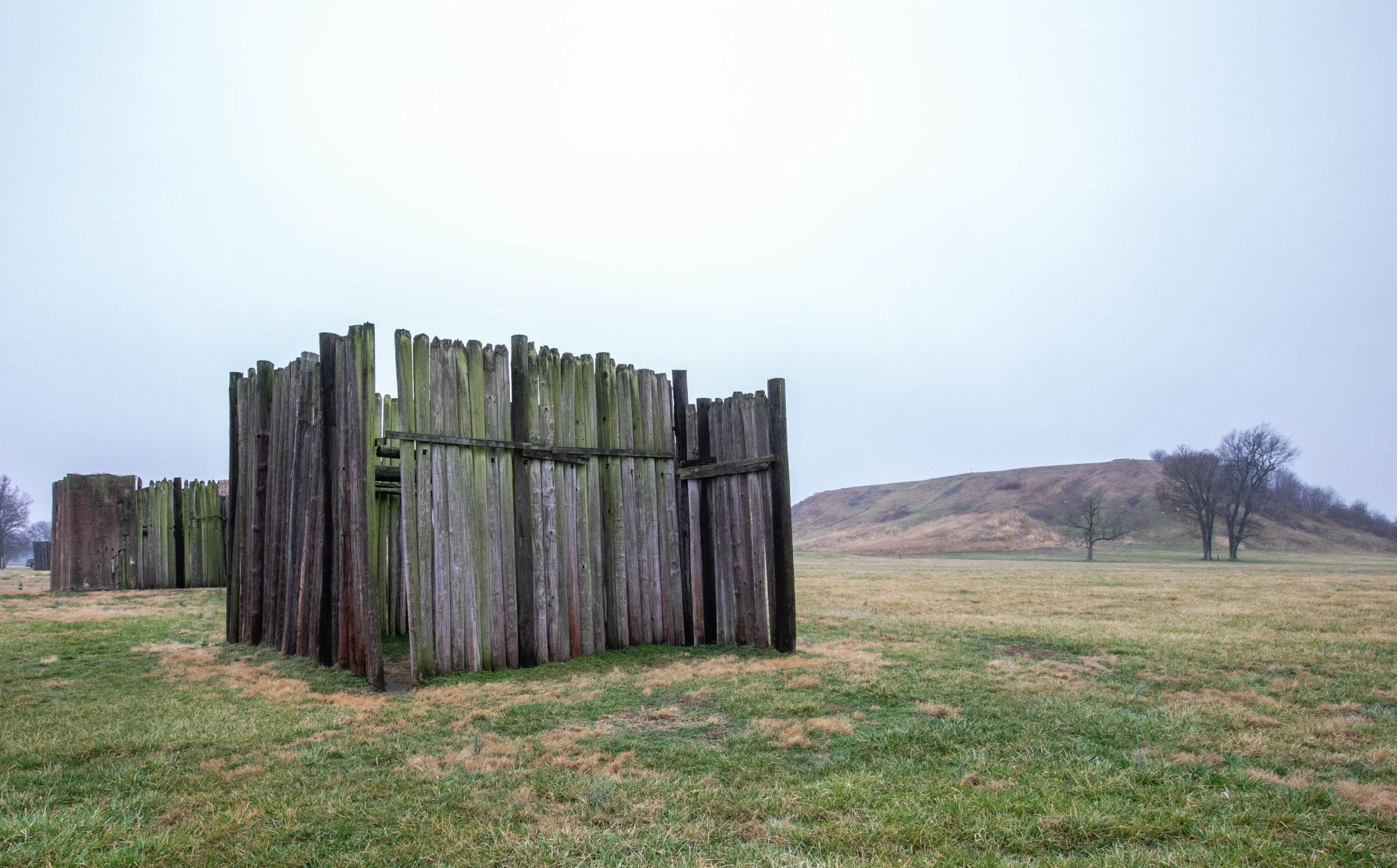
The Cahokia Mounds, once a thriving settlement near present-day St. Louis, was abandoned by 1400, leaving behind a mystery. Recent research challenges the long-held belief of drought-induced crop failure as the cause. Instead, evidence suggests the Cahokians may have had the skills to mitigate such environmental challenges, and their departure was likely influenced by social factors and external pressures.
Nine hundred years ago, the Cahokia Mounds settlement, located just across the Mississippi River from what is now St. Louis, was a thriving metropolitan area with a population of around 50,000. It was one of the largest communities in the world at the time. However, by 1400, this once-bustling site had become nearly deserted, and the reasons for the mass departure remain a mystery.
One popular theory is that the Cahokia residents abandoned the settlement after a massive crop failure brought on by a prolonged drought. But a new study in the journal The Holocene by Natalie Mueller, assistant professor of archaeology in Arts & Sciences at Washington University in St. Louis, and Caitlin Rankin, PhD ’20, suggests the Cahokians likely had other reasons to leave town.
Rankin dug deep into the soil at the historic Cahokia site to collect isotopes of carbon, atoms left behind by the plants growing when the human population collapsed and drought was common across the Midwest.
Insights From Plant Isotopes
All plants use one of two types of carbon, Carbon 12 and Carbon 13, for photosynthesis, but not all plants do photosynthesis the same way. Plants adapted to dry climates — including prairie grasses and maize, an important new crop during the Cahokia period — incorporate carbon into their bodies at rates that leave behind a tell-tale signature when the plants die and decay.
Most of the other plants that the Cahokians would have harvested for food — including squash, goosefoot, and sumpweed — will leave a different signature, one they share with plants from wetlands and native forests.
Rankin’s samples showed that ratios of Carbon 12 and Carbon 13 stayed relatively consistent during that crucial period — a sign there was no radical shift in the types of plants growing in the area. “We saw no evidence that prairie grasses were taking over, which we would expect in a scenario where widespread crop failure was occurring,” Mueller said.
The Cahokians are known for their ingenuity, and Rankin said they may have had the engineering and irrigation skills to keep crops flourishing under difficult conditions. “It’s possible that they weren’t really feeling the impacts of the drought,” said Rankin, now an archaeologist with the Bureau of Land Management in Nevada.
Mueller added that the sophisticated society that blossomed at Cahokia almost certainly included a storage system for grains and other foods. Residents also enjoyed a varied and diverse diet — including fish, birds, deer, bear, and forest fruits and nuts — that would have kept them nourished even if a few food sources disappeared.
Future Research and the Real Reasons for Abandonment
To get a better grasp of the diets and agricultural practices of Indigenous people of the Midwest, Mueller hopes to build a database that collects paleo-botanical evidence from across the region. “Gathering that information would help us see if people switched to different crops in response to climate change,” she said. She’s also planning to grow certain food crops in controlled conditions on campus to understand how they might have responded to ancient droughts and other challenges.
So, why did the Cahokians leave their land of plenty? Mueller suspects it was a gradual process. “I don’t envision a scene where thousands of people were suddenly streaming out of town,” she said. “People probably just spread out to be near kin or to find different opportunities.”
“They put a lot of effort into building these mounds, but there were probably external pressures that caused them to leave,” Rankin said. “The picture is likely complicated.”
Reference: “Correlating Late-Holocene climate change and population dynamics at Cahokia Mounds (American Bottom, USA)” by Caitlin G Rankin and Natalie G Mueller, 18 June 2024, The Holocene.
DOI: 10.1177/09596836241254488
Never miss a breakthrough: Join the SciTechDaily newsletter.
Follow us on Google and Google News.
29 Comments
Has disease brought by the Spanish explorers up the Mississippi been eliminated? I thought this was recorded history as to why the Native American Indian populations were often decimated by the diseases brought to them.
That would have been a neat trick, 300 years before Columbus.
900 years ago was in the 12th century. The Norse may had been to north America by then, but not the Spaniards. Columbus went to the Caribbean in 1492 maybe 350 years later.
I agree with Charles Fransico’s earlier comment about the New Madrid Seismic Zone. Around 900 AD there are signs of multiple earthquakes, changes to the Mississippi River, and sand blows. The Native Americans could have also had repeated flooding from changes in the river.
If they left their land of plenty under external pressures, some proofs of fights should be found.
I went to Cohokia back in 2003, where I fell in love with the site and the mystery of it. The desertion of Cohokia might have been brought on by a cataclysmic earthquake on the New Madrid fault just south of there.
People don’t just up leave a thriving society for no good reason. Had to be something big. Tornadoes, wildfires, drought, floods. Disease. I feel that this is lazy research. Put better effort into this.
Disease that destroyed a population that large, or even made such an impact to have them leave,would have easy signs. Like mass graves, large quickly made graves. I believe the most likely reason is the fault line, no matter how advanced the population was, this time frame and amout of knowledge they could’ve had would still not know about earthquakes. Superstitious was still most likely involved and the ground shaking would scare any population around that time frame to flee.
Maybe they all had the same mother-in-law.
Lack of firewood for heat and cooking food.
This is how science works: one set of people put forward a theory (people left this site for some reason and then a bit of investigation in one field – then give out an idea (“it might have been due to drought”).
Another small team come along and look around evidence left, from a plant biology basis, and conclude that drought was not the reason they left.
It is NOT up to the plant biology team to make supposition as to why they DID leave unless it was so.ething in their own field.
Like some people in the comments have said, it could have been because of earthquake activity…. it would now be up to researchers in that field to look to see if they can find any reasons to suggest that that may have been a cause.
And so, little by little we establish what MAY have happened.
I thought it was “Cahokia”…???? (From research several decades ago…)
There are mounds all over N America.Also many have been flattened by farmers. It’s entirely likely that when the Mayans ‘disappeared’ from Mexico & Guatemala they actually traveled North & ended up in the US in a more egrarian form. i.e. no building pyramids etc
No, not at all. The religious artifacts show continuity with previous North American cultures, not Mayan. And mound building wasn’t something new in the region — Poverty Point and the Hopewell demonstrate that. The style was new, but not the idea or technique.
There’s even a site near Evansville, IN that has a Mississippian mound complex near a Hopewell mound, and one of the Mississippian platforms has a rounded conical mound — Hopewell style — on top.
The Kensington Stone indicates that Europeans reached far into America by the 1400s is it possible they brought disease to the indigenous people
The Kensington stone is a modern fake.
Seriously people are attempting to blame the disappearance of the Cahokia tribe on Europeans, the year the people in their settlement disappeared was 1124 a whole 389 years before Juan Ponce De Leon and his crew set foot on the soil of Florida or anywhere within the Gulf Coast region.
https://www.science20.com/news_articles/the_most_violent_era_in_america_was_before_europeans_arrived-141847
https://www.canada.ca/en/department-national-defence/services/military-history/history-heritage/popular-books/aboriginal-people-canadian-military/warfare-pre-columbian-north-america.html
https://www.bing.com/images/search?view=detailV2&ccid=zYepkuwr&id=3CA34683917A847F2BBD9F46EDF5B9C2322D6020&thid=OIP.zYepkuwrG3JOWIOrH-3MaAHaJS&mediaurl=https%3A%2F%2Fi.pinimg.com%2Foriginals%2Fb6%2Fd4%2Fca%2Fb6d4ca89fa1de235dde4abd25249c5ce.jpg&cdnurl=https%3A%2F%2Fth.bing.com%2Fth%2Fid%2FR.cd87a992ec2b1b724e5883ab1fedcc68%3Frik%3DIGAtMsK59e1Gnw%26pid%3DImgRaw%26r%3D0&exph=923&expw=736&q=Detailed+map+of+Iroquois+territory+&simid=608012721050955384&form=IRPRST&ck=9585B9707694EC55D3C9D67C0D4756A7&selectedindex=0&itb=0&pc=SANSAAND&ajaxhist=0&ajaxserp=0&vt=4&sim=11
https://www.bing.com/images/search?view=detailV2&ccid=zYepkuwr&id=3CA34683917A847F2BBD9F46EDF5B9C2322D6020&thid=OIP.zYepkuwrG3JOWIOrH-3MaAHaJS&mediaurl=https%3A%2F%2Fi.pinimg.com%2Foriginals%2Fb6%2Fd4%2Fca%2Fb6d4ca89fa1de235dde4abd25249c5ce.jpg&cdnurl=https%3A%2F%2Fth.bing.com%2Fth%2Fid%2FR.cd87a992ec2b1b724e5883ab1fedcc68%3Frik%3DIGAtMsK59e1Gnw%26pid%3DImgRaw%26r%3D0&exph=923&expw=736&q=Detailed+map+of+Iroquois+territory+&simid=608012721050955384&form=IRPRST&ck=9585B9707694EC55D3C9D67C0D4756A7&selectedindex=0&itb=0&pc=SANSAAND&ajaxhist=0&ajaxserp=0&vt=1&sim=11
Never mind that 2nd map attachment, did not realize you only need to click on it to open the article.
The facts don’t lie tribes of whaf is now North America had been fighting over resources since at least 1000 CE if not earlier those completely passive in tune with nature claims nothing but Candy Coating by Loonietics.
Let me set the record straight:
https://www.rt.com/news/stone-age-america-archaeologists-445/
Crow Creek Massacre site — pre-Columbian mass grave showing many of the dead had been scalped, and with a gap in the demographics of the victim indicating that pubescent girls had been taken. The Americas were as violent as any other place humanity settled.
Those who are still declared the 1st immigrants to arrive on this continent were not therefore terms such as native or indigenous do not apply.
Some of y’all are acting like undisciplined children.
I’m not sure what made any of you think this was supposed to be a full explanation of what happened, or that a link to “BING images” constitutes as proof of anything, but the effort and results here were about the isotope testing.
What was the source of their drinking water ?
Did they did wells or rely on surface water from streams , lakes or rivers ?
Surfacewaters may disappear but not groundwater .
They were within walking distance of the Mississippi. The odds of that drying up are so close to zero as to be indistinguishable.
Hurricanes, tornadoes, floods, quakes, dry seasons, extreme hot cold temperatures, cause humans and animals to move. When the food chain gets interrupted, the searches begins, I always felt that early humans had to move. Their waste management system, was limited to how much poop could be contained, before a move was necessary. Sanitation wasn’t a priority back then.
I was told many years ago that the abandonment was due to a religious movement that espoused a return to a simpler more communal form of life. To my understanding, this story was passed down over the centuries.