
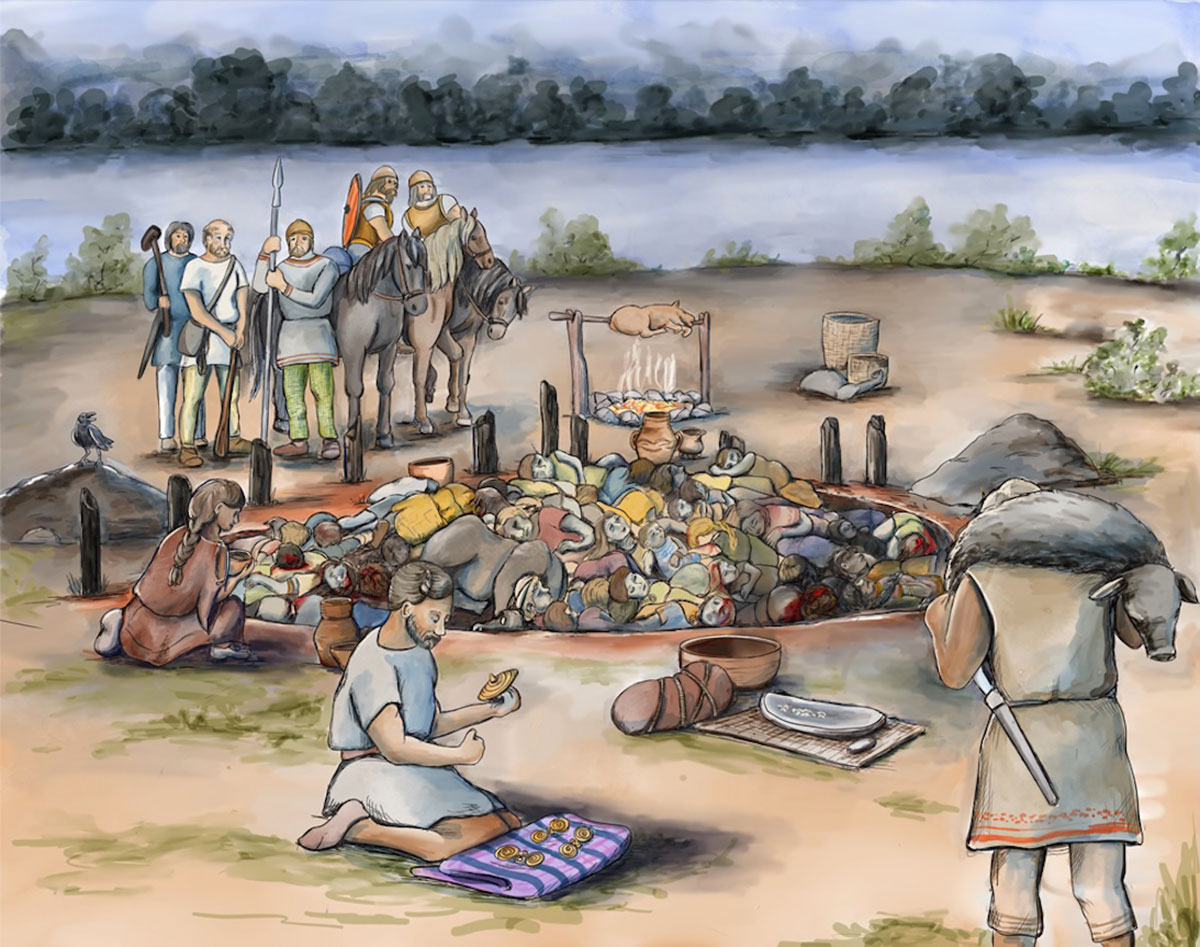
A 2,800-year-old mass grave in Serbia reveals a chilling pattern: women and children deliberately targeted, most unrelated to one another, and buried in a ritualized ceremony.
New research suggests that women and children were intentionally singled out in one of the largest known prehistoric mass killings in Europe.
Excavations at the Gomolava burial site in northern Serbia uncovered a mass grave holding the remains of more than 77 people. Most of the victims were women and children. They were buried together about 2,800 years ago after dying from violent injuries, including blows to the head and stab wounds. According to researchers, the evidence points to a coordinated episode of large-scale violence rather than a random attack.
“When we encounter mass graves from prehistory with this kind of demographic, we might expect they were families from a village that was attacked,” said co-lead and ERC grantee Associate Professor Barry Molloy, UCD School of Archaeology.
“Gomolava genuinely took us by surprise when our genetic analysis showed the majority of people studied were not only unrelated, not even their great–great-grandparents were. This was highly unusual for a prehistoric mass grave and not what we expect to find if they had all lived together in a village.”
A combination of genetic, skeletal, and other scientific analyses revealed a striking pattern. As with the adults, most of the children in the grave were female. Of the 77 victims, 40 were children between one and twelve years old, 11 were adolescents, and 24 were adults. Of the adults, 87 percent were female. The only infant identified in the burial was male.
Researchers say this pattern is significant. In many historical contexts, young people might be taken captive and enslaved rather than killed. The fact that younger individuals were also killed suggests the violence went beyond a quick raid. Instead, the targeting of women and children may have been intended to send a brutal warning to a broader community.
The findings, published in Nature Human Behaviour, offer new insight into conflict during the Iron Age and shed light on how acts of extreme violence were used to project power in prehistoric Europe.
Ritual Burial and Symbolic Violence
The burial itself sets Gomolava apart from other mass graves of the same era. Rather than being stripped of valuables and discarded, the victims were laid to rest with personal belongings such as bronze jewelry and ceramic drinking vessels.
“It is typical in prehistoric mass graves for victims to be hastily buried together in a pit, maybe by survivors or even their killers. The victims at Gomolava were hastily buried in a disused semi-subterranean house, but uniquely, not only had the bodies not been looted of their valuables, offerings were made in what must have been a respectful ritual,” said Associate Professor Molloy.
Animal remains, including a butchered calf, were placed in the grave. Broken grain grinding stones and burned seeds were carefully arranged above the burial site.
This level of effort indicates that the perpetrators or those who controlled the site carried out a deliberate and symbolic ceremony after the killings. The burial appears to have been planned, not a rushed attempt to hide the bodies.
“The brutal killings and subsequent commemoration of the event can both be read as a powerful bid to balance power relations and assert dominance over land and resources,” said co-lead Dr Linda Fibiger, University of Edinburgh’s School of History, Classics and Archaeology.
Conflict in a Changing Landscape
DNA testing confirmed that the individuals in the grave were not close relatives. Isotope analysis of their teeth and bones revealed varied childhood diets, suggesting they grew up in different locations. This evidence raises the possibility that the women and children came from multiple settlements and were captured or forcibly displaced before their deaths.
The massacre likely occurred during a period of upheaval in the Carpathian Basin. At that time, communities were building enclosed settlements and reoccupying Bronze Age settlement mounds and sections of large fortified sites.
Researchers propose that the construction of these fortifications and the territorial claims tied to them may have intensified disputes over land and resources. Conflicts could have involved neighboring groups challenging boundaries or mobile pastoralists seeking seasonal access to the same areas.
“Our team has been tracing the Bronze Age collapse and its aftermath in Europe. What we found at Gomolava tells us that as things recovered in this area moving into the Iron Age, reasserting control over landscapes could include widespread and extremely violent episodes between competing groups,” added Associate Professor Molloy.
Reference: “A large mass grave from the Early Iron Age indicates selective violence towards women and children in the Carpathian Basin” by Linda Fibiger, Miren Iraeta-Orbegozo, Jovan Koledin, Jason E. Laffoon, Cheryl A. Makarewicz, Dorothea Mylopotamitaki, Caroline Bruyere, Thomas Booth, Christopher Bronk Ramsey, Robert Layfield, Lucas Anchieri, Yuejiao Huang, Anna Kjær Knudsen, Jonas Niemann, Darko Radmanović, Neil J. Oldham, Barry Shaw, Saoirse Tracy, Sara Nylund, J. Stephen Daly, Christine Winter-Schuh, David van Acken, Harald Ringbauer, Alissa Mittnik, Jazmin Ramos-Madrigal, Hannes Schroeder and Barry Molloy, 23 February 2026, Nature Human Behaviour.
DOI: 10.1038/s41562-025-02399-9
The research was supported by the European Research Council (ERC) grant “The Fall of 1200 BC” based at UCD School of Archaeology.
Never miss a breakthrough: Join the SciTechDaily newsletter.
Follow us on Google and Google News.
10 Comments
thanks
Maybe there had been lack of food that year, so they had to kill the non-essential excess people?
Looks like angel wings
Seems like they are making a huge assumption that it was the same people who did both the killing and the burial. It seems more logical to me that the victims were buried thoughtfully by people who found them already dead, killed by someone else.
Interesting, indeed, that people were buried respectfully. Is it possible that the burial was done by people who returned from traveling to find their friends dead? It seems from DNA analysis of Viking graves that there were certainly communities that were not defined by biological relationships. Perhaps this was another of those communities?
Attitudes toward populations showing signs of disease might have played into the killing of those showing evidence of something which could spread. There might have been attempts to control fecundity, since females seem to have been selected. We have no accurate method of accessing the social mind-set of primitive populations, so mystery remains.
A machine head
That these people were unrelated suggests that they may have been captured at an earlier date? If DNA links could be discovered among the youngest people, this would suggest impregnation by captors. I’m going to suggest a slave revolt that was put down? Or perhaps these were hostages? Or slaves who were at risk of being recaptured by their own tribes who were killed?
Why not some sort of ritualistic sacrifice, do we know anything about the religious practices of these people.
Perhaps the victims were brought there by their own people for the ceremony.