
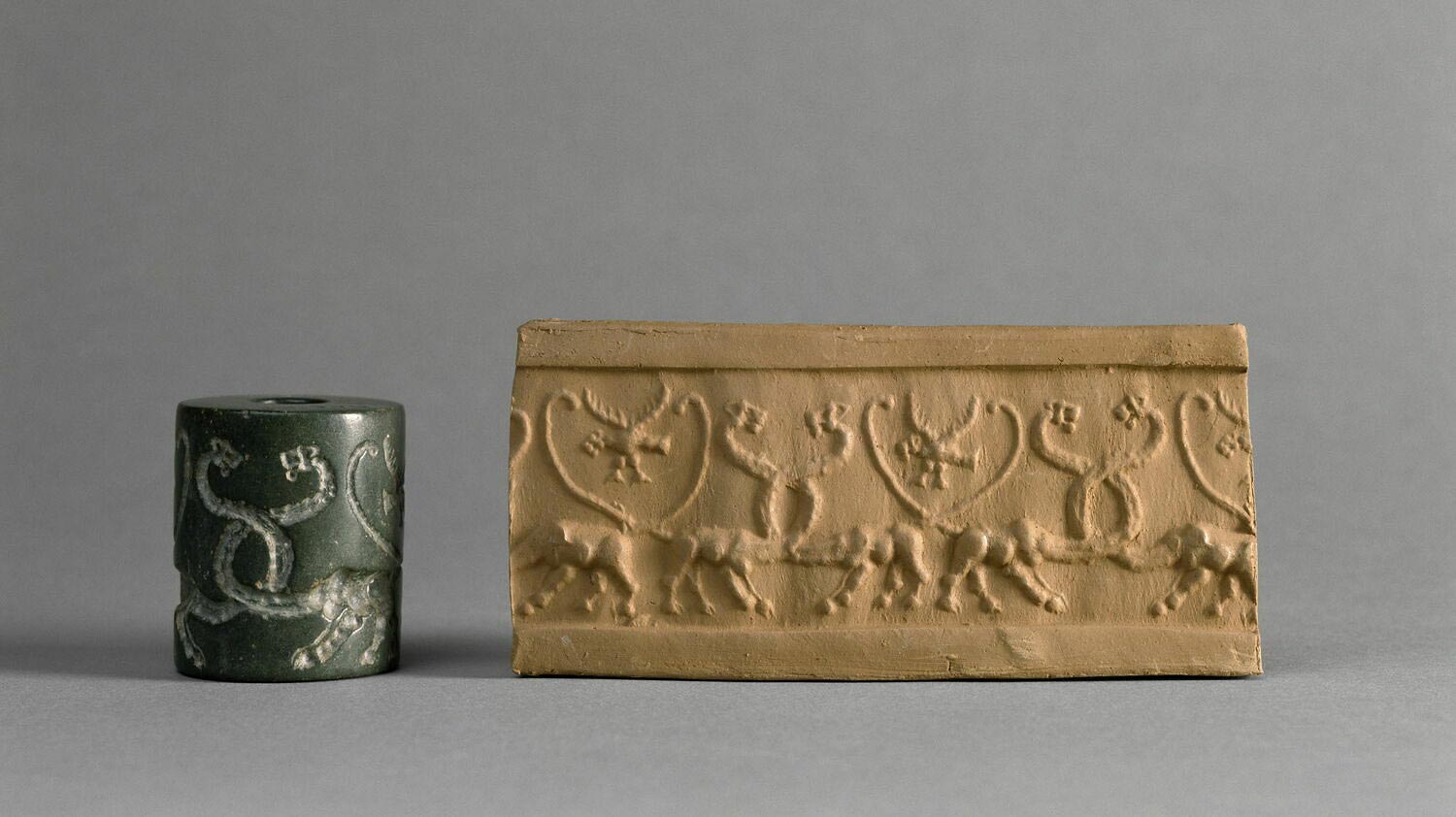
Ancient cylinder seals in Mesopotamia shaped the development of proto-cuneiform writing in Uruk around 3000 BCE, linking prehistoric imagery to the inception of written communication.
Researchers from the University of Bologna have traced the origins of writing in Mesopotamia to designs imprinted by ancient cylinder seals on clay tablets and other artifacts. Their study, published in Antiquity, identifies direct correlations between the designs engraved on these cylinders, dating back around six thousand years, and some of the signs in the proto-cuneiform script that emerged in the city of Uruk, located in what is now southern Iraq, around 3000 BCE.
This research offers new perspectives on the origins of writing and may help researchers not only gain new insights into the meanings of the designs on cylinder seals but also to decipher many still-unknown signs in proto-cuneiform.
“The conceptual leap from pre-writing symbolism to writing is a significant development in human cognitive technologies,” explains Silvia Ferrara, professor in the Department of Classical Philology and Italian Studies at the University of Bologna and lead researcher. “The invention of writing marks the transition between prehistory and history, and the findings of this study bridge this divide by illustrating how some late prehistoric images were incorporated into one of the earliest invented writing systems.”

Cylinder Seals and Proto-Cuneiform
Among the first cities to emerge in Mesopotamia, Uruk was an immensely important center throughout the fourth millennium BCE, exerting influence over a large region extending from southwestern Iran to southeastern Turkey.
In this region, cylinder seals were created. Typically made of stone and engraved with a series of designs, these cylinders were rolled onto clay tablets, leaving a stamped impression of the design.
Starting in the mid-fourth millennium BCE, cylinder seals were used as part of an accounting system to track the production, storage, and transport of various consumer goods, particularly agricultural and textile products.
It is in this context that proto-cuneiform appeared: an archaic form of writing made up of hundreds of pictographic signs, more than half of which remain undeciphered to this day. Like cylinder seals, proto-cuneiform was used for accounting, though its use is primarily documented in southern Iraq.

Unveiling Ancient Symbolism
“The close relationship between ancient sealing and the invention of writing in southwest Asia has long been recognized, but the relationship between specific seal images and sign shapes has hardly been explored,” says Ferrara. “This was our starting question: did seal imagery contribute significantly to the invention of signs in the first writing in the region?”
To find an answer, the researchers systematically compared the designs on the cylinders with proto-cuneiform signs, looking for correlations that might reveal direct relationships in both graphic form and meaning.
“We focused on seal imagery that originated before the invention of writing, while continuing to develop into the proto-literate period,” add Kathryn Kelley and Mattia Cartolano, both researchers at the University of Bologna and co-authors of the study. “This approach allowed us to identify a series of designs related to the transport of textiles and pottery, which later evolved into corresponding proto-cuneiform signs.”
This discovery reveals, for the first time, a direct link between the cylinder seal system and the invention of writing, offering new perspectives for studying the evolution of symbolic and writing systems.
“Our findings demonstrate that the designs engraved on cylinder seals are directly connected to the development of proto-cuneiform in southern Iraq,” confirms Ferrara. “They also show how the meaning originally associated with these designs was integrated into a writing system.”
Reference: “Seals and signs: tracing the origins of writing in ancient South-west Asia” by Kathryn Kelley, Mattia Cartolano and Silvia Ferrara, 5 November 2024, Antiquity.
DOI: 10.15184/aqy.2024.165
Never miss a breakthrough: Join the SciTechDaily newsletter.
Follow us on Google and Google News.
3 Comments
Strange how the cylinder-seal motif of intertwined long-necked animals resembles a similar design on the Palermo Stone, which ostensibly commemorates the union of Upper & Lower Egypt.
Mesopotamia civilizations/territory were also in North America and there was cuneiform found there all over Mississippi and mexico which makes sence considering the Hellenistic Jews migratory pattern thru Asia then to north america.codex Paris there’s ancient Chinese writing that pre exists ones found in China itself. You just have to know what ISBN to look for.its like me era asking why go events always reinforce a religion then sell you the book to that religion which they had an option to add to to make it seem like it’s that time lol.
Hi thanks and mesopotamia are kurdish people is kurdistan land yes is not Iran and Turkey and Iraq and Syria is this name is coming to our country land kurdistan yes kurdistan mesopotamia sumerian all is kurdistan land 12000 years old history of kurdish people and thanks best regards