
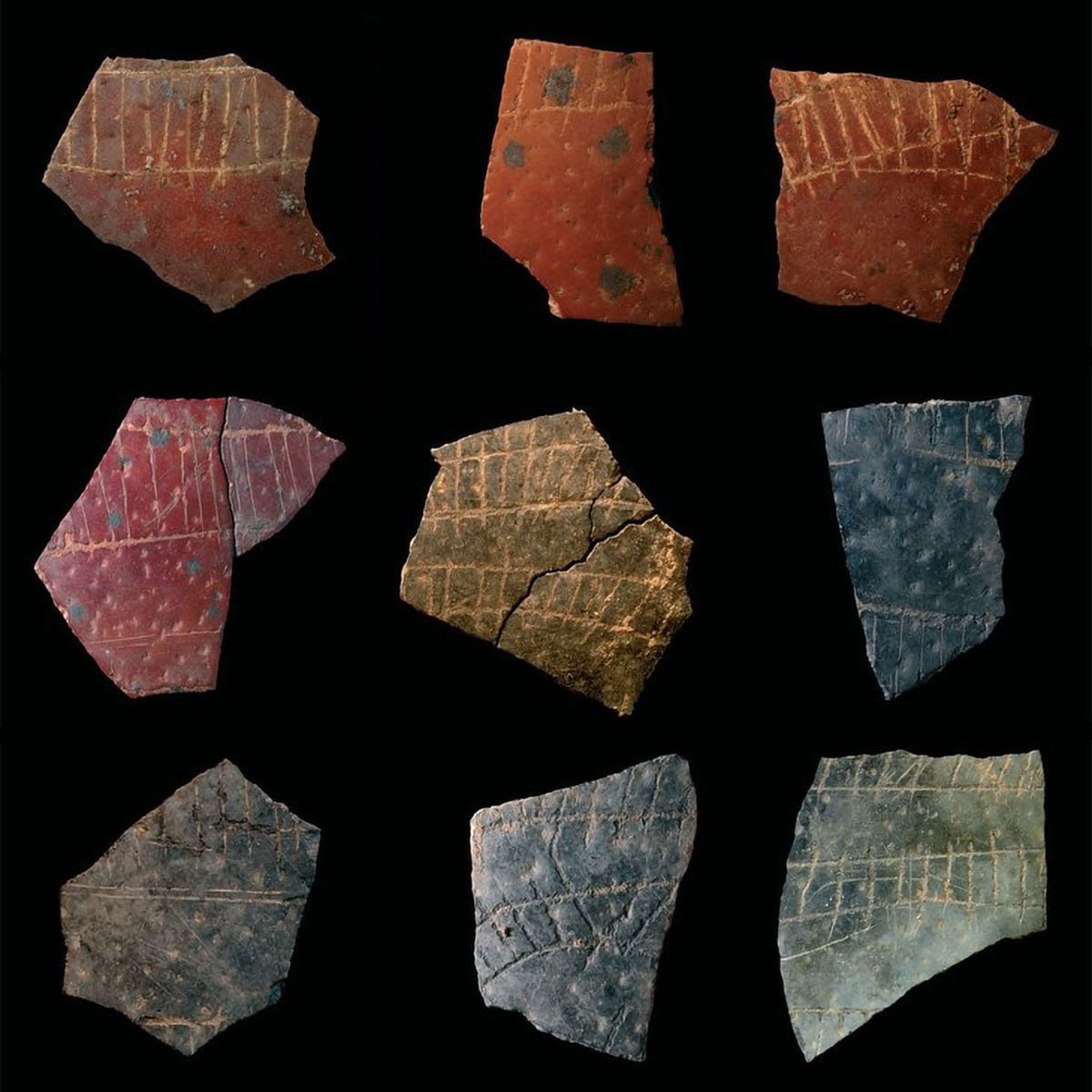
Ancient ostrich eggshell engravings from southern Africa reveal something unexpected: a hidden geometry.
At multiple archaeological sites across southern Africa, researchers have uncovered hundreds of unusual fragments of ostrich eggshell. These pieces date back more than 60,000 years and were engraved by groups of Homo sapiens living in the region at the time.
A new study led by scientists at the University of Bologna has found that these engravings were not random scratches or casual decorations. Instead, they followed consistent and carefully structured geometric principles. The research, published in the journal PLOS One, identifies clear evidence of organized visual design based on parallel lines, right angles, and repeated patterns.
“These signs reveal a surprisingly structured, geometric way of thinking,” says Silvia Ferrara, Professor at the University of Bologna’s Department of Classical Philology and Italian Studies, who coordinated the study. “We are talking about people who did not simply draw lines, but organised them according to recurring principles — parallelisms, grids, rotations and systematic repetitions: a visual grammar in embryo.”
Complex Patterns and Cognitive Planning
The engraved eggshells were most likely used as water containers. The research team conducted a detailed quantitative analysis of 112 fragments recovered from two South African sites (Diepkloof and Klipdrift) and one site in Namibia (Apollo 11). Using geometric and statistical techniques that had not previously been applied to these artifacts, the team reconstructed the precise angles, line directions, and spatial layouts of the engravings.
Their findings show that more than 80 percent of the designs contain consistent spatial organization. Many feature angles close to 90° and repeated sets of parallel lines. More intricate patterns, including hatched bands, grids, and diamond-shaped motifs, reflect advanced mental operations such as rotation, translation, repetition, and “embedding”, meaning the ability to arrange signs in layered or hierarchical arrangements on the same surface.
“These engravings are organized and consistent, and show mastery of geometric relationships,” Ferrara explains. “There is not only a process of repeating signs: there is real visuo-spatial planning, as if the authors already had an overall image of the figure in mind before engraving it.”
Implications for Human Cognitive Evolution
While the exact meaning of the markings remains unknown, the researchers emphasize that the most important insight relates to the mental abilities required to create them. The capacity to organize visual elements according to stable, rule-based systems is widely viewed as a hallmark of abstract thinking, an essential development in human cognitive evolution.
“Our analysis shows that Homo sapiens 60,000 years ago already possessed a remarkable ability to organise visual space according to abstract principles,” notes Valentina Decembrini, PhD student at the University of Bologna’s Department of Classical Philology and Italian Studies and first author of the study. “Transforming simple forms into complex systems by following defined rules is a deeply human trait that has characterised our history over millennia, from the creation of decorations to the development of symbolic systems and, ultimately, writing.”
Reference: “Earliest geometries: A cognitive investigation of Howiesons Poort engraved ostrich eggshells” by Valentina Decembrini, Ludovica Ottaviano, Mattia Cartolano, Enza Elena Spinapolice and Silvia Ferrara, 11 February 2026, PLOS ONE.
DOI: 10.1371/journal.pone.0338509
The research was carried out as part of the FIS Advanced project SAPIENCE – Symbols, Preliteracy and Code Evolution, directed by Professor Silvia Ferrara, in collaboration with Professor Enza Spinapolice of Sapienza University of Rome.
Never miss a breakthrough: Join the SciTechDaily newsletter.
Follow us on Google and Google News.
1 Comment
thanks for this