
New evidence suggests Poverty Point’s monumental mounds were created not by a ruling elite, but by egalitarian groups drawn together by shared ritual purpose.
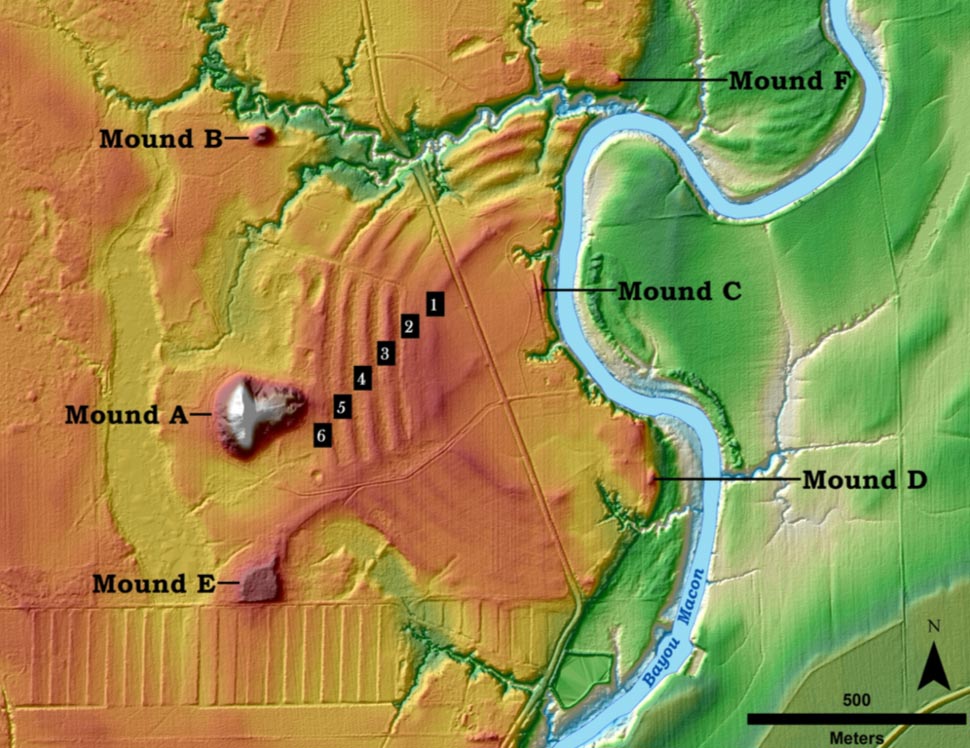
Some 3,500 years ago, hunter-gatherer groups began shaping enormous earthen mounds along the Mississippi River at Poverty Point, a UNESCO World Heritage Site in northeast Louisiana.
“Conservatively, they moved 140,000 dump truck loads of dirt, all without horses or wheels,” said Tristram “T.R.” Kidder, the Edward S. and Tedi Macias Professor of anthropology. “It was incredibly hard work. The big question is why? What was their motivation?”
Kidder and his research team in Arts & Sciences at Washington University in St. Louis recently revisited Poverty Point and nearby archaeological areas. By collecting updated radiocarbon dates and reassessing existing evidence, they have developed new ideas that confront long-standing interpretations of these ancient communities.
He presented these views, along with supporting data, in two papers published in the journal Southeastern Archaeology. The studies were co-authored with graduate student Olivia Baumgartel and 2023 WashU PhD recipient Seth Grooms, who is now at Appalachian State University.
Poverty Point is widely recognized for its massive earthworks that still stand out in the landscape. Yet the smaller discoveries are just as compelling. Archaeologists have uncovered thousands of clay cooking balls and materials originating from faraway regions, such as quartz crystal from Arkansas, soapstone from the Atlanta area, and decorative items crafted from Great Lakes copper.
“These people were trading and traveling over long distances,” Kidder said.
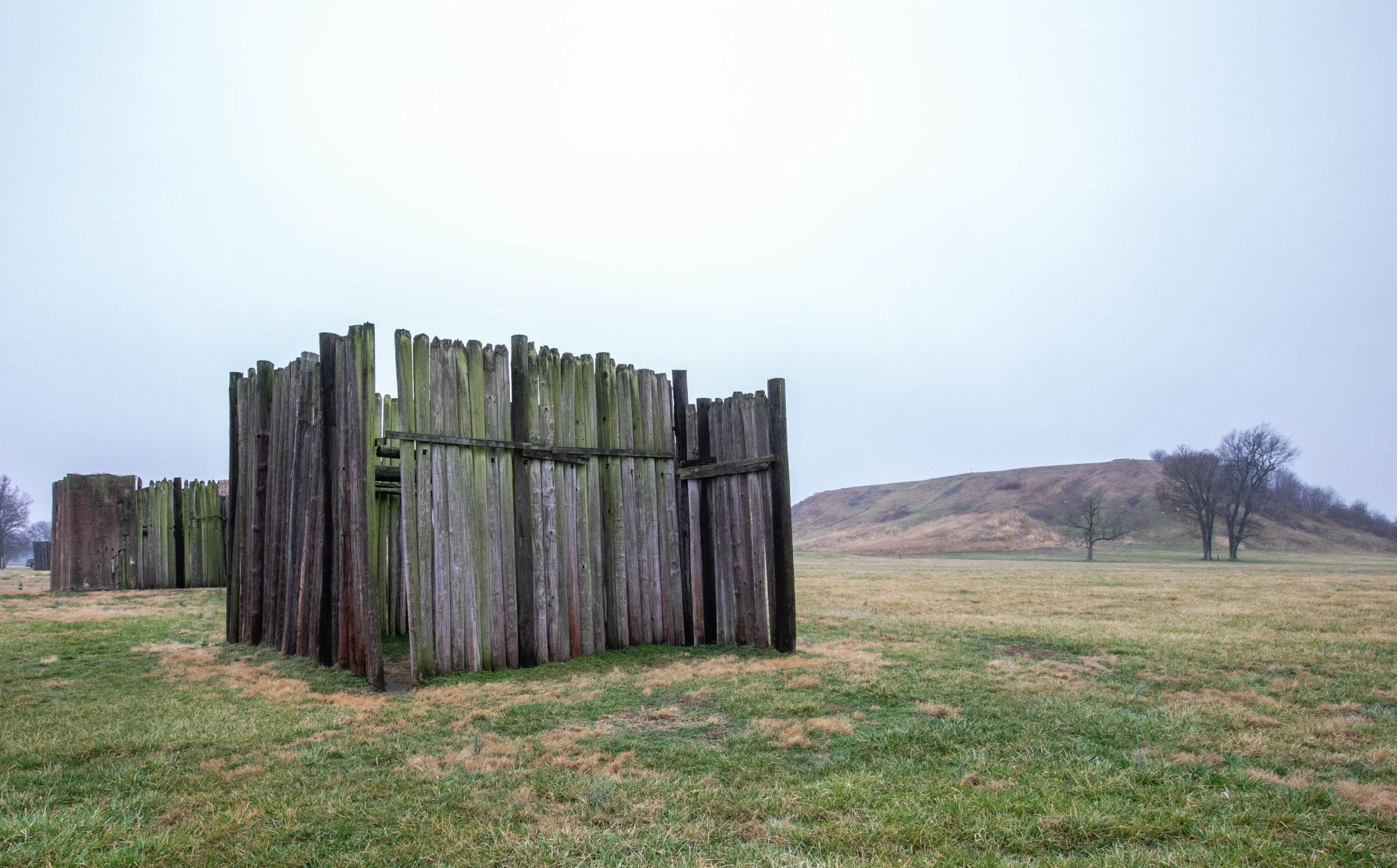
Earlier interpretations suggested that Poverty Point could only have been built by a highly structured, hierarchical society with many generations contributing labor. Archaeologists already know that the people responsible for Cahokia Mounds, another enormous earthwork complex created in what is now Illinois more than 1,000 years after Poverty Point, lived under a chiefdom. Because of this, many researchers assumed the same type of political organization existed at Poverty Point. However, archaeological evidence does not always align with the simplest or most convenient explanation.
A New Interpretation
In their recent paper, Kidder and Grooms suggest a different interpretation: Instead of a long-occupied settlement with chiefs and laborers, Poverty Point was a temporary gathering spot where people from across the Southeast and Midwest assembled by the thousands to trade, socialize, work, and worship together.
The paper builds on theories Kidder and his team of graduate students have been developing for years. Based on the evidence, they see a community with a shared sense of purpose. “We believe these people were egalitarian hunter-gatherers, not subjects to some powerful chiefdom,” Baumgartel said.
The massive earthworks weren’t monuments to a ruling class, Kidder said. Instead, they were a cooperative effort over several years to gain favor with an unpredictable universe. “When these earthworks were being constructed, the Southeast was prone to severe weather and massive floods,” he said. “We believe the inhabitants of Poverty Point built the mounds, performed rituals, and left behind valuable objects as a sacrifice and spiritual offering.”
Kidder and Grooms note that archaeologists have never found burial sites or remains of long-term dwellings at Poverty Point. “We would expect to see those things if this were a permanent village,” Kidder said. “The old paradigm that people lived at Poverty Point continuously for centuries has been crumbling, and we needed a new framework.”
Unlike pots and beads, spiritual intentions can’t be dug up and examined under a microscope. But Kidder and Grooms have good reason to believe the earthworks and objects at Poverty Point had deeper significance. “I’ve spent many years talking with people of Native American ancestry,” Kidder said. That includes Grooms, a member of the Lumbee tribe of North Carolina.
Those conversations have strengthened his theory that the people of Poverty Point had a religious motivation that doesn’t fit modern concepts of utility.
“As archaeologists, we have to leave ourselves open to different kinds of thinking,” Kidder said. “The Western view is that they wouldn’t travel all of that distance and do all of that work unless they were getting something of economic value out of it. We believe they felt a moral responsibility to repair a torn universe.”
Unique histories
Poverty Point wasn’t the only gathering place in the region. WashU researchers also are studying Claiborne and Cedarland, archaeological sites in western Mississippi that once held similar troves of artifacts. Both have been damaged by land development and souvenir seekers. “It’s a sad fact that in archaeology today, you’re almost always trailing behind someone’s bulldozer,” Kidder said.
Rather than further disturbing the sites, the team used radiocarbon dating technologies to gauge the age of clam shells and deer bones collected from the Claiborne and Cedarland sites by archaeologists some 50 years ago. The tests revealed that people occupied Cedarland about 500 years before either Claiborne or Poverty Point, showing it had its own independent history. “We’ve pulled these sites apart, given them independent histories, and have started to understand how artifacts from across the region ended up here,” Baumgartel said.
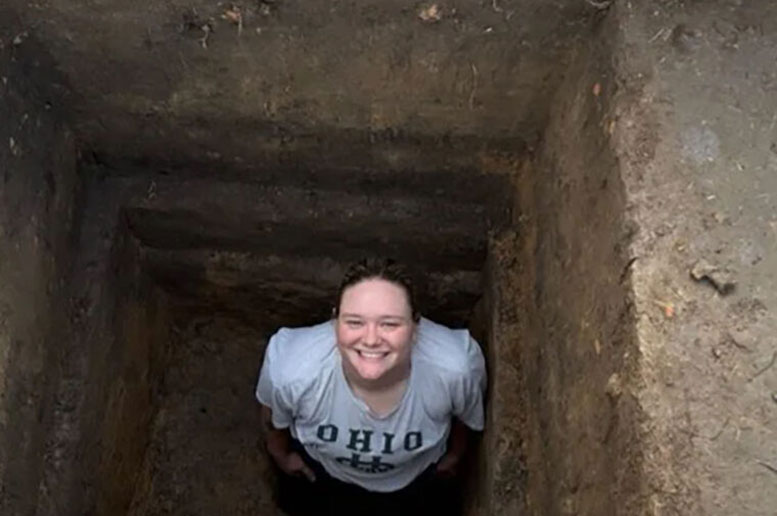
This meticulous approach continues at Poverty Point. In May and June of this year, Kidder and Baumgartel re-excavated pits originally dug in the 1970s. Using new radiocarbon dating and microscopy techniques, they hope to uncover insights that past researchers could not.
“Olivia and I spent a lot of time moving tiny amounts of dirt, and it was hot and tiring,” Kidder said. “It’s incredible to think about the effort that the people of Poverty Point went through to build those earthworks. They continue to inspire me.”
References:
“Performance, ritual, and revitalization at Poverty Point” by Tristram R. Kidder and Seth B. Grooms, 16 September 2025, Southeastern Archaeology.
DOI: 10.1080/0734578X.2025.2553970
“High-resolution dating of legacy collections from the Cedarland and Claiborne sites, southwest Mississippi” by Tristram R. Kidder, Olivia C. Baumgartel and James E. Bruseth, 9 September 2025, Southeastern Archaeology.
DOI: 10.1080/0734578X.2025.2552058
Never miss a breakthrough: Join the SciTechDaily newsletter.
Follow us on Google and Google News.
29 Comments
People die at temporary gatherings; so the fact no bodies have been found doesn’t mean no one lived there year round.
Bodies could have been placed in the river to help heal the universe from flooding.
See how easy it is to make a theory fit a great lack of actual evidence.
Most of my anthropology books interpreted everything in a spiritual manner; then economics/ both market and Marxist started shouting they had a better explanation.
Ripples in the water sacred place of spirit
Ripples in the water sacred place of spirit
Question the narrative something seems amiss we certainly need to reassess our conservative what are we missing could it be that we’ve sculpted are timeline to neatly fit our Gregorian calendar we have a cyclic universe governed by mathematical principles if we can’t see it it’s not there and therefore it does not exist isn’t it the evidence of a cataclysmic past clear enough spinning a set of stars which tattered tails of access roll about the waxing winds of never set the motion and the end becomes the roundabout the season hardly matters nor the wise for which they spend
Maybe I’m missing something, but how would they have used horses if horses were not reintroduced until around 500-700 years ago?
Ripples in the water sacred place of spirit
Mound c
Lumbee Indians are not native American. They are descendants of runaway slaves. DNA evidence proved that they have no Native American DNA. The Government doesn’t recognize them because of that.
Well. The amount of pure copper.. only found in northern US. This copper could have only come from there. And yet its found as jewelry and tools all over the world. European and aferican countries.. Asia. The US was a hub for minerals and items shipped. The government just sat down and claimed everything . People were here many thousands of years ago. While the good old boys settled and built their building… any historic artifacts were trashed. A united agreement to display they were the first intelligent people here. It’s disgusting. We have been lied to about most everything.
One of the dumbest ideas I’ve heard in a long time. People don’t build mounds like these without a leader (in fact a hierarchy of leaders). This “theory” shows a total lack of understanding of human nature. What society anywhere in the world, anywhere in time EVER did anything without leaders? Tribes have chiefs, Rome had Caesars and Senate’s, Europe had Kings and Queens, the US had presidents and Senate, etc. What recognized country or group of people ANYWHERE in the world doesn’t have representative leaders…whether elected or in power by force? Astonishingly dumb and unsupported idea expressed in this article.
An interesting set of questions and findings.
Archeological evidences give us a clue as to not only our past but clues as to our future.
We must try to be aware as to the evidences found in relation to our present and our understanding as it relates to all humans.
There are better ways of using critiques of and for this understanding.
We all must realize that we are the past, present, and future and therefore continue the quest of understanding for humanity.
and they would need an economic payoff to justify the effort. it must have been a perennial seasonal trading hub liketone henge
You are wrong. Copper in metallic form (what geologists call native copper) is found all over the world. The Lake Superior region of the U.S. does, however, have the largest deposits.
I agree and to also think there was no community or people at all living there just passes by, people trading and performing rituals and these people over years just passed by and moved some dirt by hand then left and someone else would pass by and continue this work etc i3500 years ago on a flood plane of all things, seems pretty far fetched
Are you saying the copper found at the Poverty Point site all came from the northern US, or that all copper comes from the northern US?
I think it is ridiculous to believe people hauled that much muddy dirt without any wheels. And flooding was still going on in the meantime, so they could haul for years and have it all washed away in a day. Inn5 years, we will have a new theory.
I agree completely. It is obvious from the “aerial view” that the ridges and swales are the result of a meandering river. Human beings had little contribution and little control over an ordinary “force of nature”. This type of topography is seen along numerous meandering streams and rivers.
I agree and to also think there was no community or people at all living there just passes by, people trading and performing rituals and these people over years just passed by and moved some dirt by hand then left and someone else would pass by and continue this work etc i3500 years ago on a flood plane of all things, seems pretty far fetched
I agree and to also think there was no community or people at all living there just passes by, people trading and performing rituals and these people over years just passed by and moved some dirt by hand then left and someone else would pass by and continue this work etc i3500 years ago on a flood plane of all things, seems pretty far fetched. If not ridiculous
Looks like stepped levves to protect higher land when river flooded.
Close – perfectly natural ox bow lake and banks –
Anyone who lives near the Mississippi knows one thing, it floods. My idea is that most Indian mounds were built to protect settlements against that reality. Not everything needs a ritualistic purpose.
The term “Hunter-Gatherer” is an inaccurate misnomer. The proper term is “Hunter-Harvester.” All sources of sustenance were known for many generations, there was no wandering about hoping to find some food.
Ofcourse it is. You would think that would be common knowledge. To think that all the world’s copper (millions of tonnes) didn’t all come from 1 site in America is quite naive.
Yes, Karen. Political disinformation plays a big role in what we know about our past. It is very difficult for folks to understand the depth of time. There were at least hundreds of ships over thousands of years that we do not grasp. I have studied this since 1976, almost 50 years. James Bruseth has done important work. My books are on Amazon under “Jay Stuart Wakefield”.
I visited in the 80s and found the eagle mound to be a humming bird looking to the left. After a number of trips to Mexico and Yucatan felt the site to be of aztec origins. Felt both pp site as well as cokocia probably were middleamerican colonies.
I claim to know nothing. Looks to me as either flood control or an amphiteater
Agriculture. Irrigation for crops.
Agriculture. Irrigation for crops.