
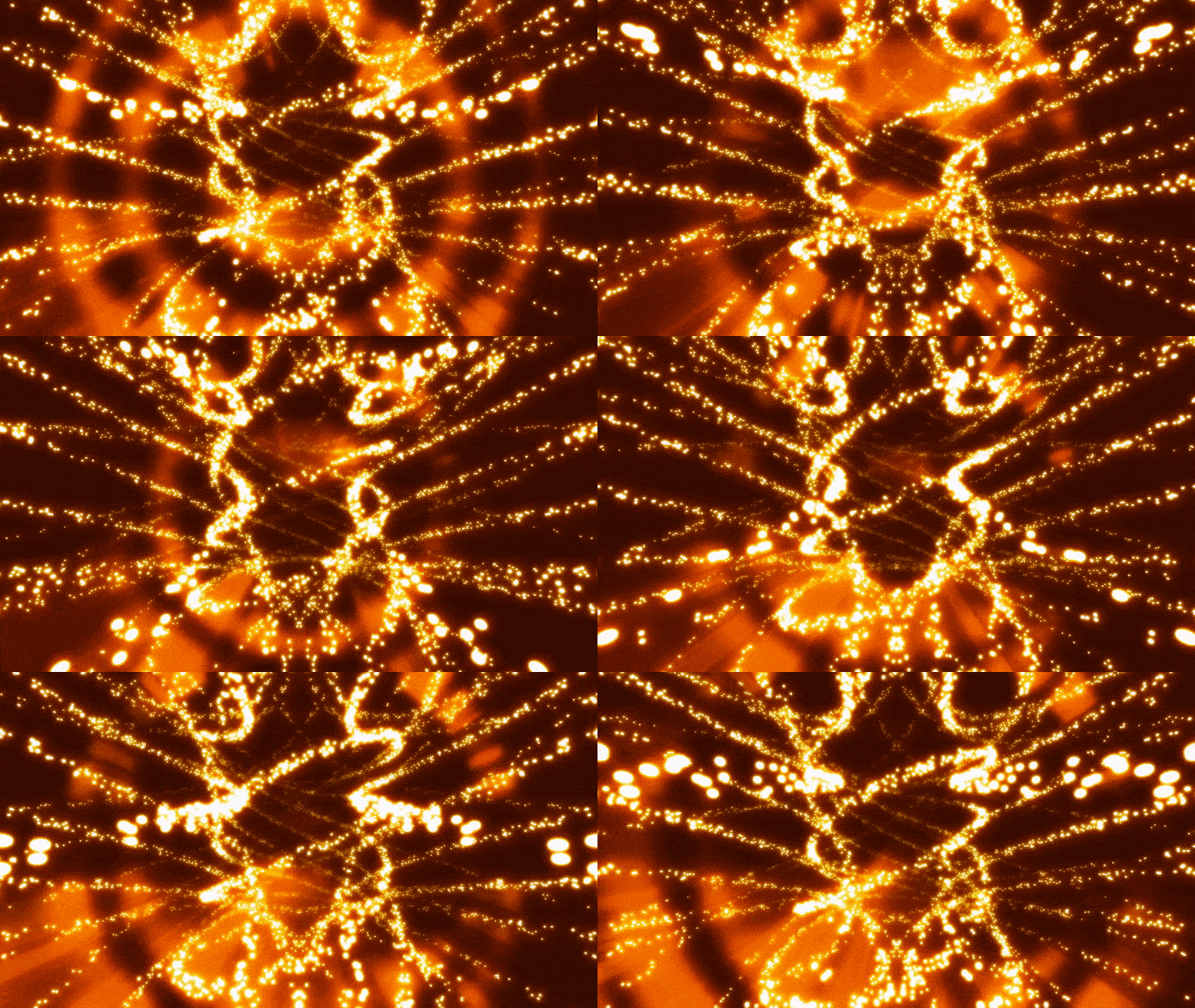
A novel state of matter has been discovered by physicists at the University of Leicester.
In recent years, active, self-propelled particles have received growing interest amongst the scientific community. Examples of active particles and their systems are numerous and very diverse, ranging from bacterium films to flocks of birds or human crowds. These systems can demonstrate unusual behavior, which is challenging to understand or model.
To this end, large-scale models of active particles were being scrutinized by experts at Leicester, in order to understand the basic principles underlying active particle dynamics and apply them in a scenario of an evacuation strategy for customers in crowded place. Unexpectedly, the ‘super-particles’ milling in a circular motion were stumbled upon by Leicester’s physicists who subsequently coined the phenomenon as “swirlonic.”
Challenging Newton’s Law with Swirlonic Behavior
The “swirlon” — a novel state of active matter — displayed a stunning behavior whereby instead of moving with acceleration, the quasi-particle groups moved with a constant velocity, proportional to the applied force and in the same direction of the force. This conduct seemingly violates the Second Newton’s Law, currently taught in secondary schools across the UK.
Professor Nikolai Brilliantov who led the investigation at the University of Leicester said: “We were completely baffled to witness how these quasi-particles swirl within active matter, behaving like individual super-particles with surprising properties including not moving with acceleration when force is applied, and coalescing upon collision to form swirlons of a larger mass.
“These patterns have previously been observed for animals at different evolution stages, ranging from plant-animal worms and insects to fish, but rather as singular structures, not as a phase which borders other phases, resembling gaseous and liquid phases of ‘normal’ matter.”
Unlocking the Unknown in Physics
Professor Ivan Tyukin, Director of Research in Applied Mathematics said: “It is always exciting to consider deepening our understanding of novel phenomena and their guiding physical principles. What we know to date is so much less than what there is to know. The phenomenon of the “swirlon” is part of the tip of the iceberg of hidden knowledge. It leaves us with the eternal question: ‘What else don’t we know’?”
The world of active particles has many practical applications including in the cutting-edge fields of artificial intelligence, space data, and robotics. Since one of the possible practical applications of active particles could be self-assembly, experts at the University of Leicester agree it is essential that physicists continue to press for discoveries based around simulation work. This will ensure that in real life, materials, substances, and groups work in ways which are reliable, expected, and predictable, without unavoidable uncertainties.
Reference: “Swirlonic state of active matter” by Nikolai V. Brilliantov, Hajar Abutuqayqah, Ivan Yu Tyukin and Sergey A. Matveev, 8 October 2020, Scientific Reports.
DOI: 10.1038/s41598-020-73824-4
Never miss a breakthrough: Join the SciTechDaily newsletter.
Follow us on Google and Google News.
6 Comments
If there is no acceleration, it stands to reason there would neither be deceleration. To this end and with the knowledge, the next obvious and practical application for such a phenomenon is endless energy, since these ‘things’ seem to violate entropy. A concept Tesla (the inventor) coined back when he was alive I do believe.
The concept of spyroe theory is vortexes combining, aligning and winding/unwinding – that represents energy.
Who needs particles to explain reality?
Properties of the space of (1): – Space is the most solid form of energy in the universe whose color is completely white. There is nothing solid and white from space in the universe. (2): – White color is the first color of the universe. (3): – The density of space is minimum but not zero. (4): – Only space in the universe There is a form of energy that cannot be divided. (5): – Space brings other forms of energy into existence. (6): – Most of the universe is made up of space energy. (7): – Other forms of energy have no effect on space nor does space have any effect on them. (8):- Space can neither be created nor destroyed, and it also cannot be converted into another form of energy. What’s correct?
If a polygon whose sides are a, b, c, d, e, f, g, …. is made a x-way round (outwards), then the area of the path will be as follows. = x (a + b + c + d + e + f + g + …) + πx ^ 2 What’s correct?
Assuming that if a person approaches the black hole in some way, then due to the excessive gravitational effects of black hole, its physical activity (splitting of cells, loss of cells, exchange of signals from brain to various organs) Hormones, enzymes, proteins etc …) are extremely slow and when they return to the Earth, they find that the time of their time The age of people is very high, which is revealed by their physical condition. This difference is due to the no movement of the earth on the rise and the slowing of activities near the black hole, so we say that time near the black hole is too slow Gets it. What’s correct sir?
This will redefine all these laws and theories of physics on all levels. Magnetic levitation studies show similarly the same phenomenon which is charged particles/energy moving in circles in different speeds clockwise and Counter clockwise. ⬇⬅⬆➡⬇ is the magnet arrangement. Check it out on youtube. I’ve been researching this stuff for years with no degree.