
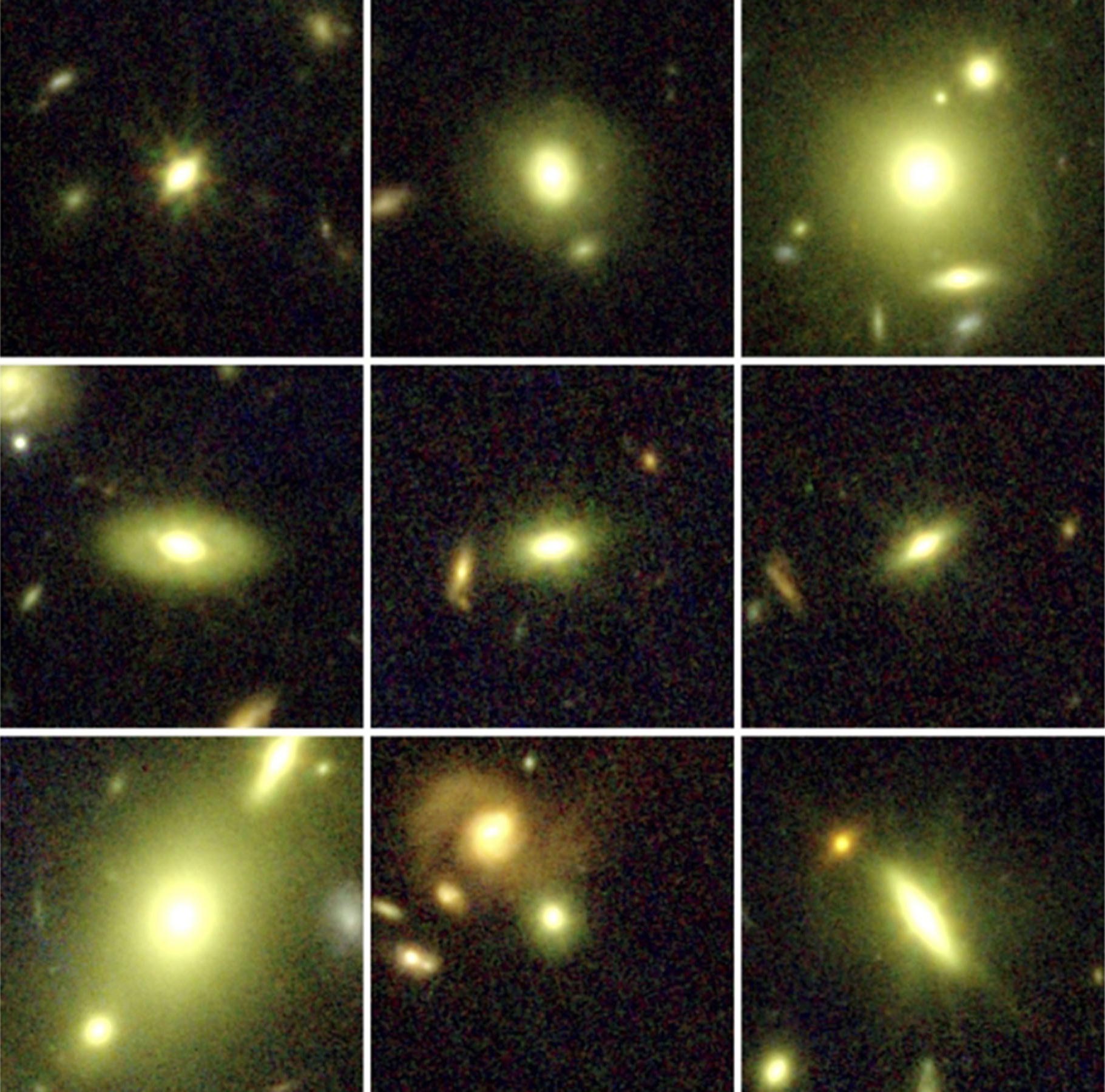
Faint stars hidden inside massive early galaxies suggest some may contain several times more stellar mass than previously estimated.
Some of the universe’s earliest massive galaxies may be hiding far more stellar mass than astronomers realized. Their brightest stars dominate what telescopes can see, but new measurements indicate that enormous populations of small, faint stars are concealed beneath that glare, suggesting these galaxies may be much heavier than previous estimates. The findings, which involved Penn State scientists, challenge existing ideas about how the first galaxies assembled and were recently published in Nature Astronomy.
An international research team used NASA’s James Webb Space Telescope (JWST) alongside earlier ground-based observations from the Very Large Telescope to investigate nine massive, mature galaxies that stopped forming stars billions of years ago. By combining the observations, the researchers were able for the first time to reliably estimate the relative numbers of tiny, faint stars and much larger, brighter stars in galaxies at such great distances.
“These galaxies are different,” said Joel Leja, the Dr. Keiko Miwa Ross Mid-Career Associate Professor of Astronomy and Astrophysics at Penn State and coauthor of the paper. “They’re different in the way that is really challenging to understand, because they are more massive than we expected — like a lot more massive, they have three or four times more mass than we expected.”
Faint stars reveal hidden galaxy mass
To uncover those faint stellar populations, astronomers separated each galaxy’s light into a spectrum, where small differences in color reveal which kinds of stars are present. Massive, luminous stars usually dominate these spectra, making the signatures of much dimmer, low-mass stars difficult to isolate. Penn State researchers contributed expertise in modeling the light detected from the galaxy systems.
“If a galaxy were a city, the brightest stars would be the skyscrapers that immediately catch your eye from afar,” said lead author Chloe Cheng, a recent doctoral graduate of Leiden University. “Our models demonstrate that a far more numerous population of low-mass stars is concealed by those rare, bright stars, like houses hidden between skyscrapers. As a result, this galaxy turns out to be much more massive than previous estimates suggested.”
The usual stellar mix does not hold
Astronomers have traditionally estimated the unseen mass contained in small, faint stars by assuming that stars form in roughly the same proportions throughout the universe. The new measurements challenge that assumption. They indicate that the most massive galaxies in the early universe contain a substantially larger share of low-mass stars than less massive galaxies such as the Milky Way. One galaxy in the sample stood out in particular, according to co-author Martje Slob, a doctoral candidate at Leiden University. It likely formed less than one and a half billion years after the Big Bang and may contain as much as four times the mass previously estimated.
“Until recently, measurements like these were simply impossible,” Slob said. “We needed not only a telescope capable of magnifying very distant galaxies, but also spectra of exceptional quality and new analysis techniques to reliably detect the subtle signatures of faint, low-mass stars hidden within these cosmic titans.”
Leja said the finding has major implications for attempts to understand the early universe. Since JWST began operating, astronomers have identified unexpectedly massive and mature galaxies that were already present not long after the Big Bang.
Extra mass deepens an early universe puzzle
“This discovery has crucial implications for our understanding of the early universe,” said Leja, who is also affiliated with The Penn State Institute for Computational and Data Sciences. “Since the launch of JWST, astronomers have found surprisingly massive and mature galaxies that already existed shortly after the Big Bang. These very early galaxies are thought to evolve into the type of galaxies studied in this work; adding up to four times more stars to these massive, early-forming galaxies sharpens these tensions further.”
If these galaxies contain substantially more low-mass stars than previously recognized, their total stellar masses were probably underestimated as well. Models of galaxy formation must therefore account for how such large populations of small stars could have assembled so early in cosmic history, the researchers said.
“This result shows that much more mass than previously thought is hidden in low-mass stars,” said Mariska Kriek, who led the research and serves as professor of extragalactic astronomy at Leiden Observatory. “That has consequences for many areas of astronomy. For example, as many planets orbit low-mass stars, this could even indicate that more planets formed in the early universe than we had previously assumed.”
Over the next several years, the researchers plan to extend the same method to galaxies from even earlier periods, bringing them closer to the epoch when the universe’s first generations of stars and galaxies emerged.
Reference: “Hidden mass in early galaxies revealed by bottom-heavy initial mass functions” by Chloe M. Cheng, Martje Slob, Mariska Kriek, Aliza G. Beverage, Pieter G. van Dokkum, Rachel Bezanson, Gabriel Brammer, Charlie Conroy, Anna de Graaff, Elham Eftekhari, Robert Feldmann, Wout M. Goesaert, Meng Gu, Joel Leja, Brian Lorenz, Pavel E. Mancera Piña, Ignacio Martín-Navarro, Andrew B. Newman, Sedona H. Price, Alice E. Shapley, Piyush Sharda, Katherine A. Suess, Arjen van der Wel and Daniel R. Weisz, 18 August 2026, Nature Astronomy.
DOI: 10.1038/s41550-026-02932-4
Never miss a breakthrough: Join the SciTechDaily newsletter.
Follow us on Google and Google News.
2 Comments
Through the lens of continuous field dynamics and the Torsion Hill Framework, this “hidden mass crisis” reflects structural properties of localized matter assembly rather than missing matter: Dimensional Accumulation ($0\text{D} \to 1\text{D} \to 2\text{D} \to 3\text{D}$): Matter assembly is driven by localized step propagation and field saturation. High localized grid density ($\rho_d$) in the early universe creates dense geometric step boundaries. This environment naturally favors the nucleation of smaller, persistent spatial knots (low-mass stars) over massive, short-lived ones. Field Drag vs. Mass Assumptions: Standard models convert light intensity to mass by assuming spatial coordinates expanded out of a uniform, low-impedance void. If the early universe had elevated Temporal Gradient Impedance ($Z_T$), light frequency shifts and phase momentum loss ($\pi\text{ Effect}$) would alter how stellar luminosity scales against true spatial clearance. Consolidated Equilibrium: The existence of these dense, low-mass stellar populations shows that early spatial clearance matrix environments reached localized equilibrium ($+1\text{ Consolidated Equilibrium}$) much faster than purely linear gravitational collapse models account for. The tension deepens for traditional cosmology because light spectrum calculations are being forced through fixed, localized IMF assumptions. When the underlying field mechanics and dimensional growth rates are accounted for, the rapid condensation of dense, low-mass structural nodes becomes a natural consequence of high-density field interaction. (check the Link ) https://docs.google.com/document/d/1iHSMitywAsr2YbvXBW65bAR9g5bELPSy1meMg_ik7f8/edit?usp=drive_link
Supersized stars (lasting <10My in age) have been found, so maybe the early universe's density encouraged supersized stars early on.