
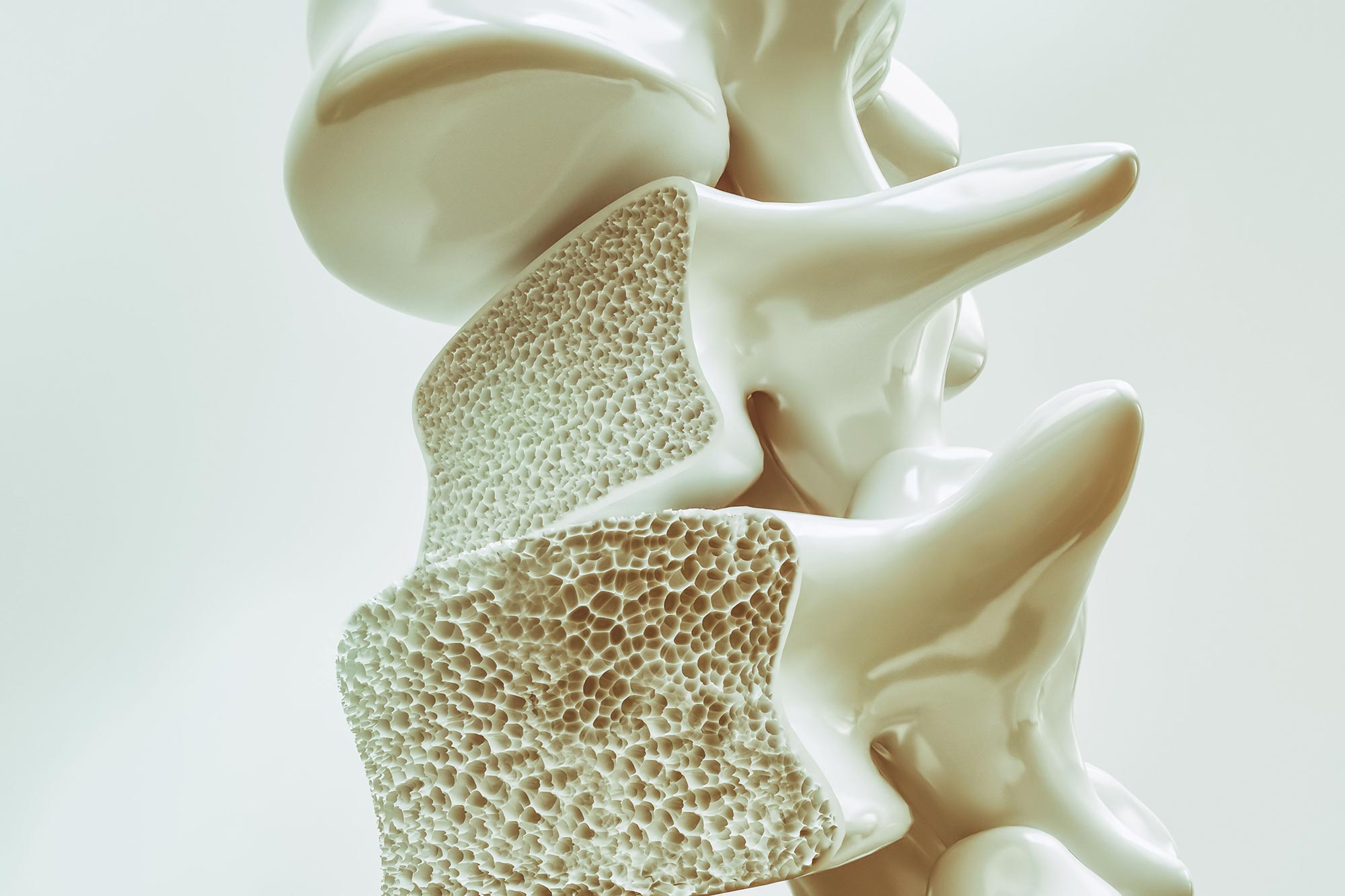
Routine chest CT scans may contain clues about more than bone health.
A scan taken to examine the chest may also reveal clues about how the brain is aging.
Researchers at Johns Hopkins University found that people with lower bone mineral density in the spine tended to experience faster cognitive decline and more rapid changes in brain white matter over time. The findings, published in Radiology, point to a possible connection between skeletal health and age-related changes in the brain.
Bone mineral density measures how much mineral, including calcium, is packed into a given volume of bone. As density falls, bones generally become more fragile and more susceptible to fractures. Although bone loss is a familiar part of aging, its relationship with changes in the brain has received far less attention.
A multidisciplinary team led by Sara Momtazmanesh, M.D., a postdoctoral research fellow in the Department of Radiology and Radiological Sciences at Johns Hopkins University in Baltimore, Maryland, investigated that connection using data from the Multi-Ethnic Study of Atherosclerosis (MESA). The participants had undergone non-contrast chest CT, multimodal brain MRI, and cognitive testing.
Researchers analyzed non-contrast chest CT scans from 2,086 MESA participants using a deep learning algorithm developed in the Johns Hopkins University laboratory of Shadpour Demehri, M.D., professor of radiology. The system measured thoracic vertebral volumetric bone mineral density (vBMD), allowing the researchers to extract information about bone health from scans that had already been obtained.
The final analysis included 715 participants who had established vBMD measurements as well as MRI and cognitive testing.
What Bone Density Revealed About the Brain
Brain MRI scans were examined for two markers of white matter health: white matter hyperintensities and fractional anisotropy.
White matter contains the long nerve fibers that help distant parts of the brain communicate. Changes in this tissue are common with aging, but a greater burden of abnormalities has also been associated with cognitive decline and increased dementia risk.
White matter hyperintensities appear as bright areas on certain MRI scans and can reflect injury involving the brain’s small blood vessels and surrounding tissue. Fractional anisotropy, meanwhile, is an MRI-based measure that provides information about the microscopic organization of white matter.
Long-term measurements of white matter hyperintensities were available for 408 participants, while 405 had longitudinal fractional anisotropy data.
Lower bone density at the beginning of the study was associated with a faster decline in overall cognitive performance.
Participants with lower vBMD accumulated more white matter hyperintensities in the corpus callosum, the large bundle of nerve fibers that connects the brain’s two hemispheres and contributes to functions including attention, working memory, and executive control.
Lower vBMD was also associated with a steeper decline in total white matter fractional anisotropy within the anterior limb of the internal capsule, an area involved in communication between brain regions important for executive function.
“This study is the first longitudinal secondary analysis linking baseline vertebral bone mineral density to changes in white matter structure, white matter hyperintensity progression and cognition,” Dr. Demehri said. “This comprehensive study using both imaging and clinical assessments sends a clear signal that bone density at baseline is associated with both functional and imaging measures of age-related brain degeneration.”
The researchers emphasized that these associations do not mean osteoporosis causes dementia.
One Aging Process, Multiple Organ Systems
“This study is not about cause and effect, but rather the observation of a metabolic syndrome that may cause both bone and brain degeneration,” Dr. Demehri said. “The co-occurrence observed in the study may reflect shared metabolic drivers of aging, including insulin resistance, dyslipidemia, and menopausal change, rather than a direct bone-to-brain effect.”
Bone loss and cognitive decline are often treated as separate problems, but both can emerge as people age and may be influenced by broader metabolic and vascular changes throughout the body.
The researchers said that identifying low vBMD could therefore help highlight people who may be experiencing skeletal and neurological decline at the same time. In the future, that information could support earlier screening and management of risk factors that affect multiple organ systems.
It may also give doctors more value from imaging that patients are already receiving. Chest CT scans are routinely performed for several medical reasons, meaning bone density information could potentially be extracted without requiring a separate scan.
“Chest CT is done for lung cancer screening, calcium scoring, nodule follow-up, and many other indications,” Dr. Momtazmanesh said. “These scans could provide an opportunistic measurement of bone density from the thoracic spine that is associated with a loss of cognitive function.”
Dr. Demehri added: “Diagnostic images contain an immense amount of data that AI can now synthesize at scale across multiple organ systems. This creates a robust, newly feasible opportunity to interconnect co-existing age-related pathologies that have traditionally been studied in isolation and to identify shared biological pathways and potential common causal mechanisms.”
Reference: “Deep Learning–derived Bone Mineral Density and Longitudinal White Matter Microstructure and Cognitive Decline: Multi-Ethnic Study of Atherosclerosis” by Sara Momtazmanesh, Quincy A. Hathaway, Michael P. Bancks, David A. Bluemke, R. Graham Barr, Wendy S. Post, Mohamad Habes, Ilya Nasrallah, Susan R. Heckbert, R. Nick Bryan, Jose A. Luchsinger, Mei Wan, Matthew Budoff, João A. C. Lima, Timothy M. Hughes, Christos Davatzikos and Shadpour Demehri, 22 September 2026, Radiology.
DOI: 10.1148/radiol.260656
Never miss a breakthrough: Join the SciTechDaily newsletter.
Follow us on Google and Google News.
1 Comment
Mysteriously, seriously ill with chronic fatigue and short-term memory problems, minimally, by early 2009, I’ve been writing of my personal lay findings of a direct relationship between medically undiagnosed very, very mild food (minimally) allergy reactions leading to a serious calcium deficiency, standard blood serum testing for calcium being unreliable and possible resultant mental health problems since 2011 (JACI and The Lancet, both, declined to publish me). I also recall writing some researchers at Johns Hopkins at various times with no replies. Simply put, Dr. Arthur F. Coca’s (by 1935; “The Pulse Test,” 1996; my) kind of not yet medically recognized sub-acute (nearly subclinical) non-IgE-mediated food allergy reactions can even result in dementia (e.g., personal family histories), aggravated (or not) with FDA approved added artificially cultured “free” (can cross the blood-brain barrier) MSG and related/resultant medical errors, long-term. The only real “surprise” for me is that in 2026 most researchers are still ignorant of the facts.