
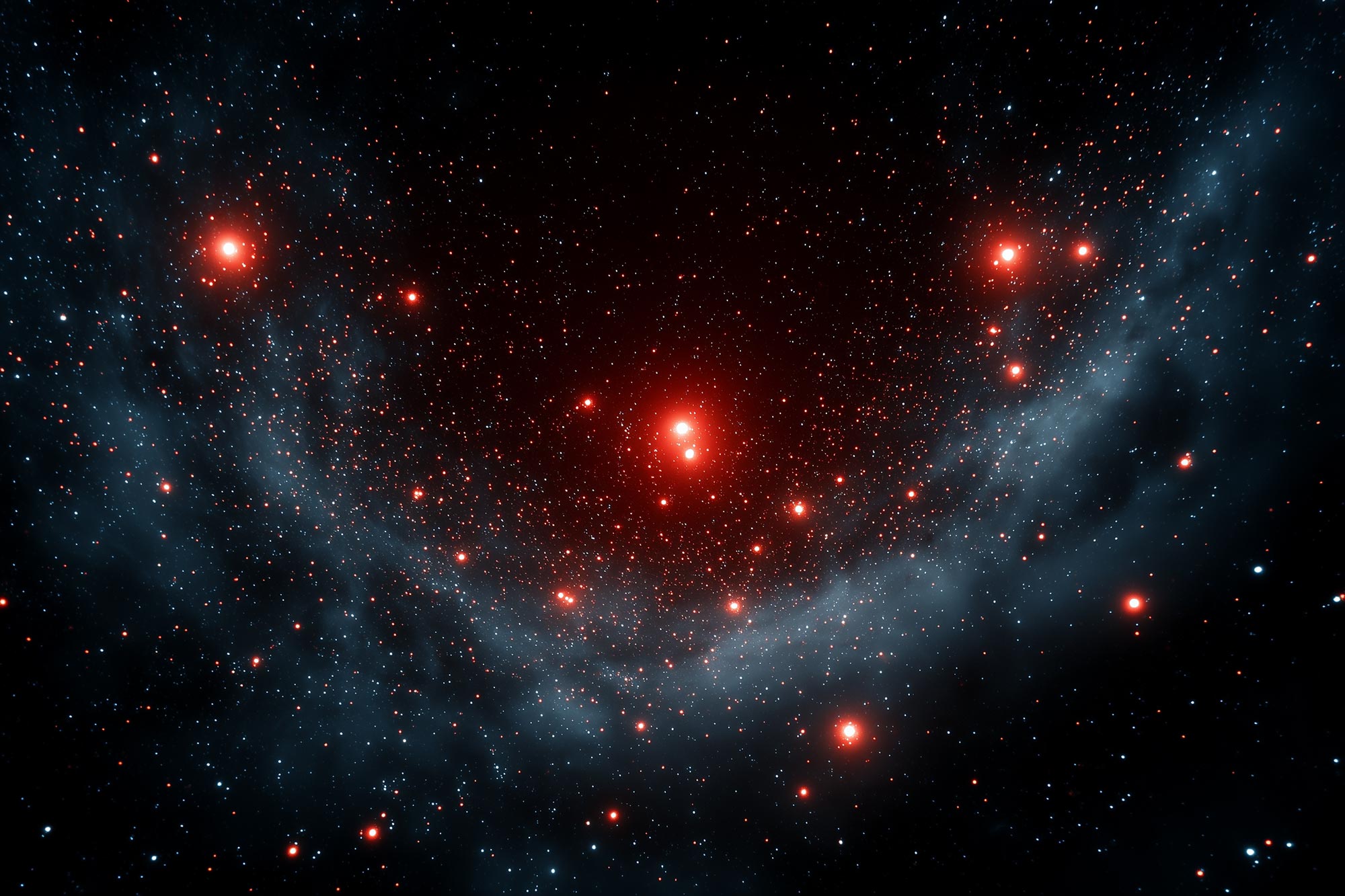
Astronomers may have uncovered the secret behind the mysterious “little red dots” seen by the James Webb Space Telescope.
These compact, glowing galaxies appeared just a billion years after the Big Bang and have baffled scientists with their unusual brightness and density. A new theory suggests they formed inside ultra-slow-spinning dark matter halos—rare cosmic environments that squeezed matter tightly together.
Mysterious “Little Red Dots” in the Early Universe
Astronomers at the Center for Astrophysics | Harvard & Smithsonian have introduced a new idea to explain one of the strangest discoveries in the young universe: the so-called “little red dots.”
In research published in The Astrophysical Journal Letters, Fabio Pacucci and Abraham (Avi) Loeb argue that these unusual galaxies likely formed inside extremely rare dark matter halos that rotate far more slowly than most.
The compact, faint objects were spotted in deep space images captured by the James Webb Space Telescope (JWST) and have unsettled current theories about how galaxies and black holes took shape in the early universe.
Their study, “Cosmic Outliers: Low-Spin Halos Explain the Abundance, Compactness, and Redshift Evolution of the Little Red Dots,” proposes a physical explanation for what makes these galaxies so distinctive.
“Little red dots are very compact and red distant galaxies that were completely undetected before the James Webb Space Telescope,” said Pacucci. “They are arguably the most surprising discovery by JWST to date. Our work shows that these could naturally form in dark matter halos with very low spin.”
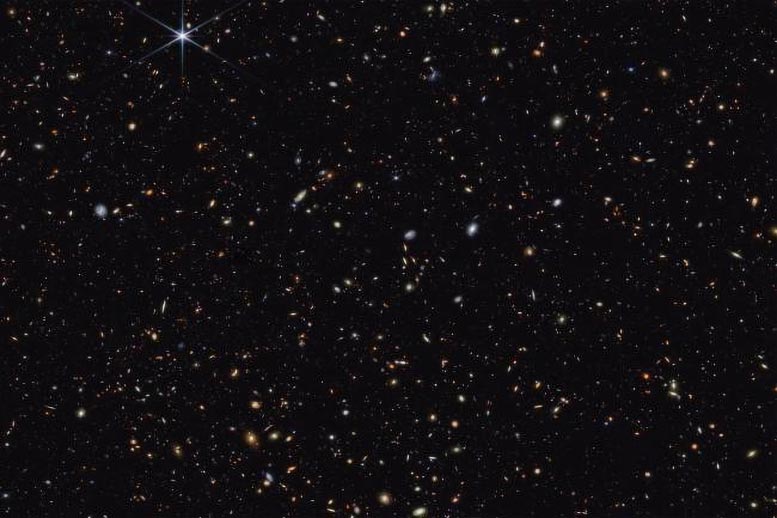
Cosmic Dawn: Tiny but Bright Galaxies
According to Pacucci, the galaxies are mostly observed at a time when the universe was only about one billion years old, though they probably emerged even earlier during a period known as the cosmic dawn. Despite being only about a tenth the size of normal galaxies, they shine unusually bright. Their deep red color suggests they may either be wrapped in cosmic dust or filled with older stars.
Astronomers have long debated whether the light from these dots comes from stars or supermassive black holes at their centers.
“It’s a fundamental mystery,” said Pacucci. “If they contain black holes, those black holes are enormous for such small galaxies. But if they only contain stars, the galaxies are too compact to contain all of them, reaching central stellar densities that are unthinkable.”
Rather than focusing on what powers the luminous dots, Pacucci and Loeb took a different approach: they examined how such objects might form in the first place.
The Low-Spin Halo Hypothesis
Dark matter halos are the invisible, spinning scaffolding around which galaxies form. In their paper, the authors show that the luminous dots formed in halos that are in the lowest 1% of the spin distribution. In other words, 99% of all halos spin faster than those. These low-spin halos would naturally create extremely compact galaxies. Much like the swings ride at a carnival, the faster the halo spins, the further out the swings stretch, causing the galaxy forming at its center to expand; likewise, a slow spin keeps the swings’ radius smaller.
This hypothesis also explains why luminous dots are relatively rare: they represent just 1% of the abundance of typical galaxies, but are more common than quasars, the extremely bright centers supermassive black holes that shine at the center of some galaxies.
In addition, the theory helps clarify why luminous dots are only observed during a brief 1-billion-year period in the early universe. As the universe evolves, dark matter halos grow larger and gain more angular momentum, making it more difficult to form compact, low-spin galaxies.
“Dark matter halos are characterized by a rotational velocity: some of them spin very slowly, and others spin more rapidly,” Loeb said. “We showed that if you assume the little red dots are typically in the first percentile of the spin distribution of dark matter halos, then you explain all their observational properties.”
Prime Environments for Black Hole Growth
While the paper does not resolve whether little red dots are powered by stars or black holes, it suggests they are prime environments for rapid stellar or black hole growth.
“Low-spin halos tend to concentrate mass in the center, which makes it easier for a black hole to accrete matter or for stars to form rapidly,” said Pacucci.
Some of the dots show broad emission lines in their spectra, which are possible signs of active black holes, but they lack the X-ray emission typically associated with them. Pacucci is leading new programs to understand better the nature of these peculiar astrophysical sources. For example, finding similar nearby galaxies will clarify what they evolve into further out in space.
Unlocking Clues to the First Black Holes
“Our work is a step toward understanding these mysterious objects,” he said. “They might help us understand how the first black holes formed and co-evolved with galaxies in the early universe.”
Reference: “Cosmic Outliers: Low-spin Halos Explain the Abundance, Compactness, and Redshift Evolution of the Little Red Dots” by Fabio Pacucci and Abraham Loeb, 11 August 2025, The Astrophysical Journal Letters.
DOI: 10.3847/2041-8213/ade871
Never miss a breakthrough: Join the SciTechDaily newsletter.
Follow us on Google and Google News.