
Close Menu
    Facebook X (Twitter) Instagram
    SciTechDaily
    • Biology
    • Chemistry
    • Earth
    • Health
    • Physics
    • Science
    • Space
    • Technology
    Facebook X (Twitter) Pinterest YouTube RSS
    SciTechDaily
    Home»Space»Astronomers Measure the Rotation Periods of Thirty Sun-Like Stars
    Space

    Astronomers Measure the Rotation Periods of Thirty Sun-Like Stars

    By Harvard-Smithsonian Center for AstrophysicsFebruary 9, 2015No Comments4 Mins Read
    Facebook Twitter Pinterest Telegram LinkedIn WhatsApp Email Reddit
    Share
    Facebook Twitter LinkedIn Pinterest Telegram Email Reddit
    A Spin-Down Clock for Cool Stars from Observations of a 2.5-Billion-Year-Old Cluster
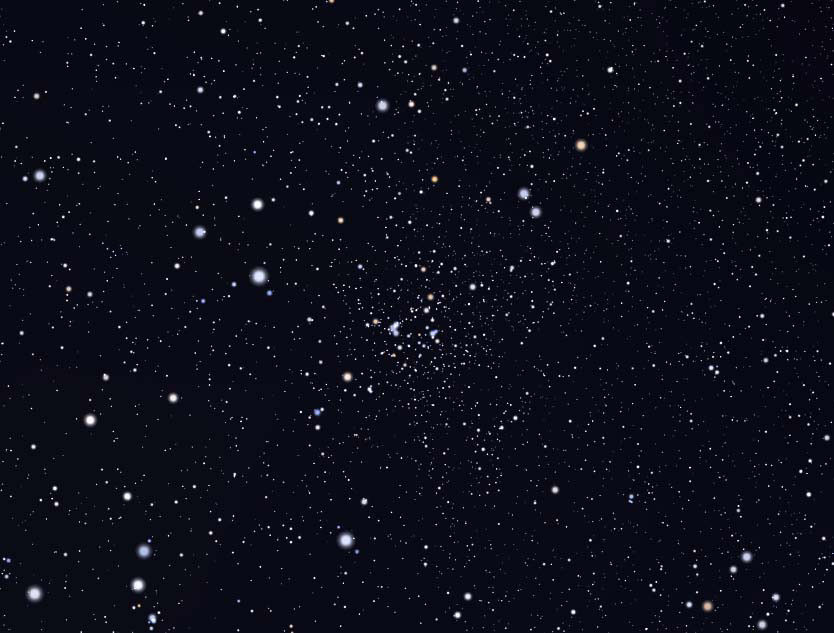
    The cluster NGC 6819, whose stars are about 2.5 billion years old. Astronomers have measured the rotation periods of thirty Sun-like stars in this cluster and used them to refine the calibrations used to infer a star’s age from its rotation period. Credit: Harvard-Smithsonian Center for Astrophysics

    Using the precise data from the Kepler exoplanet mission, astronomers from the Harvard-Smithsonian Center for Astrophysics have determined the rotation period measurements for 30 cool stars in the 2.5-billion-year-old stellar cluster NGC 6819.

    The mass of a star is perhaps its most significant feature. It determines how brightly it shines (a star ten times more massive than the Sun will, during its normal lifetime, shine about forty million times brighter than a star ten times less massive than the Sun), how long it will live (tens of millions of years versus tens of billions of years, respectively, for these two cases), and how it will eventually die (as a supernova or as slowly cooling clump of ashes). The next most significant property of a star is its age, which fixes its current character, the age of its planetary system, and the evolutionary state of its environment, and moreover which can be used to refine details in the theory of how stars evolve.

    Unfortunately, the ages of the most common stars – the modest mass, cool stars like the Sun, and smaller – are difficult to obtain. Traditional dating methods use stellar properties that either change very little as the stars age or else are hard to determine. Rotation provides an important alternative. Stars rotate (the Sun rotates once approximately every 26 days), and astronomers know that the rotation rate of a cool star decreases with time. Rotation can provide a reliable determinant of stellar age if it can be properly calibrated, in particular across a range of stellar masses. Stars in clusters make perfect reference objects because they all apparently have a similar age. Such age calibrations have indeed, been done, but so far only for stars in clusters less than about one billion years old, not older. This is in part because young stars lose their spin very rapidly as they age, primarily via magnetically powered winds that carry away angular momentum, and after about 600 million years there is a well-defined mass-rotation relationship. The Hyades cluster of stars is about this age, and it has been used to fix the rotation parameters for this young age group. At the older end of the calibration sequence the Sun, at 4.6 billion years, has a well known rotation period. What has been missing is accurate rotation information for the ages in between.

    CfA astronomers Soren Meibom and Dave Latham, along with four colleagues, have determined the rotation period measurements for 30 cool stars in the 2.5-billion-year-old stellar cluster NGC 6819. They used the precise data from the Kepler exoplanet mission to monitor cool stars in this cluster, supplemented by ground-based and other datasets. They find a well-defined relationship between rotation period and stellar mass, and make the case that stellar ages can now be determined with a precision of order 10% for large numbers of cool Galactic field stars. This important new age-dating calibration will enable astronomers to study how astrophysical phenomena involving cool stars evolve over time, and will be important to a wide range of research from the Galactic scale down to the scale of individual stars and their companions.

    Reference: “A Spin-Down Clock for Cool Stars from Observations of a 2.5-Billion-Year-Old Cluster” by Søren Meibom, Sydney A. Barnes, Imants Platais, Ronald L. Gilliland, David W. Latham and Robert D. Mathieu, 5 January 2015, Nature.
    DOI: 10.1038/nature14118

    Never miss a breakthrough: Join the SciTechDaily newsletter.
    Follow us on Google and Google News.

    Astronomy Astrophysics Cosmology Harvard-Smithsonian Center for Astrophysics Popular
    Share. Facebook Twitter Pinterest LinkedIn Email Reddit

    Related Articles

    Webb’s Mysterious “Little Red Dots” May Be the Cradle of the First Black Holes

    Astronomers Reveal a Planet Forming in an Earth-Like Orbit Around Young Star TW Hydrae

    Astronomers Show Magnetic Field is Critical for Life

    New Research Shows LIGO’s Twin Black Holes Might Have Been Born Inside a Single Star

    Preliminary Reference Earth Model Shows Earth-like Planets Have Earth-like Interiors

    Scientists Believe Globular Clusters Could Nurture Interstellar Civilizations

    Astronomers Conclude That Fewer Than 1% of Stars Have a MMSN Disk

    The Changing Frequency of Galaxy Collisions

    A Deficit of Ultra-Luminous X-Ray Sources in Starburst Galaxies

    Leave A Reply Cancel Reply

    • Facebook
    • Twitter
    • Pinterest
    • YouTube

    Don't Miss a Discovery

    Subscribe for the Latest in Science & Tech!

    Trending News

    New “Nanozyme Hypothesis” Could Rewrite the Story of Life’s Origins

    Anatomy Isn’t Finished: The Human Body Still Holds Secrets

    “Pretty Close to Home”: The Hidden Earthquake Threat Beneath Seattle

    The Surprising Reason You Might Want To Sleep Without a Pillow

    Scientists Say This Natural Hormone Reverses Obesity by Targeting the Brain

    35-Million-Year-Old Mystery: Strange Arachnid Discovered Preserved in Amber

    Is AI Really Just a Tool? It Could Be Altering How You See Reality

    JWST Reveals a “Forbidden” Planet With a Baffling Composition

    Follow SciTechDaily
    • Facebook
    • Twitter
    • YouTube
    • Pinterest
    • Newsletter
    • RSS
    SciTech News
    • Biology News
    • Chemistry News
    • Earth News
    • Health News
    • Physics News
    • Science News
    • Space News
    • Technology News
    Recent Posts
    • Saturn’s Magnetic Shield Isn’t What Scientists Expected
    • Hidden Oceans of Magma Could Be Protecting Alien Life
    • After Decades of Searching, Astronomers Finally Track Down the Universe’s Missing Hydrogen
    • Scientists Capture Hidden Electron Patterns Inside Quantum Materials
    • New Study Challenges Alzheimer’s Theories: It’s Not Just About Plaques
    Copyright © 1998 - 2026 SciTechDaily. All Rights Reserved.
    • Science News
    • About
    • Contact
    • Editorial Board
    • Privacy Policy
    • Terms of Use

    Type above and press Enter to search. Press Esc to cancel.