
Close Menu
    Facebook X (Twitter) Instagram
    SciTechDaily
    • Biology
    • Chemistry
    • Earth
    • Health
    • Physics
    • Science
    • Space
    • Technology
    Facebook X (Twitter) Pinterest YouTube RSS
    SciTechDaily
    Home»Physics»Charge-Density-Wave Induced Electronic Nematicity in Kagome Superconductor
    Physics

    Charge-Density-Wave Induced Electronic Nematicity in Kagome Superconductor

    By University of Science and Technology of ChinaMarch 1, 2022No Comments2 Mins Read
    Facebook Twitter Pinterest Telegram LinkedIn WhatsApp Email Reddit
    Share
    Facebook Twitter LinkedIn Pinterest Telegram Email Reddit
    Superconductivity in Kagome State
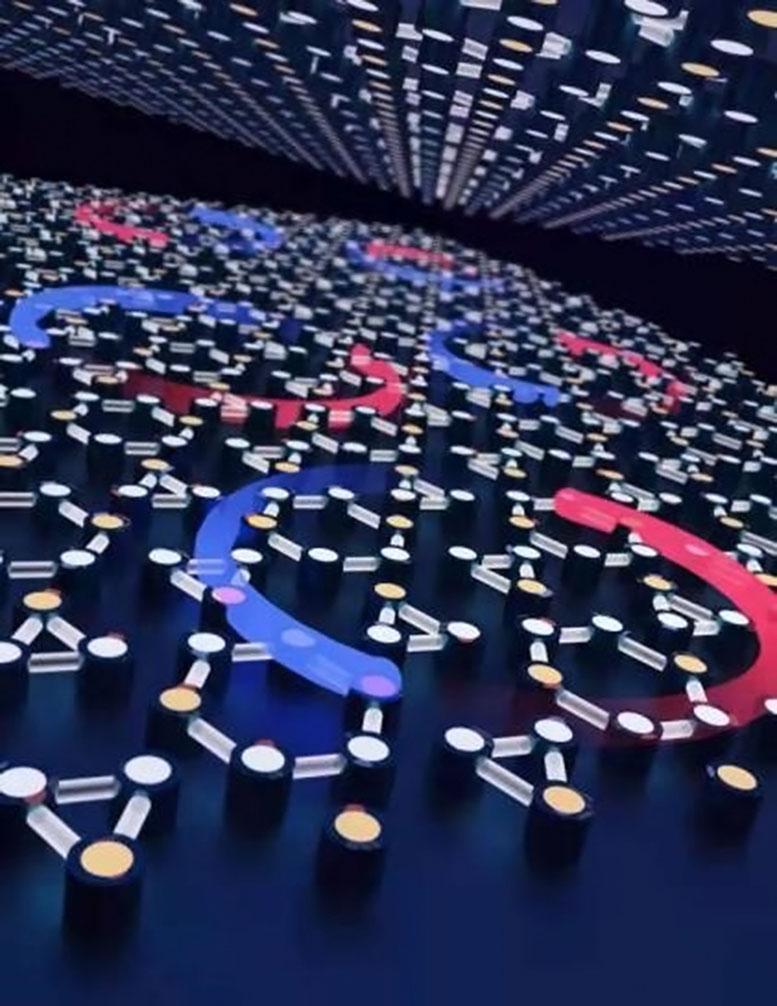
    Superconductivity in kagome state caused by triple-Q CDW order. Credit: Image by NIE Linpeng’s team

    Chinese researchers have discovered a phase transition in the kagome superconductor CsV3Sb5, where a charge-density-wave state transitions into a Potts nematic phase. This novel Z3 symmetry phase may help better understand the relationship between superconductivity and charge-density-wave (CDW) order.

    In a recent article published in Nature, a research team led by Prof. CHEN Xianhui, WU Tao and WANG Zhenyu from the University of Science and Technology of China (USTC) of the Chinese Academy of Sciences found the key evidence for phase transition in a kagome superconductor CsV3Sb5. At a low temperature, the team observed a transition from charge-density-wave (CDW) order to electronic nematicity which was firstly described by a three-state Potts model.

    On the heels of the team’s previous research on triple-Q modulation of kagome superconductors and the unusual competition between superconductivity and charge-density-wave order, the team made another progress in discovering new states of electronic nematicities. They discovered that the triple-Q charge density wave state would evolve into a thermodynamically stable electron nematic phase before entering the superconducting state. They also managed to determine the transition temperature to be 35 Kelvin.

    It is noteworthy that the electronic nematicity the team recently found was disparate from the nematicity in high-temperature superconductors (HTS). The electronic nematicity in HTS is the Ising type with Z2 symmetry; in contrast, the nematic phase found in CsV3Sb5 had Z3 symmetry. This particular state is theoretically described by the three-state Potts model, thus it is also called Potts nematic phase. Interestingly, this novel nematicity was also observed recently in bilayer corner graphene system.

    The discovery of this phase transition not only demonstrated a novel electronic nematicity, but provided fundamental experimental evidence for further understanding of the competition between superconductivity and CDW order in kagome systems. Besides, the findings also cast new light on the understanding of pair density wave (PDW) state in HTS.

    Reference: “Charge-density-wave-driven electronic nematicity in a kagome superconductor” by Linpeng Nie, Kuanglv Sun, Wanru Ma, Dianwu Song, Lixuan Zheng, Zuowei Liang, Ping Wu, Fanghang Yu, Jian Li, Min Shan, Dan Zhao, Shunjiao Li, Baolei Kang, Zhimian Wu, Yanbing Zhou, Kai Liu, Ziji Xiang, Jianjun Ying, Zhenyu Wang, Tao Wu and Xianhui Chen, 9 February 2022, Nature.
    DOI: 10.1038/s41586-022-04493-8

    Never miss a breakthrough: Join the SciTechDaily newsletter.
    Follow us on Google and Google News.

    Nematicity Superconductor University of Science and Technology of China
    Share. Facebook Twitter Pinterest LinkedIn Email Reddit

    Related Articles

    Atomic Scale Imaging of Magnetic Structures

    Physicists Identify the Origin of Superconductivity in High-Temperature Superconductors

    New Magnetic Phase in Iron-Based Superconductors Discovered

    Researchers Entangle Two Independent Photons with Different Frequencies

    New Insights Into How Superconducting Materials Interact With Magnetic Ones

    Iron-Based HTS Shows Unexpected Electronic Asymmetry

    Experimental Evidence Shows Iron-Based Superconductors Exhibit S-Wave Symmetry

    Iron-Based Crystal Superconductor Breaks High-Temperature Record

    ‘Collapsing’ Iron Superconductor Capable of Operating at 47 Degrees Kelvin

    Leave A Reply Cancel Reply

    • Facebook
    • Twitter
    • Pinterest
    • YouTube

    Don't Miss a Discovery

    Subscribe for the Latest in Science & Tech!

    Trending News

    Scientists Discover How Coffee Impacts Memory, Mood, and Gut Health

    Why Did the Neanderthals Disappear? Scientists Reveal Humans Had a Hidden Advantage

    Physicists Propose Strange Experiment Where Time Goes Quantum

    Magnesium Magic: New Drug Melts Fat Even on a High-Fat, High-Sugar Diet

    Weight-Loss Drugs Like Ozempic May Come With an Unexpected Cost

    Mezcal “Worm” in a Bottle Mystery: DNA Testing Reveals a Surprise

    New Research Reveals That Your Morning Coffee Activates an Ancient Longevity Switch

    This Is What Makes You Irresistible to Mosquitoes

    Follow SciTechDaily
    • Facebook
    • Twitter
    • YouTube
    • Pinterest
    • Newsletter
    • RSS
    SciTech News
    • Biology News
    • Chemistry News
    • Earth News
    • Health News
    • Physics News
    • Science News
    • Space News
    • Technology News
    Recent Posts
    • Harvard Scientists Reveal Secret Structure Behind How You Smell
    • Scientists Just Discovered the Hidden Trick That Keeps Your Cells Alive
    • This Simple Movement Could Be Secretly Cleaning Your Brain
    • Male Birth Control Breakthrough: Scientists Find Way To Turn Sperm Production Off and Back On
    • A Common Vitamin Could Hold the Key to Treating Fatty Liver Disease
    Copyright © 1998 - 2026 SciTechDaily. All Rights Reserved.
    • Science News
    • About
    • Contact
    • Editorial Board
    • Privacy Policy
    • Terms of Use

    Type above and press Enter to search. Press Esc to cancel.