
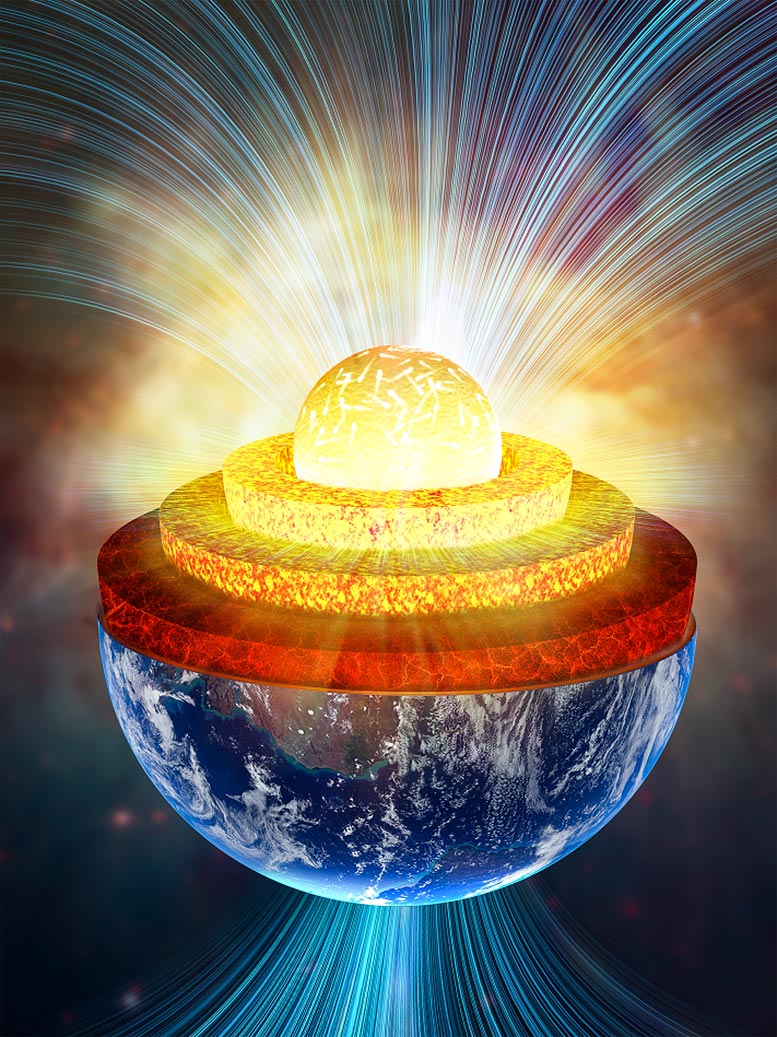
The inner core of Earth is in a superionic state, where light elements move like a liquid within a solid iron lattice. This discovery explains the core’s softness and low shear wave velocity.
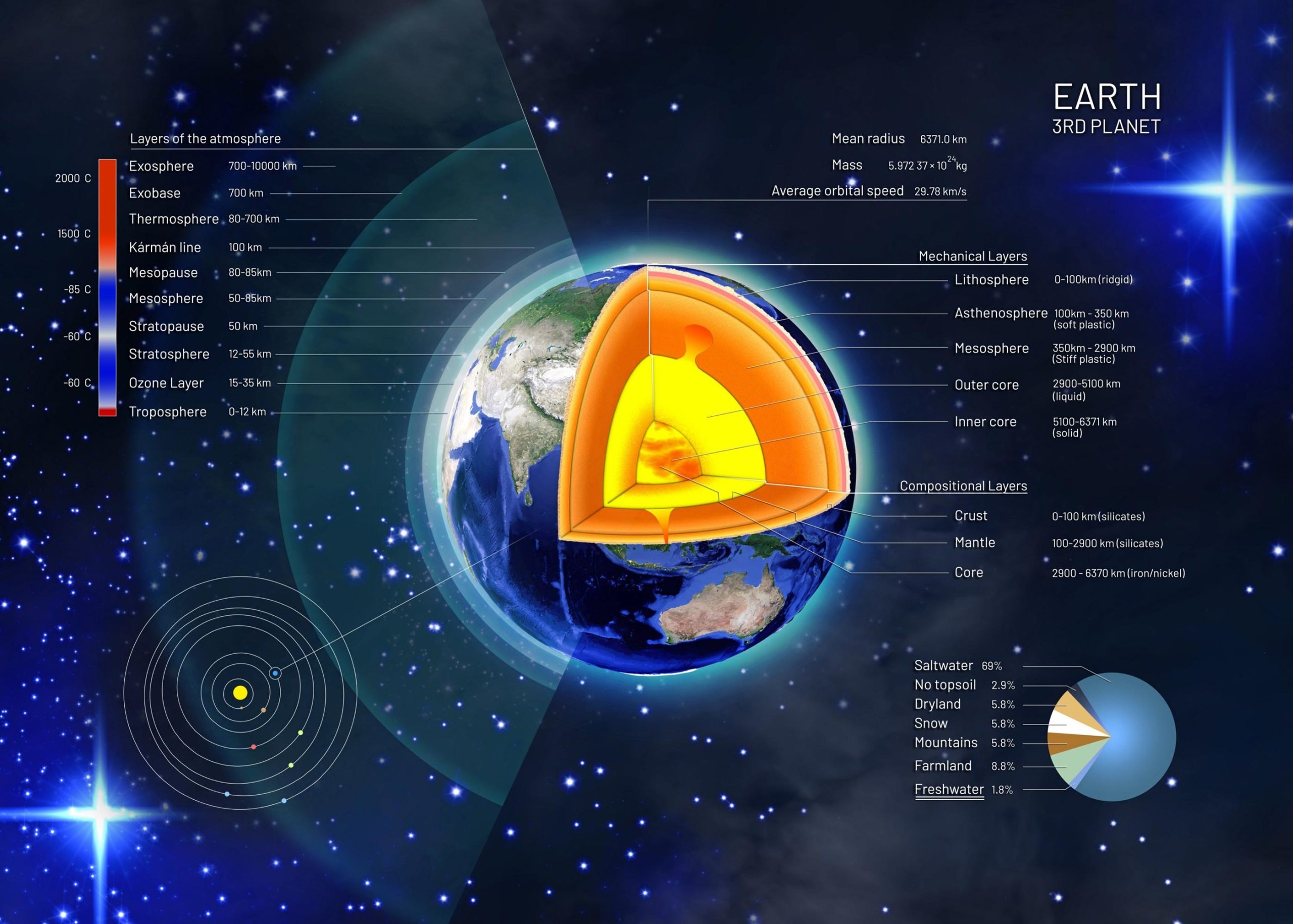
Earth’s core, the deepest part of our planet, is characterized by extremely high pressure and temperature. It is composed of a liquid outer core and solid inner core.
The inner core is formed and grows due to the solidification of liquid iron at the inner core boundary. The inner core is less dense than pure iron, and some light elements are believed to be present in the inner core.
Superionic State in Earth’s Inner Core
A joint research team led by Prof. Yu He from the Institute of Geochemistry of the Chinese Academy of Sciences (IGCAS) has found that the inner core of the Earth is not a normal solid but is composed of a solid iron sublattice and liquid-like light elements, which is also known as a superionic state. The liquid-like light elements are highly diffusive in iron sublattices under inner core conditions.
This study will be published in the journal Nature today (February 9, 2022).
A superionic state, which is an intermediate state between solid and liquid, widely exists in the interior of planets. Using high-pressure and high-temperature computational simulations based on quantum mechanics theory, researchers from IGCAS and the Center for High Pressure Science & Technology Advanced Research (HPSTAR) found that some Fe-H, Fe-C, and Fe-O alloys transformed into a superionic state under inner core conditions.
In superionic iron alloys, light elements become disordered and diffuse like a liquid in the lattice, while iron atoms remain ordered and vibrate about their lattice grid, forming the solid iron framework. The diffusion coefficients of C, H, and O in superionic iron alloys are the same as those in liquid Fe.
“It is quite abnormal. The solidification of iron at the inner core boundary does not change the mobility of these light elements, and the convection of light elements is continuous in the inner core,” said Prof. Yu He, the first and corresponding author of the study.
Seismic Velocities and Core Softness
One longstanding mystery about the inner core is that it is quite soft, with quite a low shear wave velocity. The researchers calculated the seismic velocities in these superionic iron alloys and found a significant decrease in shear wave velocity. “Our results fit well with seismological observations. It is the liquid-like elements that make the inner core soften,” said co-first author SUN Shichuan from IGCAS.
Highly diffusive light elements may influence seismic velocities, offering important clues to other mysteries in the deep core. The superionic model may explain the anisotropic structure, seismic wave attenuations, and structural changes of the inner core during the previous decades by examining the distribution and convection of these liquid-like materials in the inner core.
Reference: “Superionic iron alloys and their seismic velocities in Earth’s inner core” by Yu He, Shichuan Sun, Duck Young Kim, Bo Gyu Jang, Heping Li and Ho-kwang Mao, 9 February 2022, Nature.
DOI: 10.1038/s41586-021-04361-x
Never miss a breakthrough: Join the SciTechDaily newsletter.
Follow us on Google and Google News.
11 Comments
The biggest illusion is that celestial body have sharp layers and several distinct boundaries.
There isn’t much proof of that.
Interesting.
Here are some Thoughts for Consideration.
Cetris Paribus- Temperature and Pressure Conditions not considered
1. From Element number 1 (Hydrogen- Atomic Mass 1) to element number 26 (Iron Atomic Mass -55,85), the Periodic Table appears to behave differently than from Element number 27 (Cobalt – Atomic Mass 58.93) onwards. The heavy metals on fission produce Cobalt 60, a highly radioactive element.
2. The Composition of the Planet Earth is mostly Silicon (Element No. 14 with an atomic mass of 28.09) , which is just below Carbon (Element No. 6 with atomic Mass 12.01) , which is in Column 14 of the Periodic Table. Most of the other metallic elements are extracted from Minerals.
3. I understand that we have managed to dig a hole of about 7 miles and can physically examine the composition of the Planet and determine its properties and likely composition of the Earths Mantle, till that level accurately using that data.
4.Volcanoes spew out molten Lava and other material material from the lower layers beneath the earths mantle and can give us an idea of what below the same. So also Earthquakes , which also produce Fractal Patterns. No sure what data is being captured by the Satellites , which can help prvent devastating Earth Quakes and Tsunamis we experience .
5. Prognastications about about an Iron Core surrounded by multiple liquid layers of molten lava and a slurry of varying viscosity needs to be proved conclusively. Not sure about the ability and use of various forms of energy like sound (Seismic waves) , light (from IR to UV) and electromagnetic radiation to get feedback and data, on what actually exists in the depths of the Earth and the data obtained and what conclusions have been reached by Geologists based on such data.
6. The greater the accuracy of the data collected on a baseline planet like Earth about a rocky planet like Earth, the more likely is it to find others in the universe which are similar. Reports that WEBB Telescope can analyse atmospheres a long long distance away is interesting.
Views expressed are personal and not binding on anyone.
Further to above.
Phase Transitions of the composition of the Planet is extremely complex, when we dont even know the composition of the various layers. The Simulations findings need to be verified by experiments in a lab by replicating the Pressure and Temperature Conditions which exist at the core and a soild iron core.
Superionic Alloys of Iron and other Metallic Elements at the Core of Planets other than Earth if accurate, can be a game changer in oour understanding of Rocky Planets like Mars and others in distant stars.
Is this study implying that elements we know to be gaseous at surface atmospheric pressures and temperatures are more a liquid metallic form at the earth’s core? And thus more soluable into heavier elements,such as iron or lead for instance. This seems practical to me, but maybe I’m way off mark. Is the core of a star exploding the only way to develop some of these elements? Or can they be produced from planetary cores if the chemistry and mass provides?
Why would the core of our planet, that has the energy to spew liquid rock 4,000 miles away, be a highly entropic solid? How does a solid generate that kind of energy?
The core of our planet is going to possess an extreme amount of energy and minimum entropy matter is going to be in the plasma state. This plasma isn’t fusion which scientists can’t even create to sustain itself. It is called quark plasma which utilizes the strong force between quarks to exist. The catalyst for this reaction is something that the universe has an unlimited supply of which is the pressure of the dark matter of space. Our universe consists of an extremely pressurized field of electron neutrinos. Once the quarks have been separated by a sufficient enough collision, it is the pressure of space that keeps them apart indefinitely. Space comes into the reaction to keep the quarks apart and, consequently, are thrown out of the reaction as gamma rays. This is what black holes are made of. Our planet began its life in this state if matter. Quark plasma uses the electron neutrinos of space to eventually form neutrons on the surface to create the first light the mass will exude. The neutrons break down to the first hydrogen atoms and then the constantly forming neutrons fuse with the hydrogen to form the first helium atoms using the beta minus decay reaction. This process continues creating heavier and heavier elements making the star darker and darker until the light is extinguished and a surface forms. All the while, the quark plasma underneath continues unimpeded because the catalyst of space flows through normal matter unimpeded attacking the reaction underneath the surface. That is why the energy in our universe seems so timeless.
Why don’t I see my comment? I don’t get it. Why is science so infatuated with anything that actually explains our universe? The core of this planet is NOT a sphere of iron. What can that do?
No wonder the theory of everything is so hard to find. The big bang THEORY is a total FACT. Science is not interested in finding the truth.
Ridiculous
And just how do we know all of this, this is speculation at best.i mean let’s face it people, 200 plus years ago we knew that the 3arth was flat.you have all of this “the inner makes of celestial bodies (including our own) is composed of this and that,
.” I say prove it or al least add that these are all unproved theories, at best. What is the deepest mankind has ever drilled into our own planet? I’m pretty sure the soviets drilled a hole some sevenish kilometres deep and with a diameter of somewhere around 250mm – 300mm.and thad does not mean that this is the same composition world wide.
Come on people at least admit that we don’t know what earth’s core or surrounding layers are made from.or even the age of our planet.
Pure speculation and estimation.
Without solid tangible proof it’s only a theory an educated guess at best if you will.
If you disagree with the scientists, go do your own science; produce something original and publish it, putting it up for review, in scholarly periodicals! Otherwise, read, try to understand, and stay out of the way!!
There is no proof for anything…all of this is speculation and theory.
This topic really brought out all the crazies to this comment section. Just because we can’t actually go into the earth doesn’t mean we can’t measure any data from there, specifically seismic data, and correlate it back to experiments completed up here under laboratory conditions that match the inner earth, or in simulations, like what this article discusses. Just because you can’t grasp the concepts being discussed, doesn’t mean that others can’t.