
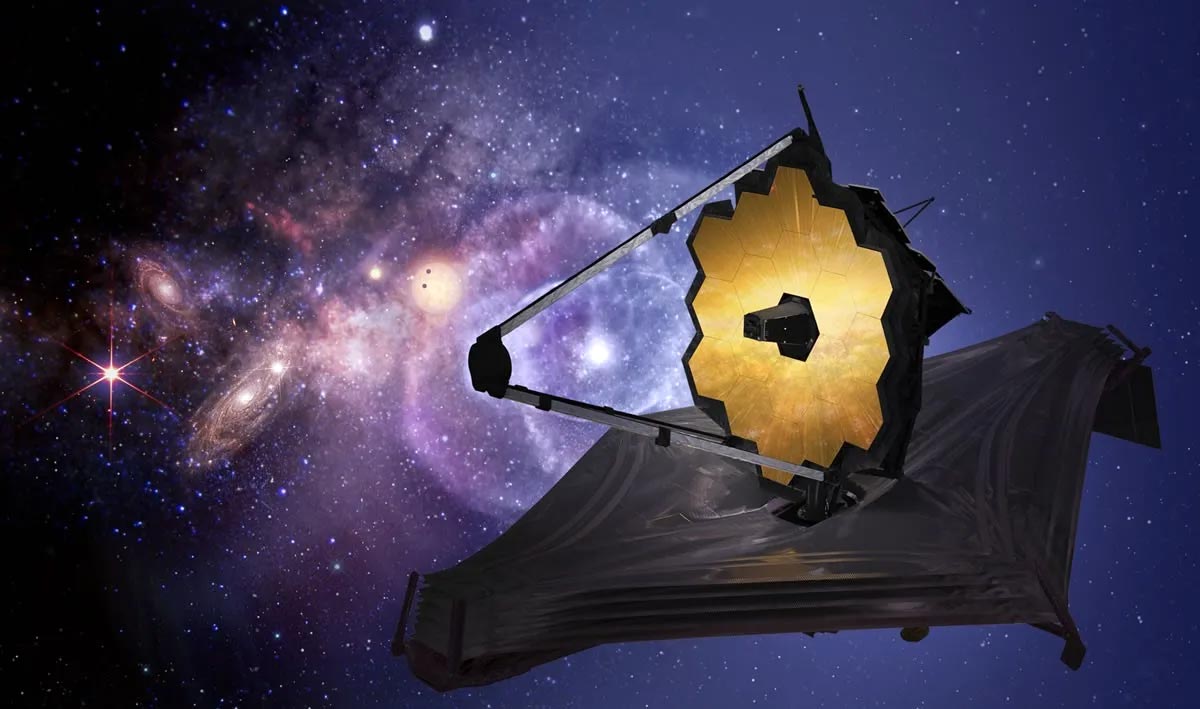
New observations from the James Webb Space Telescope have revealed unexpected features in the early universe, including unusually bright galaxies, rapidly forming black holes, and compact objects that defy conventional explanations.
A new study led by Colgate Assistant Professor of Physics and Astronomy Cosmin Ilie, working with Jillian Paulin of the University of Pennsylvania, Andreea Petric of the Space Telescope Science Institute, and Katherine Freese of the University of Texas at Austin, brings together solutions to three major mysteries from the cosmic dawn.
The research outlines how hypothetical objects known as dark stars could account for the surprising appearance of “blue monster” galaxies, the high number of massive black hole galaxies seen at very early times, and the unusual “little red dots” detected in observations from the James Webb Space Telescope (JWST).
According to current theory, the universe’s first stars formed in regions dominated by dark matter, specifically within the dense centers of dark matter microhalos. A few hundred million years after the Big Bang, clouds made primarily of hydrogen and helium cooled enough to collapse under their own gravity, setting the stage for the birth of the first stellar objects.
This transition marked the start of the cosmic dawn, an era when conditions may have allowed for a different type of star to emerge. These stars, known as dark stars, would be powered by energy from dark matter annihilations rather than nuclear fusion alone. Over time, such objects could grow to enormous sizes and naturally evolve into the seeds of supermassive black holes.
JWST Discoveries Challenge Existing Models
The James Webb Space Telescope (JWST) has now pushed observations farther back in time than ever before, revealing objects that strain traditional ideas about how the first stars and galaxies formed. Among its most surprising findings is a large population of distant galaxies classified as “blue monsters,” meaning they are exceptionally bright, extremely compact, and largely free of dust.
Their presence was not anticipated, as simulations and theoretical models developed before JWST did not predict galaxies with these properties in the early universe.
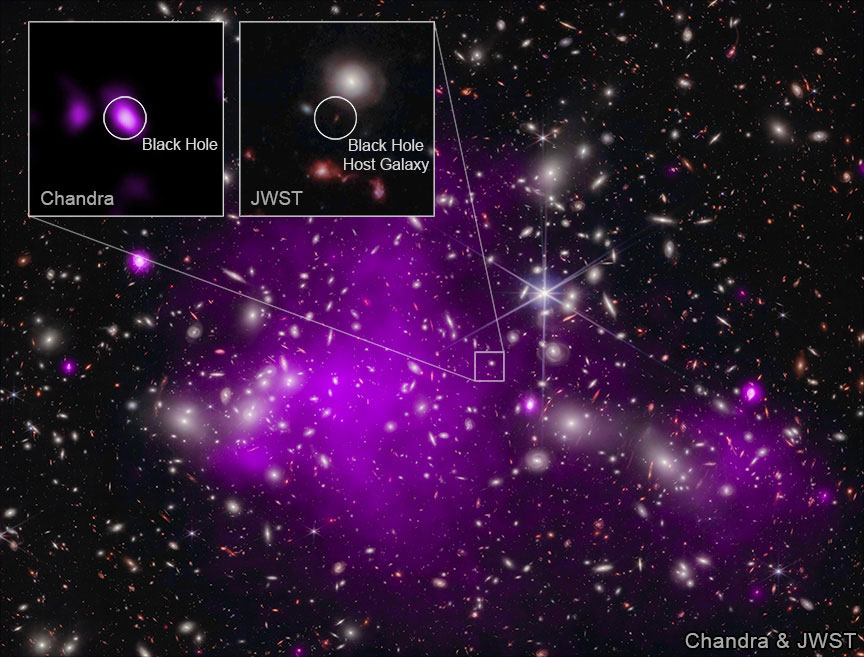
Moreover, the JWST data further exacerbate the problem of the seeds for larger-than-expected supermassive black holes (SMBHs) powering the most distant quasars ever observed. Lastly, JWST has observed a whole new class of objects, including “little red dots” (LRDs), which are very compact, dustless cosmic dawn sources which unexpectedly emit little to no X-ray radiation.
Those three puzzles, combined, indicate that the commonly accepted pre-JWST models for the formation of the first galaxies and first supermassive black holes require significant refinements.
Dark Stars as a Unifying Explanation
“Some of the most significant mysteries posed by the JWST’s cosmic dawn data are in fact features of the dark star theory,” Ilie said.
While dark stars are yet to be confirmed experimentally, this recent publication adds a significant piece to the existing evidence: photometric and spectroscopic candidates, which were discovered in two separate PNAS studies published in 2023 and 2025, respectively.
In addition to discussing in-depth mechanisms via which dark stars could provide solutions to the mysteries posed by the blue monsters, little red dots, and overmassive black hole galaxies, this work also presents the most up-to-date spectroscopic analysis, finding evidence for dark star smoking-gun absorption features due to helium in the spectra of JADES-GS-13-0, in addition to the one previously found for JADES-GS-14-0.
Dark stars are some of the most exciting astrophysical objects to possibly exist, as their study would allow for a determination of the physical properties of the dark matter particle, and thus complement the vast experimental efforts for the detection of dark matter in laboratories on Earth, via direct detection or particle production.
Reference: “Supermassive Dark Stars and Their Remnants as a Possible Solution to Three Recent Cosmic Dawn Puzzles” by Cosmin Ilie, Jillian Paulin, Andreea Petric and Katherine Freese, 18 December 2025, Universe.
DOI: 10.3390/universe12010001
Funding: U.S. Department of Energy, Space Telescope Science Institute, Swedish Research Council, Colgate University Research Council and Picker Interdisciplinary Science Institute
Never miss a breakthrough: Join the SciTechDaily newsletter.
Follow us on Google and Google News.
1 Comment
In past postings I’ve shared my model of gravity applying that to how it negates the need for any dark matter or dark energy; rotation/spin rules. It’s all right here in our own back yard. For one example of a cheaply and easily replicated experiment that demonstrates invisible forces at work, I invite all to view my most recent (June, 2025) gravity/inertia experiment/demonstration on my non-economic ad-free video channel; please share, some people still need to know: https://odysee.com/@charlesgshaver:d/5Gravity:c“