
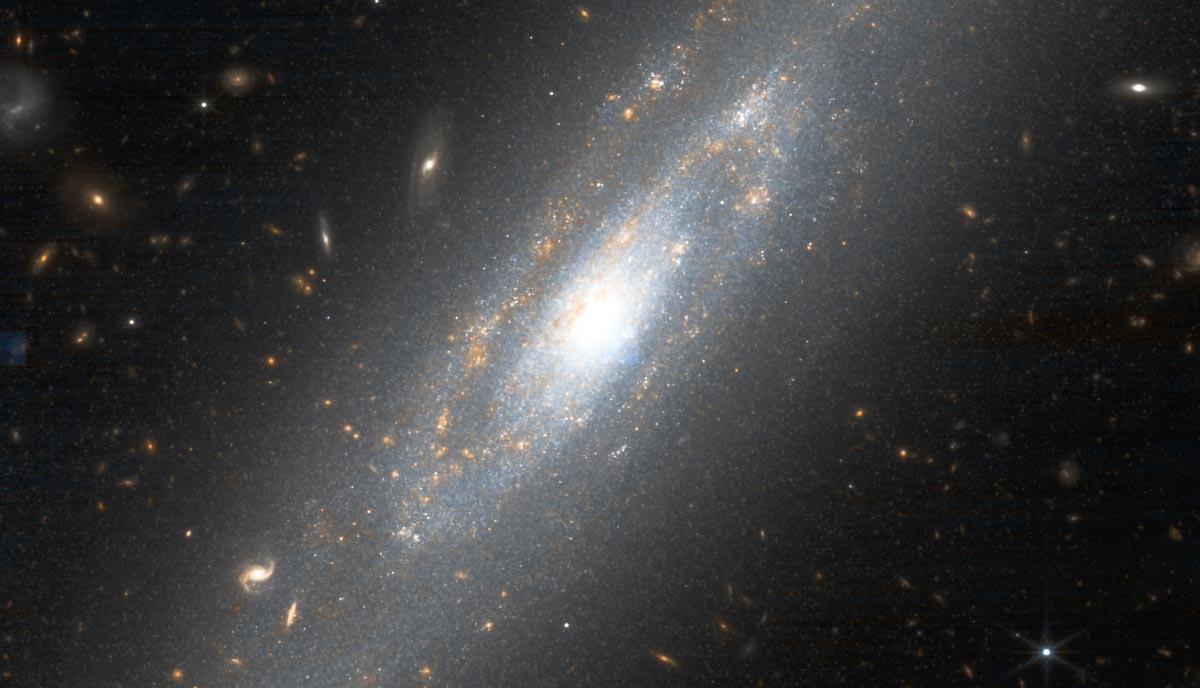
A University of Chicago-led analysis measuring the universe expansion rate, finds there may not be a ‘Hubble tension’.
The “crisis in cosmology,” sparked by differing measurements of the universe’s expansion, may be nearing a resolution thanks to the James Webb Space Telescope. New data analyzed by scientists suggests that the Hubble tension might not be as severe as previously thought. This could mean our current model of the universe remains accurate.
The Debate on the Universe’s Expansion Rate
We know many things about our universe, but astronomers are still debating exactly how fast it is expanding. In fact, over the past two decades, two major ways to measure this number — known as the “Hubble constant” — have come up with different answers, leading some to wonder if there was something missing from our model of how the universe works.
New Insights From the James Webb Space Telescope
But new measurements from the powerful James Webb Space Telescope seem to suggest that there may not be a conflict, also known as the ‘Hubble tension,’ after all.
In a paper submitted to the Astrophysical Journal, University of Chicago cosmologist Wendy Freedman and her colleagues analyzed new data taken by NASA’s powerful James Webb Space Telescope. They measured the distance to ten nearby galaxies and measured a new value for the rate at which the universe is expanding at the present time.
Their measurement, 70 kilometers per second per megaparsec, overlaps the other major method for the Hubble constant.
“Based on these new JWST data and using three independent methods, we do not find strong evidence for a Hubble tension,” said Freedman, a renowned astronomer and the John and Marion Sullivan University Professor in Astronomy and Astrophysics at the University of Chicago. “To the contrary, it looks like our standard cosmological model for explaining the evolution of the universe is holding up.”
Hubble Tension?
We have known the universe is expanding over time ever since 1929, when UChicago alum Edwin Hubble (SB 1910, PhD 1917) made measurements of stars that indicated the most distant galaxies were moving away from the Earth faster than nearby galaxies. But it has been surprisingly difficult to pin down the exact number for how fast the universe is expanding at the current time.
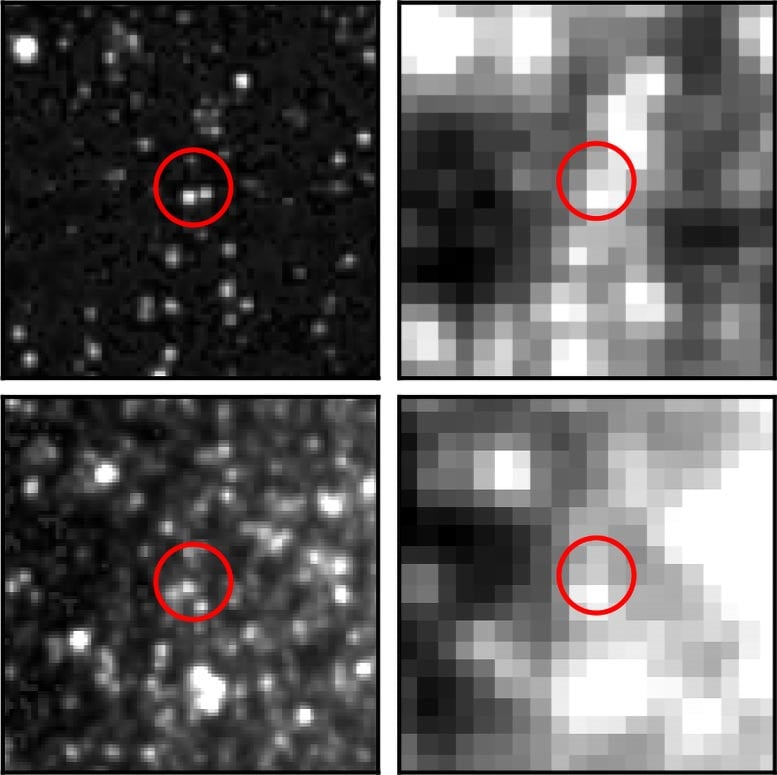
This number, known as the Hubble constant, is essential for understanding the backstory of the universe. It’s a key part of our model of how the universe is evolving over time.
“Confirming the reality of the Hubble constant tension would have significant consequences for both fundamental physics and modern cosmology,” explained Freedman.
Different Approaches to Measurement
Given the importance and also the difficulty in making these measurements, scientists test them with different methods to make sure they’re as accurate as possible.
One major approach involves studying the remnant light from the aftermath of the Big Bang, known as the cosmic microwave background. The current best estimate of the Hubble constant with this method, which is very precise, is 67.4 kilometers per second per megaparsec.
The second major method, which Freedman specializes in, is to measure the expansion of galaxies in our local cosmic neighborhood directly, using stars whose brightnesses are known. Just as car lights look fainter when they are far away, at greater and greater distances, the stars appear fainter and fainter. Measuring the distances and the speed at which the galaxies are moving away from us then tells us how fast the universe is expanding.
In the past, measurements with this method returned a higher number for the Hubble constant—closer to 74 kilometers per second per megaparsec.
The Puzzle of Hubble Tension
This difference is large enough that some scientists speculate that something significant might be missing from our standard model of the universe’s evolution. For example, since one method looks at the earliest days of the universe and the other looks at the current epoch, perhaps something large changed in the universe over time. This apparent mismatch has become known as the ‘Hubble tension.’
Enter the James Webb Space Telescope
The James Webb Space Telescope or JWST, offers humanity a powerful new tool to see deep into space. Launched in 2021, the successor to the Hubble Telescope has taken stunningly sharp images, revealed new aspects of faraway worlds, and collected unprecedented data, opening new windows on the universe.
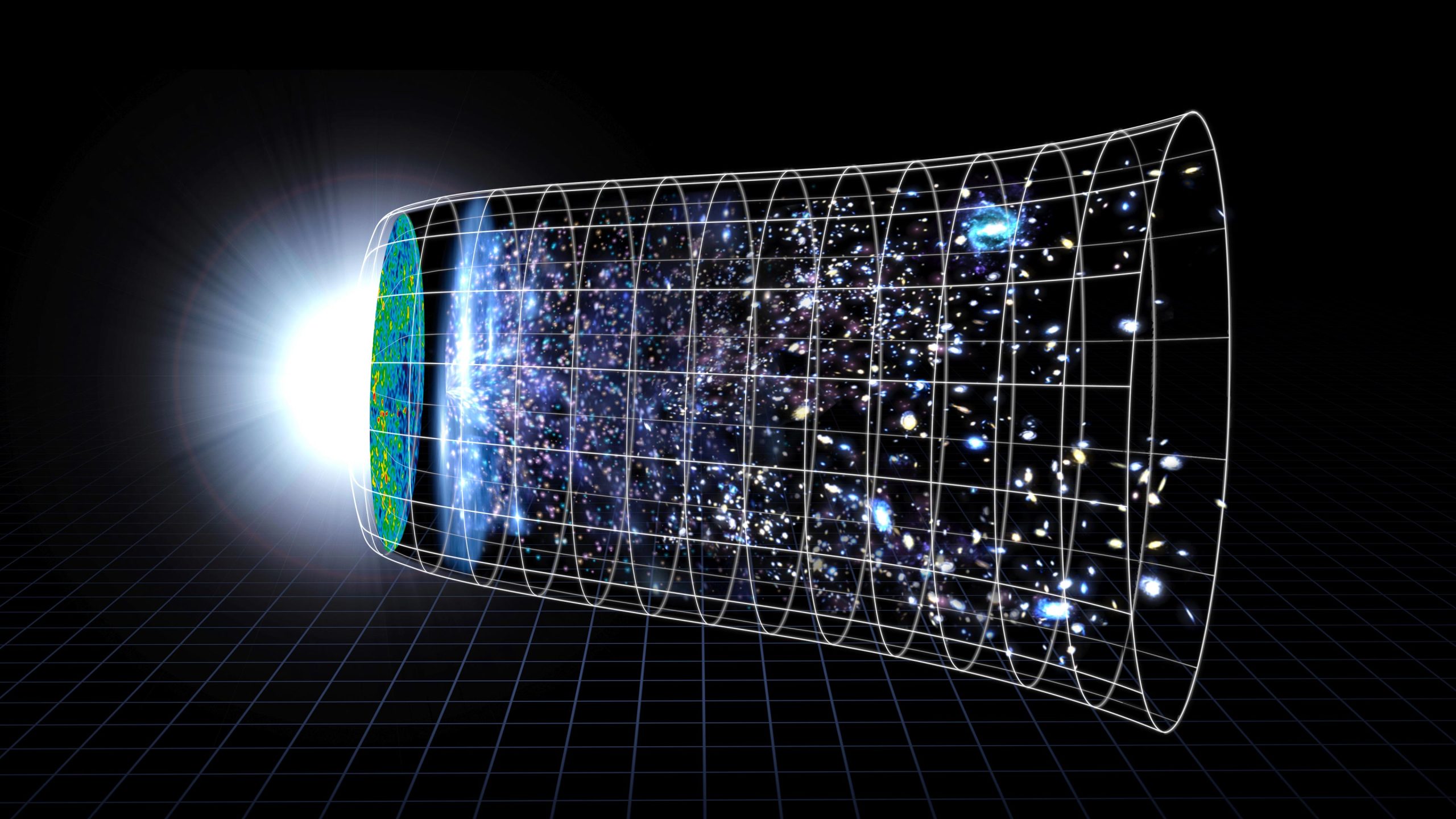
Freedman and her colleagues used the telescope to make measurements of ten nearby galaxies that provide a foundation for the measurement of the universe’s expansion rate.
To cross-check their results, they used three independent methods. The first uses a type of star known as a Cepheid variable star, which varies predictably in its brightness over time. The second method is known as the “Tip of the Red Giant Branch,” and uses the fact that low-mass stars reach a fixed upper limit to their brightnesses. The third, and newest, method employs a type of star called carbon stars, which have consistent colors and brightnesses in the near-infrared spectrum of light. The new analysis is the first to use all three methods simultaneously, within the same galaxies.
Reassessing the Hubble Constant
In each case, the values were within the margin of error for the value given by the cosmic microwave background method of 67.4 kilometers per second per megaparsec.
“Getting good agreement from three completely different types of stars, to us, is a strong indicator that we’re on the right track,” said Freedman.
The Hubble constant is essential for understanding the backstory of the universe.
“Future observations with JWST will be critical for confirming or refuting the Hubble tension and assessing the implications for cosmology,” said study co-author Barry Madore of the Carnegie Institution for Science and visiting faculty at the University of Chicago.
Reference: “Status Report on the Chicago-Carnegie Hubble Program (CCHP): Three Independent Astrophysical Determinations of the Hubble Constant Using the James Webb Space Telescope” by Wendy L. Freedman, Barry F. Madore, In Sung Jang, Taylor J. Hoyt, Abigail J. Lee and Kayla A. Owens, 12 August 2024, Astrophysics > Cosmology and Nongalactic Astrophysics.
arXiv:2408.06153
The other authors on the paper were UChicago research scientist In Sung Jang, Taylor Hoyt (PhD’22, now at Lawrence Berkeley National Laboratory), and UChicago graduate students Kayla Owens and Abby Lee.
Funding: NASA.
Never miss a breakthrough: Join the SciTechDaily newsletter.
Follow us on Google and Google News.
26 Comments
Of course it’s not constant. The rate expansion is dependent on where you look. Gravitational forces are not equal in all directions, so neither is the rate of expansion.
In an explosion on Earth, do all the fragments fall in the same distance all around? No, some go farther than others. Heavier items fall first then some of the lightest blow away in the wind.
The believe there is a ‘constant’ expansion rate all across the known Universe is truly ignorant.
Wow that was a bunch of ignorant bs
Please read up on a subject before you comment on it, and you probably wouldn’t sound so pathetically idiotic.
The space expansion that in the largest sense define “big bang” is not an “explosion”, the homogeneity and isotropy of the universe that we see, including in the cosmic background radiation, is too smooth by a factor 10^-5. (An explosion would expect to see as much inhomogeneity as the force of an explosion, plus it would unlike space expansion “expand into something”. Space expansion is just a scale stretch, see “Scale factor (cosmology)”, Wikipedia.)
On large scales gravity in the form of the dark energy-dark matter cosmology that constrain how space expansion forms the universe (see the Wikipedia article) is uniform of course, Why the universe is on average flat space, uniform and homogeneous is explained by the inflation era that happened before the hot big bang era, if nothing else. (See “Which Parts of the Big Bang Theory are Reliable, and Why?”, Matt Strassler. I can also recommend the youtube “Where do particles come from?”, Sixty Symbols, that explains the enormous space stretching and flattening involved in inflation.)
exactly maybe the direction you observe have different cosmological conditions and many constants be no so “constants”, maybe even the minimum critical mass limit for a star to become a black hole be not the same
in different parts of “this” universe, if you thing the space-time fabric with a specific “thickness” that have to be “broken” by mass accumulation to open a “hole” towards other physical dimensions (higher) maybe that elastic constant of that fabric be different in different parts of this universe, like a balloon with no homogenius thickness in its silicon walls depending which part of the balloon you measure, considering this non uniform “elastic” coefficient for the space-time fabric could open new windows and explain some weird observations
Your a Answer is in Genesis.
Nope. It’s in Alice in Wonderland. Both are equally valid sources of scientific information.
First, I wanted to mock you, but then I realized that you might be a well-meaning ignorant. In astrophysics the base assumption is – the rules of the universe are the same everywhere. If this assumption doesn’t stand, there is no point in studying space, because no matter what you observe, you can just shrug and say “oh, it’s just space being space… You know, higher dimensions and ectoplasmic discharges and whatnot.”
So no – we don’t resort to magic. We don’t resort to new age mumbo-jumbo. If you want to contribute to science, please read up. There are so many non-technical sources that explain many of these topics well. Learn to swim instead of peeing in the pool.
Much of my response to Mike Ganger applies here as well, the conditions and constants have been quantified and researched by experts (scientists) and you can peruse the material if you will. (Some easy starts are given in my response.) Mostly the universe is known to be on average flat space, homogeneous and isotropic, from a thermal equilibrium state that was attained in the inflation era before the universe reheating.
[And no, the Hubble rate is not “constant” even if the Hubble constant is taken as an observational “now” value – the meaning is clarified in “Scale factor (cosmology)”, Wikipedia. It is not that far from the future asymptote that the Hubble rate constant heads towards.]
Mainly I agree with the other responses to your comment, in science there is quantification but also the use of “think horses, not zebras” to arrive at accurate and robust descriptions. Whatever you are smoking, it isn’t good for your understanding of nature.
I see the qualifications required to leave a comment here are quite as rigorous as that which is required to have any expertise in cosmology LoL
All that Hubble showed was that the frequency of electromagnetic radiation changed systematically according to the distance of its source from the Earth. Once the frequency of light throughout time and/or distance is assumed then the “Big Bang” becomes an inevitable conclusion.
However, it is a rather strange conclusion, something coming from nothing when “nothing” could not exist at the time.
Your last sentence shows that you have no clue what you are talking about.
Pray; what went on before the “Big Bang”? A collapsing universe? A constantly reversible collapsing and inflating universe? Assorted dimensions, each containing universes next to each other but invisible to each other? A teeny-weeny subatomic-scale point of infinite density surrounded by nothing, whatever that “nothing” might have been? A quantum fluctuation in a vast “nothing” out of which universes pop at random (which carries the implication of why only this one universe we live in?)? Or simply what the priests tell us, “God did it”.
Please enlighten me in a few simple words a non-astrophysicist can understand. Teach; neither sneer nor mock.
“Something from nothing” is an erroneous concept from organized superstition, where their magic claims exactly that. But we can’t observe and test “nothing”, all we see is something.
As for cosmology, yes: inflation preceded the hot big bang, see my references in my response to Mike Ganger, Matt Strassler’s article has a clarifying illustration but also Ed Copeland’s video (hosted by “Sixty Symbols”) has a short illustrated intro. The observed energy density of the vacuum (“dark energy”) is evidence for an inflationary multiverse, but there is no consensus on that. As Strassler’s illustration says the honest answer to for how long inflation happened is that “we don’t know (for sure)”.
Thank you. Yes; if there ain’t something how can there be nothing.
And we do assume that what we call the assorted laws of physics have not changed during the existence of the universe; that leads to a bit of a curly one if that assumption is incorrect.
Now can it solve the crisis on Earth?
It helps, of course, as everything in science collaborates to improve science and technology. The JWST optic technology helps to solve the nearsightedness crisis, for instance. “To help people on Earth, this technology originally created for measuring Webb mirrors was fine-tuned, and applied to the world of eye surgery as the iDESIGN system.”
NASA hosts a preliminary “Webb Spinoffs” compendium, if you are interested.
Ah, the notorious “trickle-down” theory.
Just because we have NASA to thank for Velcro, doesn’t mean that everything else they come up with will one day be useful to the tax paying populace.
And, mind you, nearsightedness crisis was caused by technology to begin with.
That is not even the whole story [see e.g. “Space telescope data reignite debate over how fast universe is expanding—and whether ‘new physics’ is needed – Triple measurement of the Hubble constant using JWST suggests unidentified biases may account for disparate results”, Daniel Clery, Science]:
“The CCHP team found the distances to the 10 galaxies measured by the brightest red giants and the carbon stars agreed to about 1%, but differed from the Cepheid-based distance by 2.5% to 4%.”
The paper abstract finish with citing the value from the two newer methods, not from the disagreeing Cepheid based data, getting H_o = 69.03 +/- 1.75 (total error) km/sec/Mpc.
That there has been less likelihood of an underlying tension and more likelihood of unidentified bias have long been my own understanding, based on many surveys that show the LCDM model is robust and preferred by data but the observed tension is not. Further, Planck’s Efstathiou has a conference video where he show that if you accept Planck data you can point to the redshift range where Cepheid and supernova data may be biased- this is the range that JWST now studies. The new study show that pointing to bias now comes out of ladder methods data itself.
In other words, previous measurements using two different approaches were both inaccurate although not equally so?
Every measurement has an error. When you measure something with a ruler or any other measurement instrument, you get an approximate number—not an exact one.
Scientists are extremely careful in accounting for measurement error. They use the errors in their calculations and the come up with answers that are good to +/- the average value. When scientists use different methods to calculate some property value, the error bars often overlap and you know the true answer is somewhere in the overlap.
I sure do wish science journalists would quit referring to Webb as a Hubble replacement. It doesn’t replace Hubble, it complements it. They observe different parts of the electromagnetic spectrum. Different telescopes observe different frequencies of EM: radio waves, infrared (like Webb), visible light (like Hubble), UV, X-rays, and gamma rays. They learn different things from different parts of the spectrum.
“Never argue with a fool; onlookers may not be able to tell the difference.” – Mark Twain
Relativity really has a lot of great red flags going for it:
1.) Regular overexposure of the public to what would be military level intel if true,
2.) Rampant False opposition.
3.) Political-level of infantility in defense.
A cosmologist came up with the brilliantly stupid idea that time is driven by entropy, for instance. Thats par for the course in the kind of quality discourse relativity fanatics generate.
Mit dem JWST sollte man noch mehr deep field fotos machen.
Wenn man besonders lange belichtungszeiten verwendet, dann wird man vielleicht noch tiefer ins univerum schauen können.
The “Big Bang” is perhaps an unfortunate choice of term, as it connotes something exploding to form the universe as we see it. It’s not a big cosmic firecracker and it’s impossible to visualize accurately because there was no space or time- at least as we understand them- before. There was no “outside” vantage point.
As for the question of what came before the “Big Bang,” there is no reliable information available to that as of yet. The question cannot be answered at this time, even though it feel compelling. If there was something before the beginning of our universe, it’s likely no information of that was preserved.
This is all subject to change with new discoveries.