

A group of astronomers led by the University of California, Davis has obtained new data that suggest the universe is expanding more rapidly than previously thought.
The study comes on the heels of a hot debate over just how fast the universe is ballooning; measurements thus far are in disagreement.
The team’s new measurement of the Hubble Constant, or the expansion rate of the universe, involved a different method. They used NASA’s Hubble Space Telescope (HST) in combination with W. M. Keck Observatory’s Adaptive Optics (AO) system to observe three gravitationally-lensed systems. This is the first time ground-based AO technology has been used to obtain the Hubble Constant.
“When I first started working on this problem more than 20 years ago, the available instrumentation limited the amount of useful data that you could get out of the observations,” says co-author Chris Fassnacht, Professor of Physics at UC Davis. “In this project, we are using Keck Observatory’s AO for the first time in the full analysis. I have felt for many years that AO observations could contribute a lot to this effort.”
“When we thought that we had taken care of all possible problems with the analysis, we unblind the answer with the rule that we have to publish whatever value that we find, even if it’s crazy. It’s always a tense and exciting moment.” Geoff Chen
The team’s results are published in the latest online issue of the Monthly Notices of the Royal Astronomical Society.
To rule out any bias, the team conducted a blind analysis; during the processing, they kept the final answer hidden from even themselves until they were convinced that they had addressed as many possible sources of error as they could think of. This prevented them from making any adjustments to get to the “correct” value, avoiding confirmation bias.
“When we thought that we had taken care of all possible problems with the analysis, we unblind the answer with the rule that we have to publish whatever value that we find, even if it’s crazy. It’s always a tense and exciting moment,” says lead author Geoff Chen, a graduate student at the UC Davis Physics Department.
The unblinding revealed a value that is consistent with Hubble Constant measurements taken from observations of “local” objects close to Earth, such as nearby Type Ia supernovae or gravitationally-lensed systems; Chen’s team used the latter objects in their blind analysis.
“Therein lies the crisis in cosmology. While the Hubble Constant is constant everywhere in space at a given time, it is not constant in time.” Chris Fassnacht
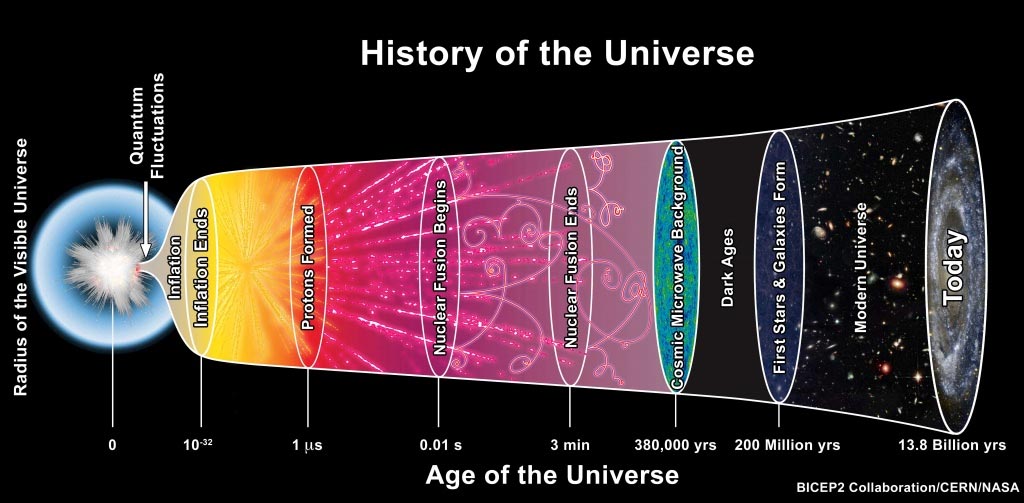
The team’s results add to growing evidence that there is a problem with the standard model of cosmology, which shows the universe was expanding very fast early in its history, then the expansion slowed down due to the gravitational pull of dark matter, and now the expansion is speeding up again due to dark energy, a mysterious force.
This model of the expansion history of the universe is assembled using traditional Hubble Constant measurements, which are taken from “distant” observations of the cosmic microwave background (CMB) – leftover radiation from the Big Bang when the universe began 13.8 billion years ago.
Recently, many groups began using varying techniques and studying different parts of the universe to obtain the Hubble Constant and found that the value obtained from “local” versus “distant” observations disagree.
“Therein lies the crisis in cosmology,” says Fassnacht. “While the Hubble Constant is constant everywhere in space at a given time, it is not constant in time. So, when we are comparing the Hubble Constants that come out of various techniques, we are comparing the early universe (using distant observations) vs. the late, more modern part of the universe (using local, nearby observations).”
This suggests that either there is a problem with the CMB measurements, which the team says is unlikely, or the standard model of cosmology needs to be changed in some way using new physics to correct the discrepancy.
Methodology
Using Keck Observatory’s AO system with the Near-Infrared Camera, second generation (NIRC2) instrument on the Keck II telescope, Chen and his team obtained local measurements of three well-known lensed quasar systems: PG1115+ 080, HE0435-1223, and RXJ1131-1231.
Quasars are extremely bright, active galaxies, often with massive jets powered by a supermassive black hole ravenously eating material surrounding it.
“We can now try this method with more lensed quasar systems to improve the precision of our measurement of the Hubble Constant. Perhaps this will lead us to a more complete cosmological model of the universe.” Chris Fassnacht
Though quasars are often extremely far way, astronomers are able to detect them through gravitational lensing, a phenomenon that acts as nature’s magnifying glass. When a sufficiently massive galaxy closer to Earth gets in the way of light from a very distant quasar, the galaxy can act as a lens; its gravitational field warps space itself, bending the background quasar’s light into multiple images and making it look extra bright.
At times, the brightness of the quasar flickers, and since each image corresponds to a slightly different path length from quasar to telescope, the flickers appear at slightly different times for each image – they don’t all arrive on Earth at the same time.

With HE0435-1223, PG1115+ 080, and RXJ1131-1231, the team carefully measured those time delays, which are inversely proportional to the value of the Hubble Constant. This allows astronomers to decode the light from these distant quasars and gather information about how much the universe has expanded during the time the light has been on its way to Earth.
“One of the most important ingredients in using gravitational lensing to measure the Hubble Constant is sensitive and high-resolution imaging,” said Chen. “Up until now, the best lens-based Hubble Constant measurements all involved using data from HST. When we were unblinded, we found two things. First, we had consistent values with previous measurements that were based on HST data, proving that AO data can provide a powerful alternative to HST data in the future. Secondly, we found that combining the AO and HST data gave a more precise result.”
Next Steps
Chen and his team, as well as many other groups all over the planet, are doing more research and observations to further investigate. Now that Chen’s team has proven Keck Observatory’s AO system is just as powerful as HST, astronomers can add this methodology to their bucket of techniques when measuring the Hubble Constant.
“We can now try this method with more lensed quasar systems to improve the precision of our measurement of the Hubble Constant. Perhaps this will lead us to a more complete cosmological model of the universe,” says Fassnacht.
Read Cosmic Mystery Deepens After New Measurement of Expansion Rate of the Universe for more on this topic.
Reference: “A SHARP view of H0LiCOW: H0 from three time-delay gravitational lens systems with adaptive optics imaging” by Geoff C-F Chen, Christopher D Fassnacht, Sherry H Suyu, Cristian E Rusu, James H H Chan, Kenneth C Wong, Matthew W Auger, Stefan Hilbert, Vivien Bonvin, Simon Birrer, Martin Millon, Léon V E Koopmans, David J Lagattuta, John P McKean, Simona Vegetti, Frederic Courbin, Xuheng Ding, Aleksi Halkola, Inh Jee, Anowar J Shajib, Dominique Sluse, Alessandro Sonnenfeld and Tommaso Treu, 12 September 2019, Monthly Notices of the Royal Astronomical Society.
DOI: 10.1093/mnras/stz2547
About NIRC2
The Near-Infrared Camera, second generation (NIRC2) works in combination with the Keck II adaptive optics system to obtain very sharp images at near-infrared wavelengths, achieving spatial resolutions comparable to or better than those achieved by the Hubble Space Telescope at optical wavelengths. NIRC2 is probably best known for helping to provide definitive proof of a central massive black hole at the center of our galaxy. Astronomers also use NIRC2 to map surface features of solar system bodies, detect planets orbiting other stars, and study the detailed morphology of distant galaxies.
About Adaptive Optics
W. M. Keck Observatory is a distinguished leader in the field of adaptive optics (AO), a breakthrough technology that removes the distortions caused by the turbulence in the Earth’s atmosphere. Keck Observatory pioneered the astronomical use of both natural guide star (NGS) and laser guide star adaptive optics (LGS AO) on large telescopes and current systems now deliver images three to four times sharper than the Hubble Space Telescope. Keck AO has imaged the four massive planets orbiting the star HR8799, measured the mass of the giant black hole at the center of our Milky Way Galaxy, discovered new supernovae in distant galaxies, and identified the specific stars that were their progenitors. Support for this technology was generously provided by the Bob and Renee Parsons Foundation, Change Happens Foundation, Gordon and Betty Moore Foundation, Mt. Cuba Astronomical Foundation, NASA, NSF, and W. M. Keck Foundation.
About W. M. Keck Observatory
The W. M. Keck Observatory telescopes are among the most scientifically productive on Earth. The two, 10-meter optical/infrared telescopes on the summit of Maunakea on the Island of Hawaii feature a suite of advanced instruments including imagers, multi-object spectrographs, high-resolution spectrographs, integral-field spectrometers, and world-leading laser guide star adaptive optics systems.
Some of the data presented herein were obtained at Keck Observatory, which is a private 501(c) 3 non-profit organization operated as a scientific partnership among the California Institute of Technology, the University of California, and the National Aeronautics and Space Administration. The Observatory was made possible by the generous financial support of the W. M. Keck Foundation.
The authors wish to recognize and acknowledge the very significant cultural role and reverence that the summit of Maunakea has always had within the Native Hawaiian community. We are most fortunate to have the opportunity to conduct observations from this mountain.
Never miss a breakthrough: Join the SciTechDaily newsletter.
Follow us on Google and Google News.
10 Comments
This story has been running every day under a different headline for about 2 weeks. Maybe from a different outlet each time, but that doesn’t matter. We all know by now that different measurements of the Hubble Constant don’t agree. No need to tell us every day.
Everything points to much younger than these dreams of accidental existance. Stay scientific without an agenda or presupposition and we might learn something.
I think that there is a super,super,massive,massive, huge,really big black hole out there somewhere over the rainbow pulling everything towards it,there is no expansion,only the gravitational pull of this monster and the closer we get the faster we go ,maybe it’s the end days, in a few billion billion years,just my thoughts,no data
Im not a trying to be a nut..but what if pschical laws was relitive to matter only to each existance . Thus laws via diverse existance of bodies of matter states ,dictate revelance mostly to its own existance in uniform with all law uniformly
Following form of this thought from atomic to solar thru galectic to universe orbital or expanding movement can be reasonably assumed symitrey on a at least one scale overall .
Leading to a hypothetical hypotenuse space is round and can be circumnavigation possible from any point to return us expanding body matters universe form continuem.
Easy .Each existance of bodies of matter are prevalent to pschical laws primarily to itself existance . However a uneversal law must be its continuem.
Therefore our own law of existance in body matter shows
At atom and solar to galexy shows some orbit and rounded space showing our law in space of matter could lead to circumnavigation of not only earth but space itself with all points returning to its origen.
This leads us to belive the answer of expanding universal bodies is as unsolvable as pi
I.e. infinite to ourselves .
Unless we had the uniform law discovered.
This uneverse expantion theory and negate is biased based on mathematics in applications priciple premise we are the center of expanding existensionalism .
In fact we have nothing to prove thit basis.
This uneverse expantion theory is negate it is biased based on mathematics in applications priciple premise we are the center of expanding existensionalism .
In fact we have nothing to prove that basis.
The universe as ALL is not expanding or contracting.
The parts within do go through expansion and contraction in a never ending story.
The fault lies not in the stars but in our selves Shakespeare
NEWXPLANATIOivity M=M(0) x gamma factor and substitutung v/c for the ratio of the
two expansion rates we find if we solve the only remaining constant is 1.4142 or the square root of 2.