
Lower total vehicle emissions can mask important changes in exhaust chemistry, including potentially more reactive or toxic compounds.
Stricter vehicle regulations are cutting the overall amount of volatile organic compounds (VOCs) emitted by passenger cars. But as those totals fall, the chemical makeup of what remains in the exhaust is also shifting.
An analysis of individual compounds found that oxygenated volatile organic compounds (OVOCs), a group that includes many reactive or toxic chemicals, made up a larger proportion of emissions under tighter standards. Under certain low-speed test conditions, one non-plug-in hybrid electric vehicle (HEV) also released substantially more OVOCs than a comparable conventional vehicle and produced higher estimated indicators of health risk.
The results point to an important complication for vehicle regulation. Lower overall emissions and improved fuel economy do not necessarily produce equally large reductions in atmospheric reactivity or toxicity, making the specific chemicals in exhaust increasingly relevant.
Lower emissions can hide a changing mix
Vehicle standards typically regulate total hydrocarbons or other broad categories of pollutants, an approach that has substantially reduced tailpipe emissions. Individual VOCs, however, differ widely in how readily they contribute to ozone, produce secondary organic aerosol (SOA), or pose risks to human health.
Hybrid vehicles introduce an additional challenge because their gasoline engines repeatedly turn off and restart as the powertrain switches between electric and gasoline operation. Those transitions can leave the engine exhaust and pollution control systems below their most effective operating temperatures, particularly during startup and low-speed driving.
As a result, standards based mainly on total pollutant mass could miss changes in individual reactive or toxic compounds even as overall emissions decline. Understanding how newer vehicle technologies alter the composition of exhaust is therefore important for assessing their wider environmental and health effects.
Researchers from the Chinese Research Academy of Environmental Sciences, the Chongqing Academy of Ecology and Environmental Sciences, and Peking University reported the findings in Environmental Science and Ecotechnology.
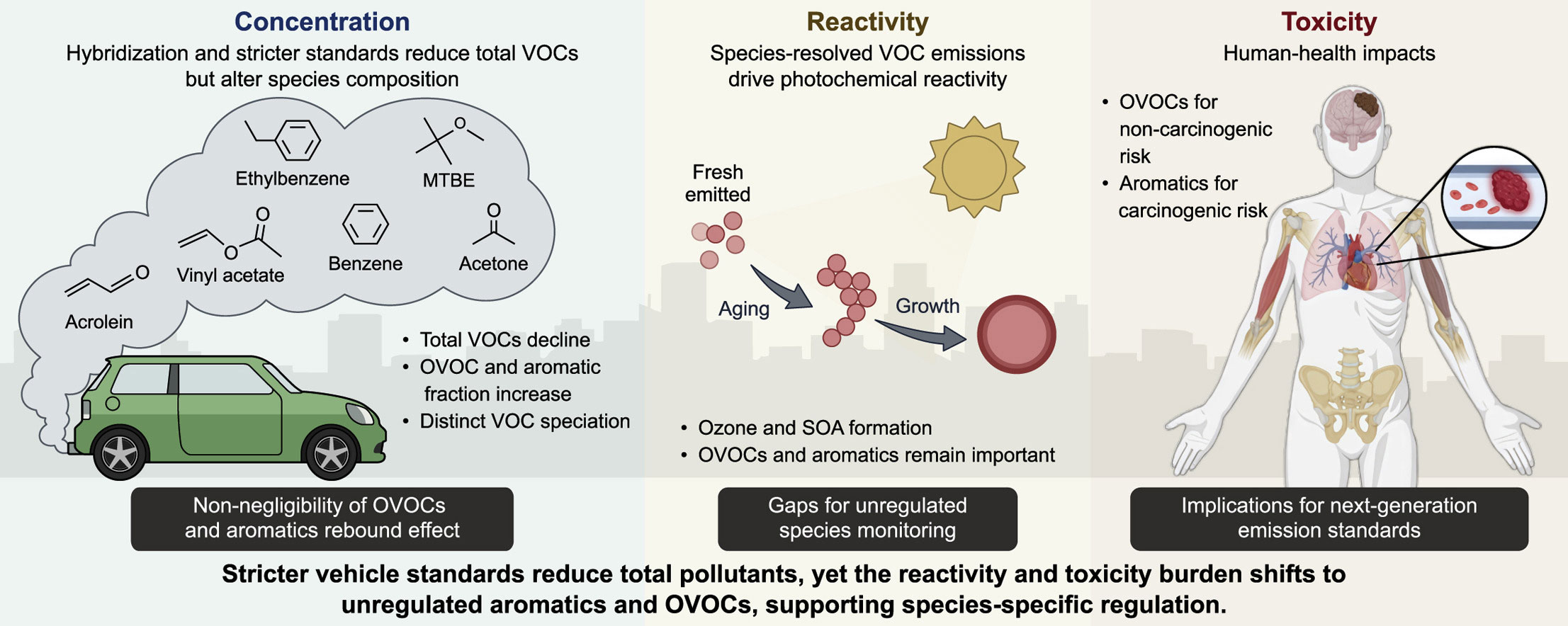
They created a concentration–reactivity–toxicity framework to compare emissions of individual VOC species from China IV, China V, and China VI gasoline vehicles, including one non-plug-in hybrid. By combining measured exhaust chemistry with estimates of secondary pollution formation and carcinogenic and non-carcinogenic risks, the researchers identified patterns that measurements of total VOC mass alone would not show.
One hybrid showed a low-speed trade-off
The researchers evaluated seven gasoline direct-injection vehicles on a chassis dynamometer, including six internal combustion engine vehicles (ICEVs) and one HEV. Testing covered both cold- and hot-start conditions using the Worldwide harmonized Light vehicles Test Cycle (WLTC).
Exhaust compounds were measured using gas chromatography–mass spectrometry (GC–MS). For individual chemicals, the researchers calculated ozone formation potential (OFP), secondary organic aerosol potential (SOAP), hazard index (HI), and cancer risk (CR).
During low-speed cold starts, conventional vehicles showed a 75% decline in total VOC emission factors between China IV and China VI. Emissions fell from 287.8 mg km⁻¹ for China IV models to 71.8 mg km⁻¹ for China VI vehicles.
Yet the chemical mixture changed as the total fell. Across the cold-start WLTC, OVOCs increased from 20%–22% of VOC emissions to 35%.
Differences also appeared between the China VI hybrid and its conventional counterpart. During low-speed hot starts, the hybrid released 25.4 mg km⁻¹ of OVOCs, nearly twice the 13.3 mg km⁻¹ measured from the comparable ICEV.
Under low-speed cold-start conditions, the hybrid’s estimated HI was 69% higher, while its estimated CR was almost twice that of the conventional vehicle. Acrolein and vinyl acetate were major contributors to OFP in the hybrid, while toluene, ethylbenzene, m,p-xylene, and benzene together accounted for more than 70% of SOAP.
The authors associated these patterns with repeated engine restarts, incomplete combustion, lower exhaust temperatures, and reduced efficiency of the three-way catalytic converter (TWC). They stressed, however, that results from a single hybrid vehicle cannot be applied to an entire fleet.
The findings should therefore not be taken to mean that hybrid vehicles are inherently more polluting, according to the authors. Instead, this particular vehicle demonstrates that strong fuel economy and low total emissions can coincide with a less favorable exhaust chemistry under certain driving conditions.
Repeated engine starts may make it harder for catalysts to efficiently remove some oxygenated compounds, especially at low speeds. The authors said larger studies covering more vehicles are needed to determine whether the same patterns appear across different models and which compounds deserve greater attention in future regulations.
Future rules may need chemical targets
The concentration–reactivity–toxicity framework could help regulators look beyond total VOC mass by identifying high-priority compounds according to their abundance, atmospheric reactivity, and toxicity.
Future standards could specifically monitor substances such as acrolein, formaldehyde, benzene, vinyl acetate, and other influential compounds while also tightening controls on aromatic chemicals in fuels.
Manufacturers could potentially improve hybrid emission control by heating catalysts more rapidly, using electrically heated catalysts, or adjusting powertrain operation to limit incomplete combustion during repeated engine starts.
Adding measurements of individual exhaust compounds to real-driving emissions tests could also help ensure that vehicle electrification delivers corresponding benefits for air quality and public health. Before the findings involving the hybrid can be generalized, however, fleet-scale testing is needed across a wider range of vehicle models, fuels, climates, and driving conditions.
Reference: “Stricter vehicle standards reduce total pollutants but increase the fraction of toxic organics” by Xinping Yang, Jie Yao, Wenqi Song, Hongfei Chen, Xihui Tong, Zhiheng Wu, Xin Li, Yunjing Wang, Chao Peng, Hang Yin and Yan Ding, 25 July 2026, Environmental Science and Ecotechnology.
DOI: 10.1016/j.ese.2026.100736
This work was supported by the National Natural Science Foundation of China (42575133, 42205111, 42305126, 42277085), Fundamental Research Funds for the Central Public-interest Scientific Institution (2025YSKY-58).
Never miss a breakthrough: Join the SciTechDaily newsletter.
Follow us on Google and Google News.
1 Comment
“An analysis of individual compounds found that oxygenated volatile organic compounds (OVOCs), a group that includes many reactive or toxic chemicals, made up a larger proportion of emissions under tighter standards.”
So just what do the catalytic converters remove? My take from this is that the catalytic converters used with hybrids need some tweaking.