
Close Menu
    Facebook X (Twitter) Instagram
    SciTechDaily
    • Biology
    • Chemistry
    • Earth
    • Health
    • Physics
    • Science
    • Space
    • Technology
    Facebook X (Twitter) Pinterest YouTube RSS
    SciTechDaily
    Home»Earth»Research Reveals New Man-Made Ozone-Depleting Gases in the Atmosphere
    Earth

    Research Reveals New Man-Made Ozone-Depleting Gases in the Atmosphere

    By University of East AngliaMarch 10, 20141 Comment3 Mins Read
    Facebook Twitter Pinterest Telegram LinkedIn WhatsApp Email Reddit
    Share
    Facebook Twitter LinkedIn Pinterest Telegram Email Reddit
    Research Reveals Four New Gases in the Earths Atmosphere
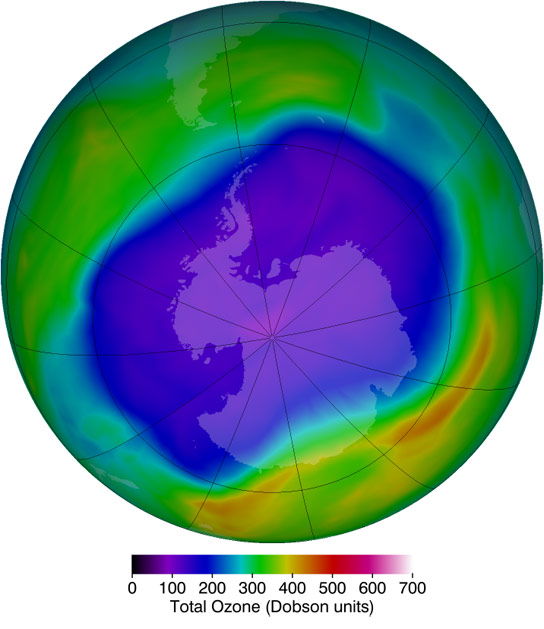
    False-color view of total ozone over the Antarctic pole. The purple and blue colors are where there is the least ozone, and the yellows and reds are where there is more ozone. Credit: NASA

    New research from scientists at the University of East Anglia reveals four new man-made gases in the atmosphere that are contributing to the destruction of the ozone layer.

    New research published in the journal Nature Geoscience reveals that more than 74,000 tonnes of three new chlorofluorocarbons (CFCs) and one new hydrochlorofluorocarbon (HCFC) have been released into the atmosphere.

    Scientists made the discovery by comparing today’s air samples with air trapped in polar firn snow – which provides a century-old natural archive of the atmosphere. They also looked at air collected between 1978 and 2012 in unpolluted Tasmania.

    Measurements show that all four new gases have been released into the atmosphere recently – and that two are significantly accumulating. Emission increases of this scale have not been seen for any other CFCs since controls were introduced during the 1990s. But they are nowhere near the peak CFC emissions of the 1980s which reached around a million tonnes a year.

    Lead researcher Dr Johannes Laube from UEA’s School of Environmental Sciences said: “Our research has shown four gases that were not around in the atmosphere at all until the 1960s which suggests they are man-made.”

    “CFCs are the main cause of the hole in the ozone layer over Antarctica. Laws to reduce and phase out CFCs came into force in 1989, followed by a total ban in 2010. This has resulted in successfully reducing the production of many of these compounds on a global scale. However, legislation loopholes still allow some usage for exempted purposes.

    “The identification of these four new gases is very worrying as they will contribute to the destruction of the ozone layer. We don’t know where the new gases are being emitted from and this should be investigated. Possible sources include feedstock chemicals for insecticide production and solvents for cleaning electronic components.

    “What’s more, the three CFCs are being destroyed very slowly in the atmosphere – so even if emissions were to stop immediately, they will still be around for many decades to come,” he added.

    This research has been funded by the Natural Environment Research Council (NERC), the National Center for Atmospheric Science (NCAS), the European Union, and the Commonwealth Scientific and Industrial Research Organisation (CSIRO).

    Reference: “Newly detected ozone-depleting substances in the atmosphere” by Johannes C. Laube, Mike J. Newland, Christopher Hogan, Carl A. M. Brenninkmeijer, Paul J. Fraser, Patricia Martinerie, David E. Oram, Claire E. Reeves, Thomas Röckmann, Jakob Schwander, Emmanuel Witrant and William T. Sturges, 9 March 2014, Nature Geoscience.
    DOI: 10.1038/ngeo2109

    Never miss a breakthrough: Join the SciTechDaily newsletter.
    Follow us on Google and Google News.

    Atmosphere Environmental Science Geoscience Ozone Planetary Science Pollution University of East Anglia
    Share. Facebook Twitter Pinterest LinkedIn Email Reddit

    Related Articles

    The Ozone Layer Is Healing, But There’s a Hidden Catch

    New NASA Study Shows That Hydrofluorocarbons Contribute to Ozone Depletion

    Naturally Occurring Atmospheric Processes and Chinese Pollution Offset Ozone Gains

    Earth’s Atmosphere Contains an Unexpectedly Large Amount of Ozone-Depleting Compound

    Scientists Estimate Earth’s Remaining Habitable Lifetime, Examine Habitability of Exoplanets

    Dredging Of Canal Could Release Harmful Chemicals

    Fluctuations in Weather Patterns Help Decrease the Antarctic Ozone Hole

    Xenon Gas Has Almost Vanished From the Atmosphere

    Coral Reveals Lead Levels from Gasoline in the Ocean

    1 Comment

    1. Julie on November 11, 2014 7:38 pm

      Gee, maybe they are being put there by all the geoengineering that’s going on now. You want to make a name for yourselves, tackle that issue. Study it, absorb it, and then expose it, please.

      Reply
    Leave A Reply Cancel Reply

    • Facebook
    • Twitter
    • Pinterest
    • YouTube

    Don't Miss a Discovery

    Subscribe for the Latest in Science & Tech!

    Trending News

    Mezcal “Worm” in a Bottle Mystery: DNA Testing Reveals a Surprise

    New Research Reveals That Your Morning Coffee Activates an Ancient Longevity Switch

    This Is What Makes You Irresistible to Mosquitoes

    Shockingly Powerful Giant Octopuses Ruled the Seas 100 Million Years Ago

    Scientists Stunned by New Organic Molecules Found on Mars

    Rewriting Dinosaur Evolution: Scientists Unearth Remarkable 150-Million-Year-Old Stegosaur Skull

    Omega-3 Supplements Linked to Cognitive Decline in Surprising New Study

    First-of-Its-Kind Discovery: Homer’s Iliad Found Embedded in a 1,600-Year-Old Egyptian Mummy

    Follow SciTechDaily
    • Facebook
    • Twitter
    • YouTube
    • Pinterest
    • Newsletter
    • RSS
    SciTech News
    • Biology News
    • Chemistry News
    • Earth News
    • Health News
    • Physics News
    • Science News
    • Space News
    • Technology News
    Recent Posts
    • Male Birth Control Breakthrough: Scientists Find Way To Turn Sperm Production Off and Back On
    • A Common Vitamin Could Hold the Key to Treating Fatty Liver Disease
    • New Research Shows Vitamin B12 May Hold the Key to Healthy Aging
    • Scientists Map Thousands of Brain Connections With RNA Barcodes
    • This Gene Tweak Turns Strawberries Into Healthier, Tastier Superfruit
    Copyright © 1998 - 2026 SciTechDaily. All Rights Reserved.
    • Science News
    • About
    • Contact
    • Editorial Board
    • Privacy Policy
    • Terms of Use

    Type above and press Enter to search. Press Esc to cancel.