

Rising emissions of five banned CFCs, linked to leaks in HFC production, pose climate risks and could offset gains under the Montreal Protocol. Researchers call for improved monitoring and stricter regulations to prevent further impact on ozone and global warming.
A new study reveals a concerning uptrend in the emissions of five ozone-depleting substances from 2010 to 2020, despite their production for most applications being prohibited by the Montreal Protocol. The release of these five chlorofluorocarbons (CFCs) partially stems from leakage during the production of ozone-friendly CFC alternatives. While these incidental or intermediate emissions are technically permitted under the Montreal Protocol, they contradict the broader objective of the agreement – and the observed increases rise concerns.
“We’re paying attention to these emissions now because of the success of the Montreal Protocol,” says Luke Western, lead author of the paper and a researcher at the National Oceanic and Atmospheric Administration’s (NOAA) Global Monitoring Laboratory and the University of Bristol.
“CFC emissions from more widespread uses that are now banned have dropped to such low levels that emissions of CFCs from previously minor sources are on our radar now.”
The study, by an international team of scientists from NOAA, the University of Bristol, Empa, CSIRO, the University of East Anglia, the University of California San Diego, the University of Colorado, Boulder, and Forschungszentrum Jülich, was recently published in the journal Nature Geoscience.
No Immediate Threat to the Ozone Layer – but a Significant Greenhouse Effect
According to the researchers, emissions from these CFCs currently do not significantly threaten ozone recovery. With the current rate of increase, however, they could become a significant contribution of the total emissions of ozone-depletion chemicals. Also, because they are potent greenhouse gases, they do have an impact on climate: Combined, their emissions are equal to the CO2 emissions in 2020 for a smaller country like Switzerland. That’s equivalent to about one percent of the total greenhouse gas emissions in the United States or 1/1’000 of all global greenhouse gas emissions.
CFCs are chemicals known to destroy Earth’s protective ozone layer. Once widely used in the manufacture of hundreds of products including aerosol sprays, as blowing agents for foams and packing materials, as solvents and refrigerants, CFC production for such uses was banned under the Montreal Protocol in 2010.
However, the international treaty didn’t ban the use and creation of CFCs during production of other chemicals including hydrofluorocarbons (HFCs) and, more recently, also hydrofluoroolefins (HFOs), which were both developed as replacements for CFCs.
This study focused on five CFCs with few, or no, known current uses – CFC-13, CFC-112a, CFC-113a, CFC-114a, and CFC-115 – and that have atmospheric lifetimes ranging from 52 to 640 years. In terms of their impact on ozone, emissions of these five CFCs are equivalent to around one-tenth of current emissions from CFC-11, one of the most abundant of this group of chemicals controlled under the Montreal Protocol.
A Record-High Abundance
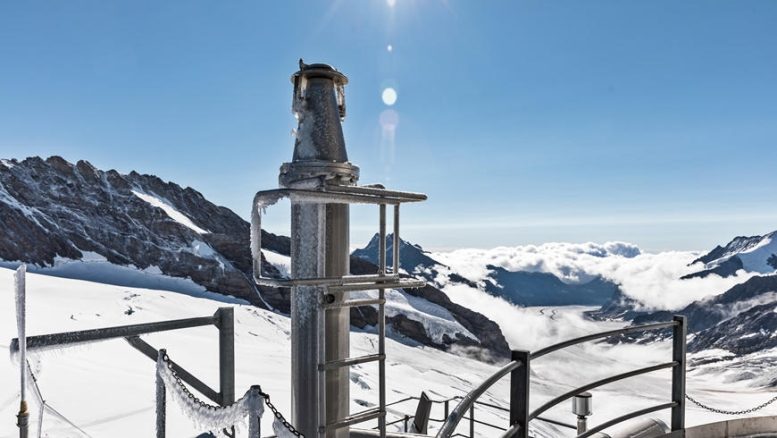
In this study, the team used measurements from 14 sites all over the world, including the Advanced Global Atmospheric Gases Experiment (AGAGE) stations such as the one station at Jungfraujoch, managed by Empa, and an atmospheric transport model to show that global atmospheric abundances and emissions of these CFCs increased after their production for most uses was phased out in 2010; in fact, they reached a record-high abundance in 2020.
The researchers determined that for three CFCs they studied – CFC-113a, CFC-114a, and CFC-115 – the increased emissions may be due in part to their role during the production of two common HFCs used primarily in refrigeration and air conditioning. “As the currently most likely source of these compounds is a byproduct in the fluorocarbons industry, there are concerns of increasing emissions of these CFCs given the production projections for some of these new-generation fluorocarbon products,” says Martin Vollmer of Empa, a co-author of the study.
The drivers behind increasing emissions of the other two CFCs, CFC-13 and CFC-112a, are less certain, however. Vollmer: “We are not aware of any current chemical fluorocarbon process, in which these two substances appear as either intermediate or byproduct.”
Time to Sharpen the Montreal Protocol?
The researchers didn’t determine where these emissions are coming from; they documented rising global emissions but weren’t able to identify particular source locations. One of the reasons for this, says Empa’s Stefan Reimann, another co-author of the study, is the numerous “blind spots” in the global monitoring network: “Even though this study combined measurements from several networks and groups, several regions of the world, including those with the largest global fluorocarbon productions, are severely undersampled.”
According to the researchers, if emissions of these five CFCs continue to rise, their impact may negate some of the benefits gained under the Montreal Protocol and also contribute substantially to global warming. The study noted these emissions might be reduced or avoided by reducing leakages associated with HFC production and by properly destroying any co-produced CFCs. “Given the continued rise of these chemicals in the atmosphere, perhaps it is time to think about sharpening the Montreal Protocol a bit more,” says another study co-author, Johannes Laube of the Forschungszentrum Jülich. One takeaway message, says Luke Western, is that the production process for some of the CFC replacement chemicals may not be entirely ozone-friendly, even if the replacement chemicals themselves are.
Reference: “Global increase of ozone-depleting chlorofluorocarbons from 2010 to 2020” by Luke M. Western, Martin K. Vollmer, Paul B. Krummel, Karina E. Adcock, Paul J. Fraser, Christina M. Harth, Ray L. Langenfelds, Stephen A. Montzka, Jens Mühle, Simon O’Doherty, David E. Oram, Stefan Reimann, Matt Rigby, Isaac Vimont, Ray F. Weiss, Dickon Young and Johannes C. Laube, 3 April 2023, Nature Geoscience.
DOI: 10.1038/s41561-023-01147-w
Never miss a breakthrough: Join the SciTechDaily newsletter.
Follow us on Google and Google News.
1 Comment
A study has shown that ozone “holes” go through natural cycles. The holes over North America cleared up long before even the most optimistic models showed any improvement whatsoever after banning various chemicals. Banning McDonalds Styrofoam had nothing to do with it closing. In other words, this garbage is a fear mongering tactic that people are using to make big money. The HVAC industry in particular and the chemical companies creating “new” replacements for refrigerants want current ones banned before the patents wearing out can hurt their mega-profits. Each new refrigerant created gives them a new cycle of being able to charge whatever they want nearly for the new product and by banning the older products, that increases their cost for older AC systems as well, making more sales of newer systems that support the new refrigerants.
In short, by perpetuating this cycle of fear mongering nonsense, these industries are making BIG MONEY off of it. The same can probably be said of other “green” industries that often have negative downsides like the stuff used to make solar panels that don’t last all that long wear out in 20-30 years and are better batteries are highly toxic to the environment and many of the blades on industrial windmills are not recyclable, but hey, it’s BIG MONEY BABY! Push that narrative! CANCEL anyone scientist who disagrees with it and badmouth them! It is THE WAY!