
Close Menu
    Facebook X (Twitter) Instagram
    SciTechDaily
    • Biology
    • Chemistry
    • Earth
    • Health
    • Physics
    • Science
    • Space
    • Technology
    Facebook X (Twitter) Pinterest YouTube RSS
    SciTechDaily
    Home»Space»Astronomers Spot Stellar Eggs Near Center of the Milky Way Hatching Into Baby Stars
    Space

    Astronomers Spot Stellar Eggs Near Center of the Milky Way Hatching Into Baby Stars

    By National Institutes of Natural SciencesApril 3, 2021No Comments2 Mins Read
    Facebook Twitter Pinterest Telegram LinkedIn WhatsApp Email Reddit
    Share
    Facebook Twitter LinkedIn Pinterest Telegram Email Reddit
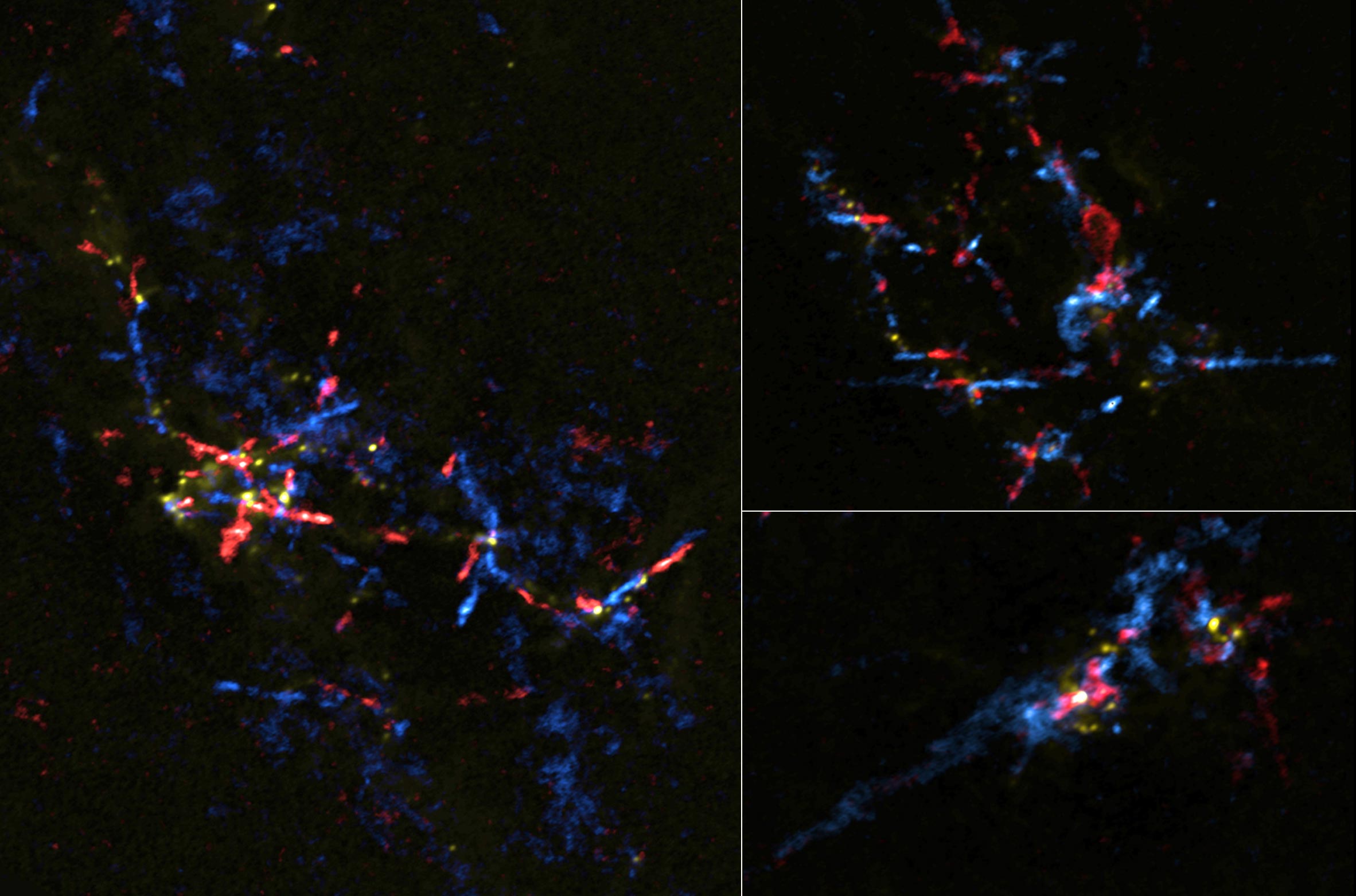
    Gas Outflows From Stellar Eggs in the Galactic Center Region
    Gas moving toward us is shown in blue and gas moving away from us is shown in red. Credit: ALMA (ESO/NAOJ/NRAO), Lu et al.

    ALMA observations reveal baby stars forming in the Milky Way’s center, overturning assumptions about star formation in turbulent galactic zones.

    Astronomers found a number of stellar eggs containing baby stars around the center of the Milky Way using the Atacama Large Millimeter/submillimeter Array (ALMA). Previous studies had suggested that the environment there is too harsh to form stars. These findings indicate that star formation is more resilient than researchers thought.

    Stellar Eggs

    Stars form in stellar eggs, cosmic clouds of gas and dust which collapse due to gravity. If something interferes with the gravity-driven contraction, star formation will be suppressed. There are many potential sources of interference near the Galactic Center. Strong turbulence can stir up the clouds and prevent them from contracting, or strong magnetic fields can support the gas against self-gravitational collapse. Previous observations indicated that star formation near the Galactic Center is much less efficient.

    To investigate the mysteries of the suppressed star formation, a team led by Xing Lu, an astronomer at the National Astronomical Observatory of Japan, used ALMA to observe regions near the Galactic Center which contain ample gas, but no known star formation. Surprisingly, the team discovered more than 800 dense cores of gas and dust.

    Dense Cores and Outflows

    “The discovery leads to the question of whether they are actually ‘stellar eggs’ or not.” explains Lu. To answer this question, the team again used ALMA to search for energetic gas outflows which are indicative of stars forming in stellar eggs. Thanks to ALMA’s high sensitivity and high spatial resolution, they detected 43 small and faint outflows in the clouds. Lu comments, “Our observations prove that even in the strongly disturbed areas around the Galactic Center, baby stars still form.”

    The research team is now analyzing ALMA’s higher resolution observation data to better understand the processes driving the gas outflows and star formation near the Galactic Center.

    Reference: “ALMA Observations of Massive Clouds in the Central Molecular Zone: Ubiquitous Protostellar Outflows” by Xing Lu, Shanghuo Li, Adam Ginsburg, Steven N. Longmore, J. M. Diederik Kruijssen, Daniel L. Walker, Siyi Feng, Qizhou Zhang, Cara Battersby, Thushara Pillai, Elisabeth A. C. Mills, Jens Kauffmann, Yu Cheng and Shu-ichiro Inutsuka, 16 March 2021, The Astrophysical Journal.
    DOI: 10.3847/1538-4357/abde3c

    Never miss a breakthrough: Join the SciTechDaily newsletter.
    Follow us on Google and Google News.

    ALMA Astronomy Astrophysics NAOJ National Institutes of Natural Sciences
    Share. Facebook Twitter Pinterest LinkedIn Email Reddit

    Related Articles

    Peering Back 13 Billion Years: Dancing Galaxies Craft a Monster at the Dawn of the Universe

    ALMA Uncovers the Building Blocks of Star Formation in Starburst Galaxy

    Spiraling Into Stardom: The Role of Gas Streamers in Multi-Star Births

    Cosmic Cradles and Graves: Tracing Life and Death of Stars in the Most Distant Galaxy

    Cosmic Shield: How Our Solar System Survived a Supernova

    Mysterious Cosmic Tadpole: A Strange Gas Cloud Dances With a Colossal Black Hole

    ALMA Peers Back 12.4 Billion Years and Discovers the Most Ancient Galaxy of Its Kind Ever Observed

    Unknown Physics on the Cosmic Scale? 1000 Supernova Explosions Chart the Expansion History of the Universe

    Natural Cosmic Telescope Helps ALMA Discover Rotating Infant Galaxy

    Leave A Reply Cancel Reply

    • Facebook
    • Twitter
    • Pinterest
    • YouTube

    Don't Miss a Discovery

    Subscribe for the Latest in Science & Tech!

    Trending News

    Beyond Pain Relief: Scientists Discover a Protein That Could Stop Osteoarthritis in Its Tracks

    Scientists Discover Why Alcohol Prevents the Liver From Healing, Even After You Quit

    Scientists Stunned As Volcano Removes Methane From the Air

    Scientists Discover Signs Africa May Be Splitting Apart Beneath Zambia

    Common Blood Pressure Drug Supercharges Cancer Treatment in Surprising New Study

    540-Million-Year-Old Fossils Reveal a Huge Surprise About Early Life on Earth

    Scientists Reverse Stroke Damage Using Stem Cells in Breakthrough Study

    Eating One Egg a Day Could Cut Alzheimer’s Risk by 27%

    Follow SciTechDaily
    • Facebook
    • Twitter
    • YouTube
    • Pinterest
    • Newsletter
    • RSS
    SciTech News
    • Biology News
    • Chemistry News
    • Earth News
    • Health News
    • Physics News
    • Science News
    • Space News
    • Technology News
    Recent Posts
    • NASA’s Roman Space Telescope Could Finally Find the Milky Way’s Missing Neutron Stars
    • Strange “Worm Towers” Found in the Wild for the First Time May Be Hitchhiking on Beetles
    • Scientists Finally Solve the Mystery of South Africa’s Tiny Leopards
    • This Strange “Golden Orb” Found 2 Miles Deep Stumped Scientists for Years
    • Giant “Last Titan” Dinosaur Discovered in Thailand Was Bigger Than 9 Elephants
    Copyright © 1998 - 2026 SciTechDaily. All Rights Reserved.
    • Science News
    • About
    • Contact
    • Editorial Board
    • Privacy Policy
    • Terms of Use

    Type above and press Enter to search. Press Esc to cancel.