
Close Menu
    Facebook X (Twitter) Instagram
    SciTechDaily
    • Biology
    • Chemistry
    • Earth
    • Health
    • Physics
    • Science
    • Space
    • Technology
    Facebook X (Twitter) Pinterest YouTube RSS
    SciTechDaily
    Home»Space»Peering Back 13 Billion Years: Dancing Galaxies Craft a Monster at the Dawn of the Universe
    Space

    Peering Back 13 Billion Years: Dancing Galaxies Craft a Monster at the Dawn of the Universe

    By National Institutes of Natural SciencesSeptember 2, 20241 Comment3 Mins Read
    Facebook Twitter Pinterest Telegram LinkedIn WhatsApp Email Reddit
    Share
    Facebook Twitter LinkedIn Pinterest Telegram Email Reddit
    Dancing Galaxies Make Monster Cosmic Dawn
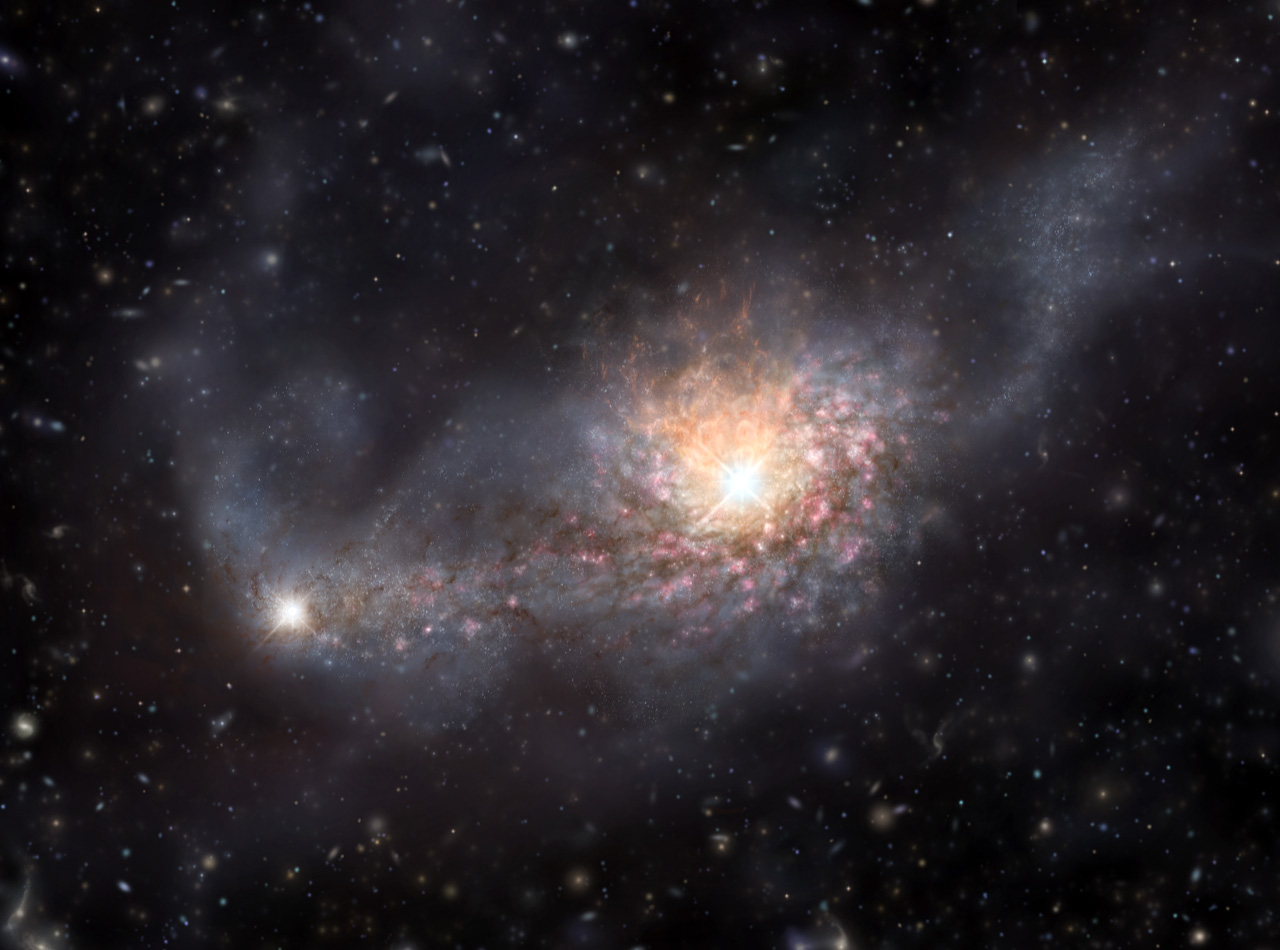
    Artist’s impression of the interacting galaxies observed in this research. The gravitational interactions during the merger trigger both starburst and quasar activity. Credit: ALMA (ESO/NAOJ/NRAO), T.Izumi et al.

    Astronomers have observed a rare galaxy merger from 12.8 billion years ago, using the ALMA radio telescope.

    This early cosmic event involves a pair of galaxies whose interaction is expected to create a monster galaxy, marked by intense quasar activity and a burst of star formation. Such discoveries are crucial for understanding the formative stages of galaxies and black holes in the Universe.

    Discovery of Ancient Galaxy Merger

    Astronomers have spotted a pair of galaxies in the act of merging 12.8 billion years ago. The characteristics of these galaxies indicate that the merger will form a monster galaxy, one of the brightest types of objects in the Universe. These results are important for understanding the early evolution of galaxies and black holes in the early Universe.

    Quasar Activity in Early Galaxies

    Quasars are bright objects powered by matter falling into a supermassive black hole at the center of a galaxy in the early Universe. The most accepted theory is that when two gas-rich galaxies merge to form a single larger galaxy, the gravitational interaction of the two galaxies causes gas to fall towards the supermassive black hole in one or both of the galaxies, causing quasar activity.

    Observations with ALMA Reveal Merging Galaxies

    To test this theory, an international team of researchers led by Takuma Izumi used the ALMA (Atacama Large Millimeter/submillimeter Array) radio telescope to study the earliest known pair of close quasars. This pair was discovered by Yoshiki Matsuoka, at Ehime University in Japan, in images taken by the Subaru Telescope.

    Located in the direction of the constellation Virgo, this pair of quasars existed during the first 900 million years of the Universe. The pair is dim, indicating that the quasars are still in the early stages of their evolution. The ALMA observations mapped the host galaxies of the quasars and showed that the galaxies are linked by a “bridge” of gas and dust. This indicates that the two galaxies are in fact merging.

    Implications of the Galactic Merger

    The ALMA observations also allowed the team to measure the amount of gas, the material for new star formation. The team found that the two galaxies are very rich in gas, suggesting that in addition to more vigorous quasar activity in the future, the merger will also trigger a rapid increase in star formation, known as a “starburst.” The combination of starburst activity and vigorous quasar activity is expected to create a super-bright object in the early Universe known as a monster galaxy.

    Reference: “Merging Gas-rich Galaxies That Harbor Low-luminosity Twin Quasars at z = 6.05: A Promising Progenitor of the Most Luminous Quasars” by Takuma Izumi, Yoshiki Matsuoka, Masafusa Onoue, Michael A. Strauss, Hideki Umehata, John D. Silverman, Tohru Nagao, Masatoshi Imanishi, Kotaro Kohno, Yoshiki Toba, Kazushi Iwasawa, Kouichiro Nakanishi, Mahoshi Sawamura, Seiji Fujimoto, Satoshi Kikuta, Toshihiro Kawaguchi, Kentaro Aoki and Tomotsugu Goto, 29 August 2024, The Astrophysical Journal.
    DOI: 10.3847/1538-4357/ad57c6

    Never miss a breakthrough: Join the SciTechDaily newsletter.
    Follow us on Google and Google News.

    ALMA Astronomy Astrophysics National Astronomical Observatory of Japan National Institutes of Natural Sciences Popular
    Share. Facebook Twitter Pinterest LinkedIn Email Reddit

    Related Articles

    Newborn Star’s Jet Ignites a Cosmic Blast. Then Gets Slammed by Its Shockwave

    ‘Ammonite’: A Mysterious Deep Space Fossil That Could Rewrite Solar System History

    Hidden Rings Around Baby Stars Reveal Earliest Clues of Planet Birth

    ALMA Uncovers the Building Blocks of Star Formation in Starburst Galaxy

    Cosmic Cradles and Graves: Tracing Life and Death of Stars in the Most Distant Galaxy

    Stellar Cocoon With Organic Molecules Discovered at Extreme Edge of Our Galaxy

    ALMA Peers Back 12.4 Billion Years and Discovers the Most Ancient Galaxy of Its Kind Ever Observed

    Natural Cosmic Telescope Helps ALMA Discover Rotating Infant Galaxy

    ALMA Reveals Gas Spirals as a Nursery of Twin Stars

    1 Comment

    1. Neil Boyer on September 4, 2024 3:54 am

      Absolutely amazing! Unbelievable! Not just what is and has been happening since time began, but equally astonishing about what humans can do today. We have travelled a long way since Adam and Eve and it almost impossible to imagine how far humans will finally travel in our quest for knowledge!

      Reply
    Leave A Reply Cancel Reply

    • Facebook
    • Twitter
    • Pinterest
    • YouTube

    Don't Miss a Discovery

    Subscribe for the Latest in Science & Tech!

    Trending News

    Millions Take These IBS Drugs, But a New Study Finds Serious Risks

    Scientists Unlock Hidden Secrets of 2,300-Year-Old Mummies Using Cutting-Edge CT Scanner

    Bread Might Be Making You Gain Weight Even Without Eating More Calories

    Scientists Discover Massive Magma Reservoir Beneath Tuscany

    Europe’s Most Active Volcano Just Got Stranger – Here’s Why Scientists Are Rethinking It

    Alzheimer’s Symptoms May Start Outside the Brain, Study Finds

    Millions Take This Popular Supplement – Scientists Discover a Concerning Link to Heart Failure

    The Universe Is Expanding Too Fast and Scientists Can’t Explain Why

    Follow SciTechDaily
    • Facebook
    • Twitter
    • YouTube
    • Pinterest
    • Newsletter
    • RSS
    SciTech News
    • Biology News
    • Chemistry News
    • Earth News
    • Health News
    • Physics News
    • Science News
    • Space News
    • Technology News
    Recent Posts
    • Doctors Surprised by the Power of a Simple Drug Against Colon Cancer
    • Why Popular Diabetes Drugs Like Ozempic Don’t Work for Everyone: The “Genetic Glitch”
    • Scientists Create Improved Insulin Cells That Reverse Diabetes in Mice
    • Scientists Stunned After Finding Plant Thought Extinct for 60 Years
    • A Common Diabetes Drug May Hold the Key to Stopping HIV From Coming Back
    Copyright © 1998 - 2026 SciTechDaily. All Rights Reserved.
    • Science News
    • About
    • Contact
    • Editorial Board
    • Privacy Policy
    • Terms of Use

    Type above and press Enter to search. Press Esc to cancel.