
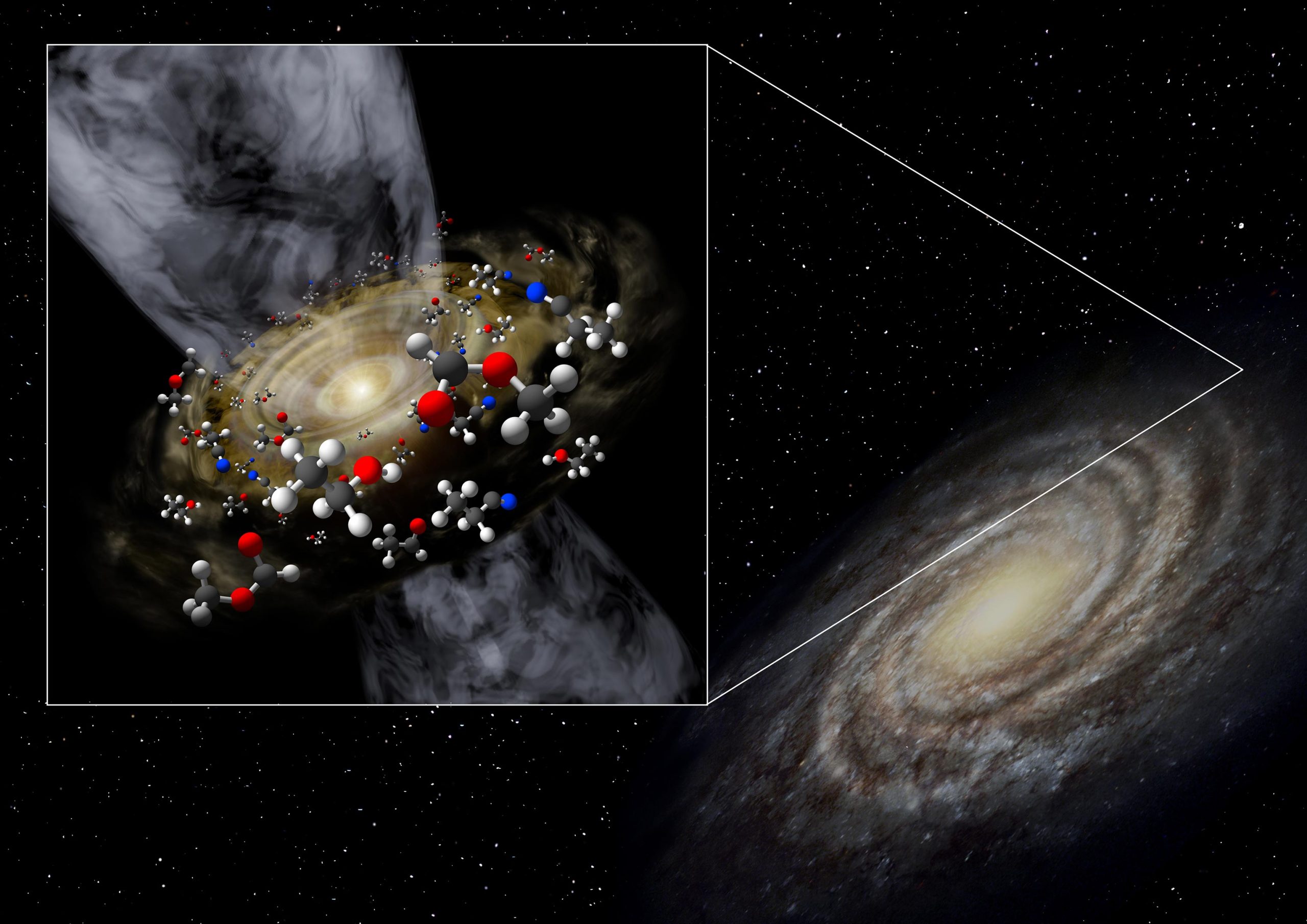
Researchers have discovered a protostar enveloped by complex organic molecules in the outermost regions of the Milky Way, indicating that complex molecular formation is possible even in these remote areas.
For the first time, astronomers have detected a newborn star and the surrounding cocoon of complex organic molecules at the edge of our Galaxy, which is known as the extreme outer Galaxy. The discovery, which revealed the hidden chemical complexity of our Universe, was published in a paper in The Astrophysical Journal.
The scientists from Niigata University (Japan), Academia Sinica Institute of Astronomy and Astrophysics (Taiwan), and the National Astronomical Observatory of Japan, used the Atacama Large Millimeter/submillimeter Array (ALMA) in Chile to observe a newborn star (protostar) in the WB89-789 region, located in the extreme outer Galaxy. A variety of carbon-, oxygen-, nitrogen-, sulfur-, and silicon-bearing molecules, including complex organic molecules containing up to nine atoms, were detected. Such a protostar, as well as the associated cocoon of chemically-rich molecular gas, were for the first time detected at the edge of our Galaxy.
A Rich Molecular Inventory in a Primordial Environment
The ALMA observations reveal that various kinds of complex organic molecules, such as methanol (CH3OH), ethanol (C2H5OH), methyl formate (HCOOCH3), dimethyl ether (CH3OCH3), formamide (NH2CHO), propanenitrile (C2H5CN), etc., are present even in the primordial environment of the extreme outer Galaxy. Such complex organic molecules potentially act as the feedstock for larger prebiotic molecules.
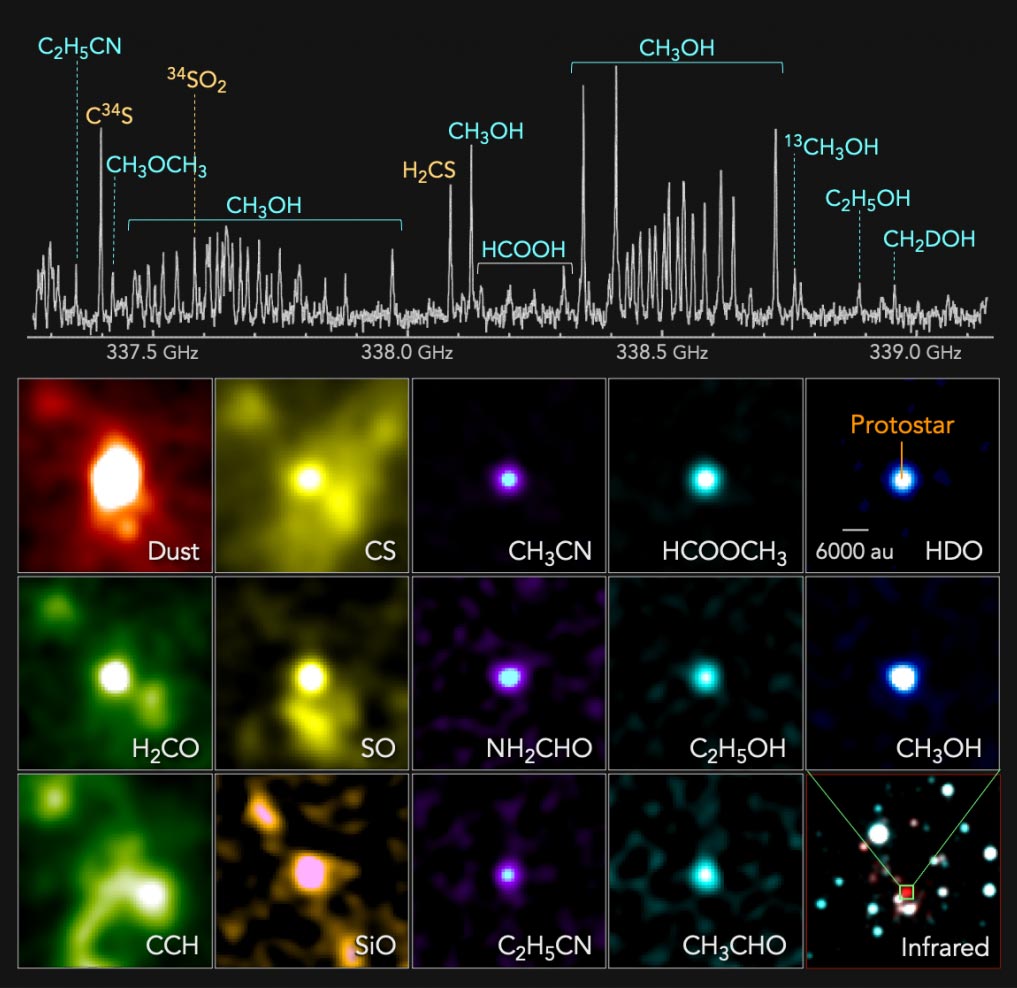
Interestingly, the relative abundances of complex organic molecules in this newly discovered object resemble remarkably well what is found in similar objects in the inner Galaxy. The observations suggest that complex organic molecules are formed with similar efficiency even at the edge of our Galaxy, where the environment is very different from the solar neighborhood.
The Outer Galaxy: A Window Into the Past
It is believed that the outer part of our Galaxy still harbors a primordial environment that existed in the early epoch of galaxy formation. The environmental characteristics of the extreme outer Galaxy, e.g., low abundance of heavy elements, small or no perturbation from Galactic spiral arms, are very different from those seen in the present-day solar neighborhood. Because of its unique characteristics, the extreme outer Galaxy is an excellent laboratory to study star formation and the interstellar medium in the past Galactic environment.
“With ALMA we were able to see a forming star and the surrounding molecular cocoon at the edge of our Galaxy,” says Takashi Shimonishi, an astronomer at Niigata University, Japan, and the paper’s lead author. “To our surprise, a variety of abundant complex organic molecules exists in the primordial environment of the extreme outer Galaxy. The interstellar conditions to form the chemical complexity might have persisted since the early history of the Universe,” Shimonishi adds.
“These observations have revealed that complex organic molecules can be efficiently formed even in low-metallicity environments like the outermost regions of our Galaxy. This finding provides an important piece of the puzzle to understand how complex organic molecules are formed in the Universe,” says Kenji Furuya, an astronomer at the National Astronomical Observatory of Japan, and the paper’s co-author.
It is not yet clear, however, if such a chemical complexity is common in the outer part of the Galaxy. Complex organic molecules are of special interest, because some of them are connected to prebiotic molecules formed in space. The team is planning to observe a larger number of star-forming regions in the future, and hopes to clarify whether chemically-rich systems, as seen in our Solar System, are ubiquitous through the history of the Universe.
Reference: “The Detection of a Hot Molecular Core in the Extreme Outer Galaxy” by Takashi Shimonishi, Natsuko Izumi, Kenji Furuya and Chikako Yasui, 1 December 2021, The Astrophysical Journal.
DOI: 10.3847/1538-4357/ac289b
This work is supported by a Grant-in-Aid from the Japan Society for the Promotion of Science (19H05067, 21H00037, 21H01145).
Never miss a breakthrough: Join the SciTechDaily newsletter.
Follow us on Google and Google News.