
Close Menu
    Facebook X (Twitter) Instagram
    SciTechDaily
    • Biology
    • Chemistry
    • Earth
    • Health
    • Physics
    • Science
    • Space
    • Technology
    Facebook X (Twitter) Pinterest YouTube RSS
    SciTechDaily
    Home»Space»ALMA Uncovers the Building Blocks of Star Formation in Starburst Galaxy
    Space

    ALMA Uncovers the Building Blocks of Star Formation in Starburst Galaxy

    By National Institutes of Natural SciencesApril 23, 2024No Comments3 Mins Read
    Facebook Twitter Pinterest Telegram LinkedIn WhatsApp Email Reddit
    Share
    Facebook Twitter LinkedIn Pinterest Telegram Email Reddit
    Molecular Signposts in Starburst Galaxy
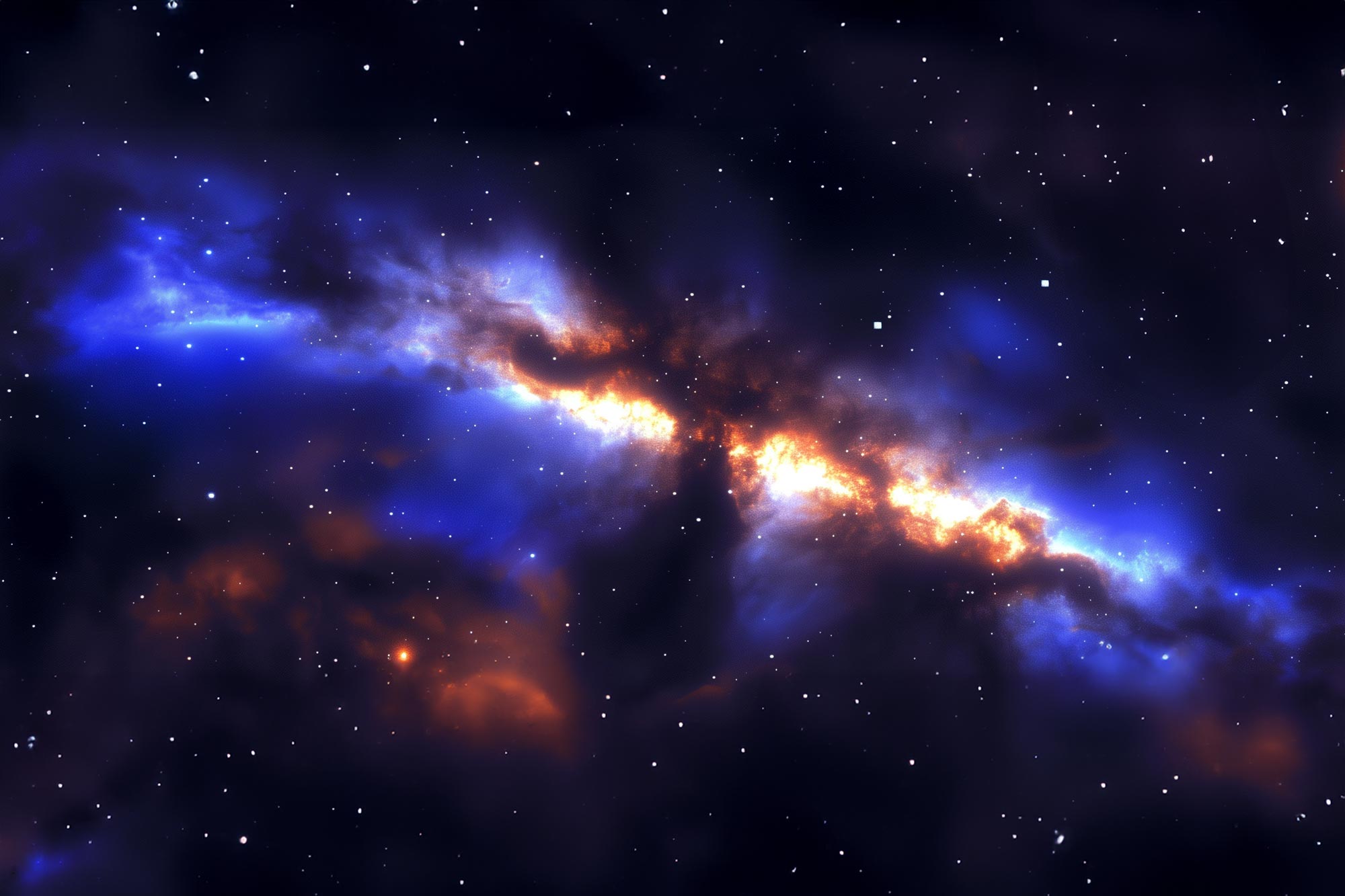
    Researchers using the ALMA telescope discovered over 100 molecular species in the starburst galaxy NGC 253, which is forming stars much more actively than the Milky Way. (Artist’s concept.) Credit: SciTechDaily.com

    ALMA’s observation of NGC 253 reveals significant molecular diversity and star formation, enhancing our knowledge of galactic processes.

    The ALMA radio telescope has detected more than 100 molecular species, including many indicative of different star formation and evolution processes, in a galaxy where stars are forming much more actively than in the Milky Way. This is far more molecules than were found in previous studies. Now the team will try to apply this knowledge to other galaxies.

    Research Team and Galaxy Overview

    A team of researchers led by Sergio Martin of the European Southern Observatory/Joint ALMA Observatory, Nanase Harada of the National Astronomical Observatory of Japan, and Jeff Mangum of the National Radio Astronomy Observatory used ALMA (Atacama Large Millimeter/submillimeter Array) to observe the center of a galaxy known as NGC 253.

    NGC 253 is located about 10 million light-years away in the direction of the constellation Sculptor. NGC 253 is an example of a starburst galaxy, a galaxy where many new stars are forming rapidly. The factors leading to the onset of a starburst are still not well understood.
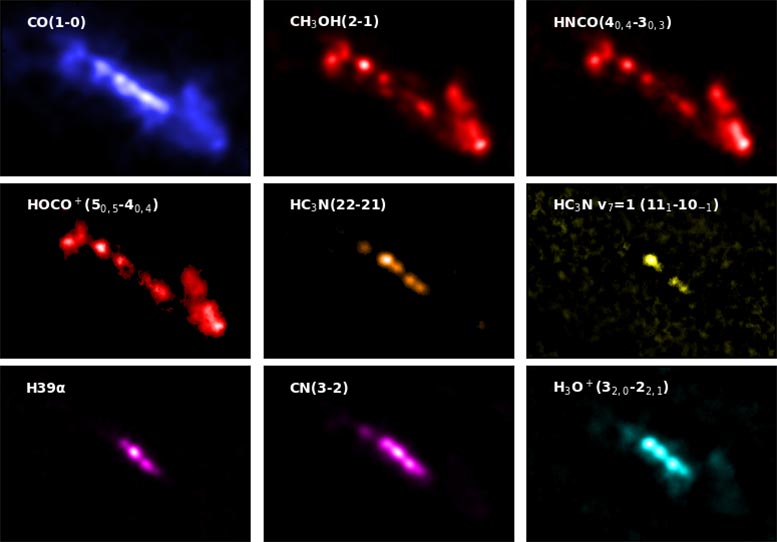
    NGC 253 ALCHEMI Atlas
    The different colors represent the distribution of molecular gas (blue), shocked regions (red), relatively high-density regions (orange), young starbursts (yellow), developed starbursts (magenta), and molecular gas affected by cosmic-ray ionization (cyan). Credit: ALMA (ESO/NAOJ/NRAO), N. Harada et al.

    Molecular Insights and Star Formation

    The birth, evolution, and death of stars change the molecular composition of the surrounding gas. ALMA’s high sensitivity and high resolution allowed astronomers to determine the locations of molecules indicative of the various stages in the life cycle of stars.

    This survey, dubbed ALCHEMI (ALMA Comprehensive High-resolution Extragalactic Molecular Inventory), found high-density molecular gas that is likely promoting active star formation in this galaxy. The amount of dense gas in the center of NGC 253 turned out to be more than 10 times higher than that in the center of the Milky Way, which could explain why NGC 253 is forming stars about 30 times more efficiently.

    Molecular Atlas and Future Implications

    The ALCHEMI survey also provided an atlas of 44 molecular species, doubling the number available from previous studies outside the Milky Way. By applying a machine-learning technique to this atlas, the researchers were able to identify which molecules serve as the best signposts to trace the story of star formation from the beginning to the end. This knowledge will help in planning future ALMA observations.

    Reference: “The ALCHEMI Atlas: Principal Component Analysis Reveals Starburst Evolution in NGC 253” by Nanase Harada, David S. Meier, Sergio Martín, Sebastien Muller, Kazushi Sakamoto, Toshiki Saito, Mark D. Gorski, Christian Henkel, Kunihiko Tanaka, Jeffrey G. Mangum, Susanne Aalto, Rebeca Aladro, Mathilde Bouvier, Laura Colzi, Kimberly L. Emig, Rubén Herrero-Illana, Ko-Yun Huang, Kotaro Kohno, Sabine König, Kouichiro Nakanishi, Yuri Nishimura, Shuro Takano, Víctor M. Rivilla, Serena Viti, Yoshimasa Watanabe, Paul P. van der Werf and Yuki Yoshimura, 15 March 2024, The Astrophysical Journal Supplement Series.
    DOI: 10.3847/1538-4365/ad1937

    Never miss a breakthrough: Join the SciTechDaily newsletter.
    Follow us on Google and Google News.

    ALMA Astronomy Astrophysics National Institutes of Natural Sciences Popular
    Share. Facebook Twitter Pinterest LinkedIn Email Reddit

    Related Articles

    Hidden Rings Around Baby Stars Reveal Earliest Clues of Planet Birth

    Peering Back 13 Billion Years: Dancing Galaxies Craft a Monster at the Dawn of the Universe

    Cosmic Cradles and Graves: Tracing Life and Death of Stars in the Most Distant Galaxy

    ALMA Peers Back 12.4 Billion Years and Discovers the Most Ancient Galaxy of Its Kind Ever Observed

    Natural Cosmic Telescope Helps ALMA Discover Rotating Infant Galaxy

    Planet Formation Theory Questioned After Discovery of Massive Gas Disk Surrounding Young Star

    Mysterious Gigantic Carbon Cocoons Discovered Surrounding Growing Galaxies

    Astronomers Observe the Birth of a Massive Star in the Milky Way

    ALMA Views a Key Stage in the Birth of Giant Planets

    Leave A Reply Cancel Reply

    • Facebook
    • Twitter
    • Pinterest
    • YouTube

    Don't Miss a Discovery

    Subscribe for the Latest in Science & Tech!

    Trending News

    Just a Few Breathless Minutes a Day Could Slash Your Risk of 8 Major Diseases

    This Simple Habit Could Cut Your Risk of Dementia by 30%

    Scientists Debunk Rattlesnake Myth That Fooled Hikers and Doctors for Decades

    Scientists Discover Plants Can “Count” – and May Be Smarter Than We Thought

    New Research Reveals Ancient Mars May Have Been Warm, Wet – and Possibly Alive

    This Surprising Daily Habit Could Cut Dementia Risk by 35%

    Just 10 Minutes a Day: Scientists Say This Ancient Chinese Practice Shows Powerful Blood Pressure Benefits

    Scientists Say This Popular Food Could Help Your Body Get Rid of Microplastics

    Follow SciTechDaily
    • Facebook
    • Twitter
    • YouTube
    • Pinterest
    • Newsletter
    • RSS
    SciTech News
    • Biology News
    • Chemistry News
    • Earth News
    • Health News
    • Physics News
    • Science News
    • Space News
    • Technology News
    Recent Posts
    • Surviving Burns May Have Changed Human Evolution
    • Scientists Discover Hidden “Footprint of Death” That Could Transform How We Fight Disease
    • Blood-Sucking Parasites Could Revolutionize Treatment for Autoimmune Diseases
    • Scientists Uncover Massive Climate Secret Beneath Sweden’s Forests
    • Scientists Unlock 3 Million Years of Climate Secrets Hidden in Antarctic Ice
    Copyright © 1998 - 2026 SciTechDaily. All Rights Reserved.
    • Science News
    • About
    • Contact
    • Editorial Board
    • Privacy Policy
    • Terms of Use

    Type above and press Enter to search. Press Esc to cancel.