
Chandra X-ray Observatory Helps Astronomers Discover a Surprisingly Lonely Galaxy
- There is a surprisingly lonely galaxy about 9.2 billion light-years from Earth.
- Its surroundings have many features of a galaxy cluster, implying the galaxy has likely pulled in and absorbed its former companion galaxies.
- Data from NASA’s Chandra X-ray Observatory and the International Gemini Observatory were used for this discovery.
- This result may push the limits for how quickly galaxies are expected to grow in the early Universe.
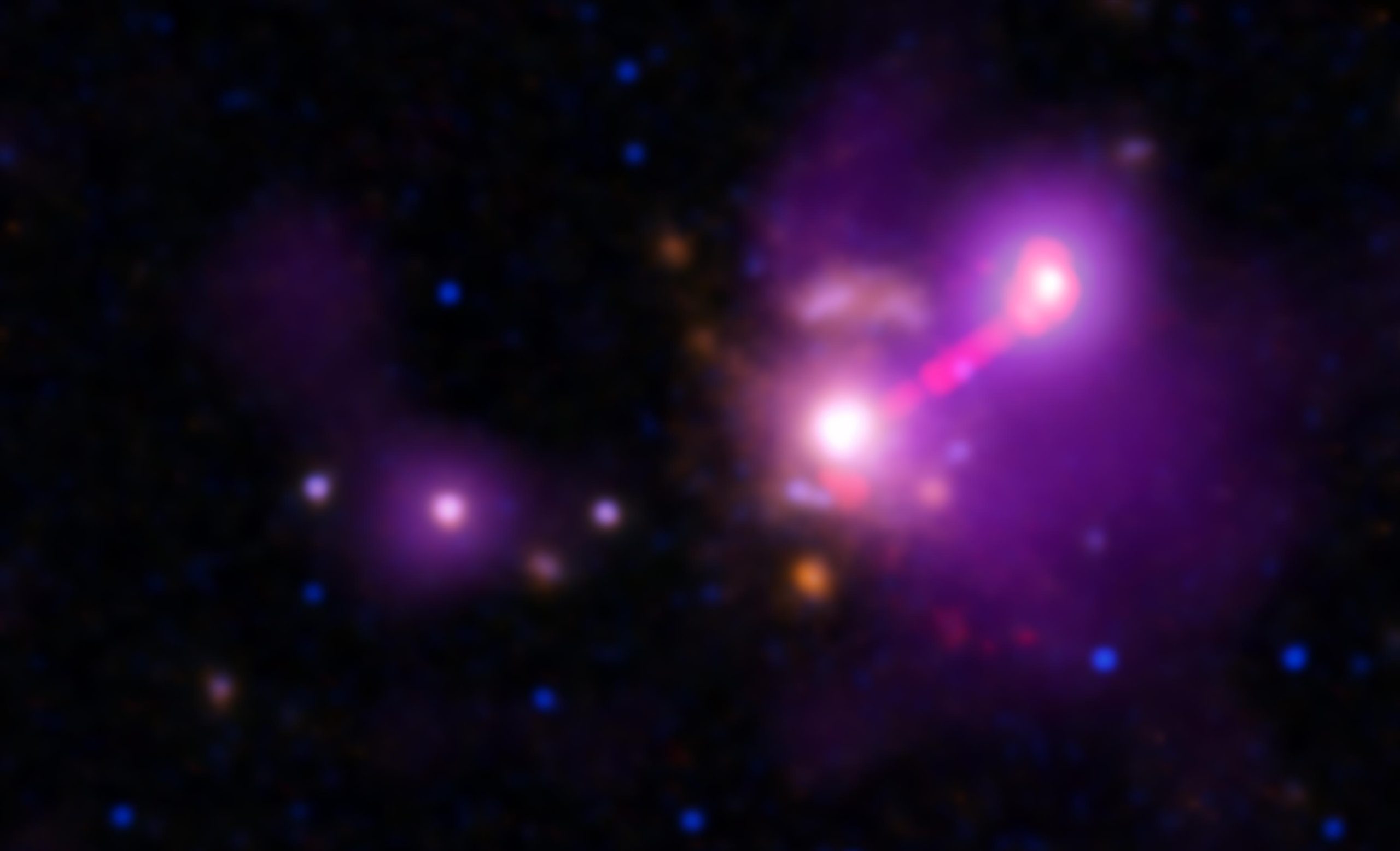
A distant — and lonely — galaxy appears to have pulled in and assimilated all of its former companion galaxies. This result made with NASA’s Chandra X-ray Observatory and the International Gemini Observatory may push the limits for how quickly astronomers expect galaxies to grow in the early universe. Credit: NASA/CXC/A. Hobart
A galaxy called 3C 297, featured in the image at the top of the article, is lonelier than expected after it likely pulled in and absorbed its former companion galaxies. The solo galaxy is located about 9.2 billion light-years from Earth and contains a quasar, a supermassive black hole pulling in gas at the center of the galaxy and driving powerful jets of matter seen in radio waves. This result made with NASA’s Chandra X-ray Observatory and the International Gemini Observatory may push the limits for how quickly astronomers expect galaxies to grow in the early universe.
In several regards, 3C 297 has the qualities of a galaxy cluster, a gigantic structure that contains hundreds or even thousands of individual galaxies. X-ray data from Chandra reveal large quantities of gas heated to millions of degrees — a signature feature of a galaxy cluster. Astronomers also found a jet from the quasar — seen by the Karl G. Jansky Very Large Array — that has been bent by interacting with its surroundings. Finally, Chandra data shows evidence that the other quasar jet has smashed into the gas around it, creating a “hotspot” of X-rays. These are typically characteristics of a galaxy cluster. Yet, data from the Gemini Observatory show there is only one galaxy in 3C 297. The nineteen galaxies that appear close to 3C 297 in a Gemini image are actually at much different distances.
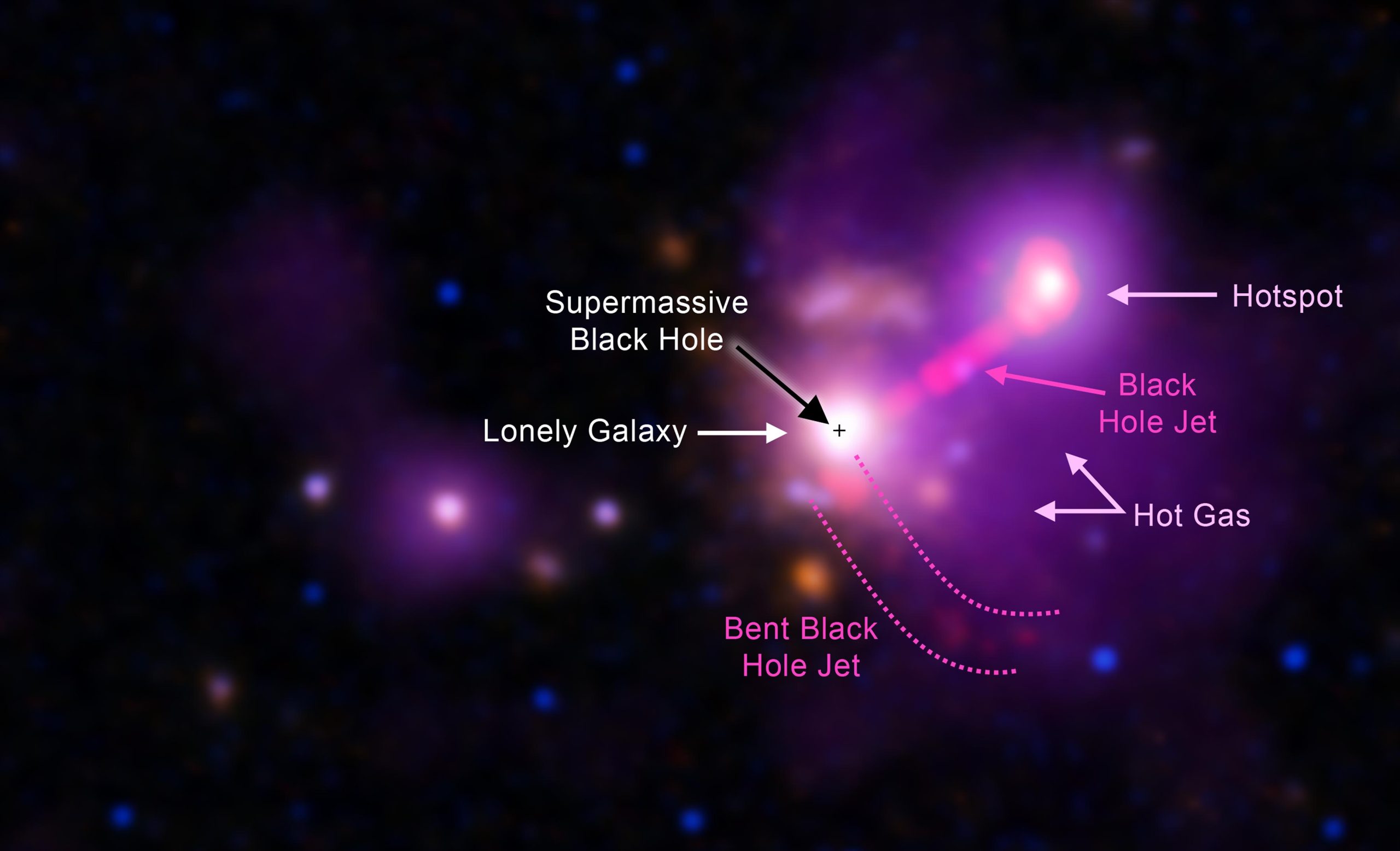
In this new composite image, Chandra data is colored purple, VLA data is red and Gemini data is green. Visible light and infrared data from the Hubble Space Telescope (blue and orange respectively) have also been included. The lonely galaxy (3C 297) and the position of its supermassive black are identified in a labeled version of the image, along with the black hole’s jets, the X-ray hotspot and the hot gas. The field of view of this image is too small to show any of the 19 galaxies that are not at the same distance as 3C 297.
One proposal for what happened to the missing galaxies is that the gravitational pull of the largest galaxy, combined with the interactions between them, caused the companion galaxies to fall and be assimilated by the alpha. The team considers 3C 297 is most likely a “fossil group” instead of a galaxy cluster, a stage of galactic evolution where one galaxy is pulling in and merging with others. If that is the case, 3C 297 represents the most distant fossil group ever found.
The authors cannot rule out the presence of dwarf galaxies around 3C 297, but their presence would still not explain the lack of larger galaxies like the Milky Way. Nearby examples are M87 in the Virgo Cluster, which has had large galactic companions for billions of years. However, 3C 297 will spend billions of years essentially alone.
The new study was published in the January 2023 issue of The Astrophysical Journal. Earlier Chandra observations lasting only three hours showed hints of the hot gas seen in the new study, as reported by co-author Chiara Stuardi in a paper published in the April 2018 issue of The Astrophysical Journal Supplement Series. Much deeper Chandra observations, however, were required to confirm it. The Chandra observations of 3C 297 were taken over a total time of 2.5 days in April and August of 2021 and 2022.
References:
“Powerful Yet Lonely: Is 3C 297 a High-redshift Fossil Group?” by Valentina Missaglia, Juan P. Madrid, Mischa Schirmer, Francesco Massaro, Alberto Rodríguez-Ardila, Carlos J. Donzelli, Martell Valencia, Alessandro Paggi, Ralph P. Kraft Chiara Stuardi and Belinda J. Wilkes, 14 December 2022, The Astrophysical Journal.
DOI: 10.3847/1538-4365/ac9f3e
“The 3CR Chandra Snapshot Survey: Extragalactic Radio Sources with Redshifts between 1 and 1.5″ by C. Stuardi, V. Missaglia, F. Massaro, F. Ricci, E. Liuzzo, A. Paggi, R. P. Kraft, G. R. Tremblay, S. A. Baum, C. P. O’Dea, B. J. Wilkes, J. Kuraszkiewicz, W. R. Forman and D. E. Harris, 2 April 2018, The Astrophysical Journal Supplement Series.
DOI: 10.3847/1538-4365/aaafcf
NASA’s Marshall Space Flight Center manages the Chandra program. The Smithsonian Astrophysical Observatory’s Chandra X-ray Center controls science operations from Cambridge, Massachusetts, and flight operations from Burlington, Massachusetts.
Never miss a breakthrough: Join the SciTechDaily newsletter.
Follow us on Google and Google News.