
Close Menu
    Facebook X (Twitter) Instagram
    SciTechDaily
    • Biology
    • Chemistry
    • Earth
    • Health
    • Physics
    • Science
    • Space
    • Technology
    Facebook X (Twitter) Pinterest YouTube RSS
    SciTechDaily
    Home»Space»NASA Tracking Supermassive Black Holes on Collision Course
    Space

    NASA Tracking Supermassive Black Holes on Collision Course

    By Chandra X-ray ObservatoryMarch 17, 20231 Comment6 Mins Read
    Facebook Twitter Pinterest Telegram LinkedIn WhatsApp Email Reddit
    Share
    Facebook Twitter LinkedIn Pinterest Telegram Email Reddit
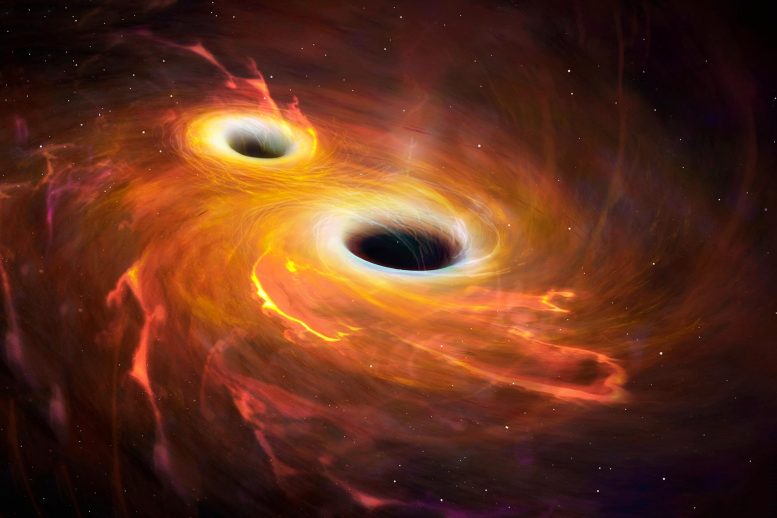
    Supermassive Black Holes Merging Illustration
    NASA’s Chandra X-ray Observatory has detected two pairs of supermassive black holes on collision courses in dwarf galaxies, which is the first evidence of such an impending encounter. This discovery provides crucial information about the early universe’s black hole growth.
    • NASA’s Chandra X-ray Observatory helped identify two pairs of dwarf galaxies on track to merge.
    • Dwarf galaxies, which are at least about 20 times less massive than the Milky Way, likely formed larger galaxies through collisions in the early Universe.
    • These newly-discovered merging dwarf galaxies can be used as analogs for more distant ones that are too faint to observe.
    • The dwarf galaxies are on collision courses and are found in the galaxy clusters Abell 133 and Abell 1758S.
    Chandra Mirabilis Elstir Vinteuil
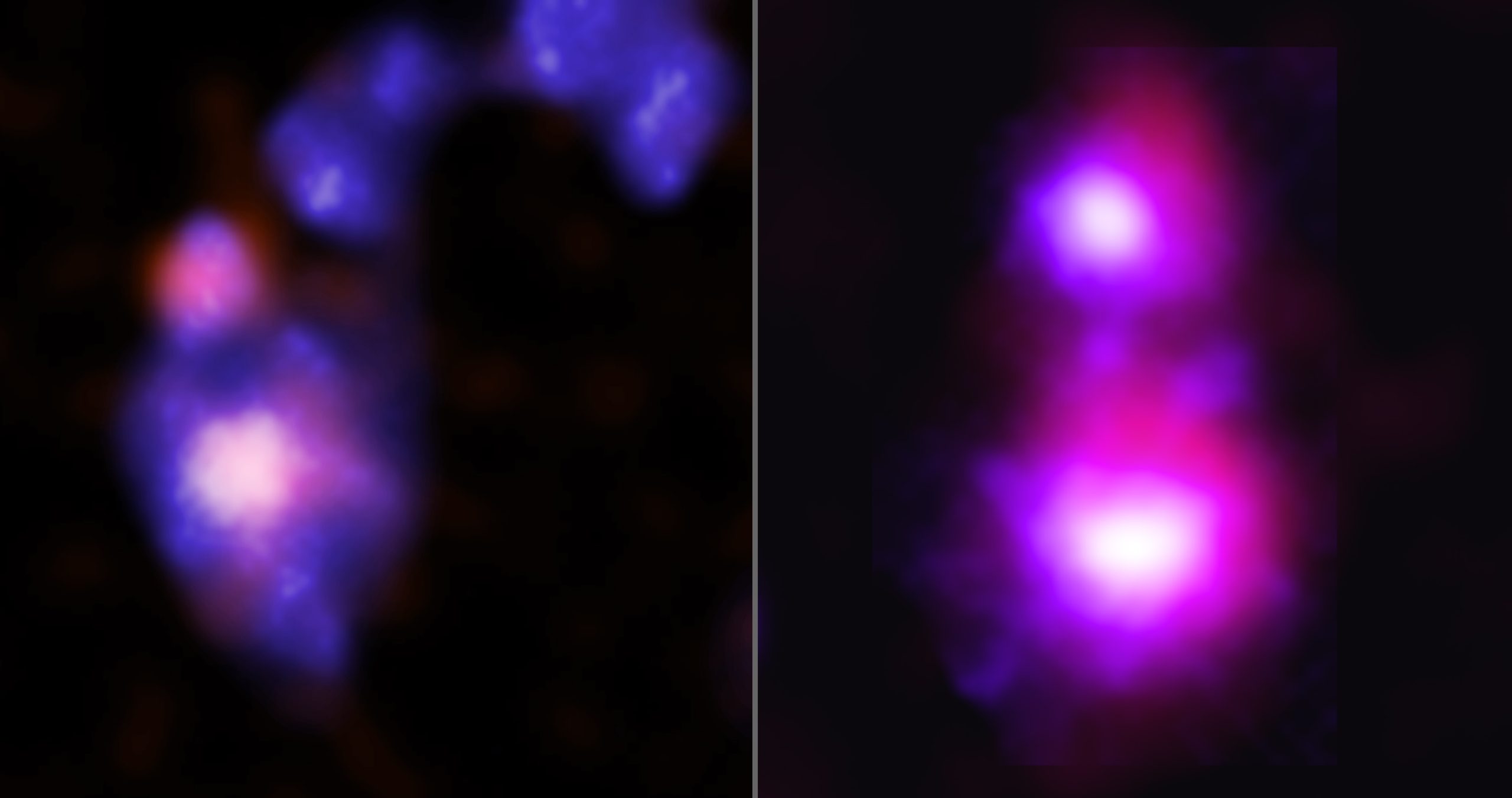
    Evidence for two pairs of supermassive black holes in dwarf galaxies on collision courses has been found with Chandra. The two pairs are shown in X-rays from Chandra and optical light from the Canada-France-Hawaii telescope. The merger on the left is in a late stage and was given the single name of Mirabilis. The other merger is in the early stages and the two dwarf galaxies are named Elstir (bottom) and Vinteuil (top). Astronomers think that dwarf galaxies – those about 20 times less massive than the Milky Way – grow through mergers with others. This is an important process for galaxy growth in the early Universe and this discovery provides examples for scientists to study in greater detail. Credit: X-ray: NASA/CXC/Univ. of Alabama/M. Micic et al.; Optical: International Gemini Observatory/NOIRLab/NSF/AURA

    A new study using NASA’s Chandra X-ray Observatory has tracked two pairs of supermassive black holes in dwarf galaxies on collision courses. This is the first evidence for such an impending encounter, providing scientists with important information about the growth of black holes in the early Universe.

    By definition, dwarf galaxies contain stars with a total mass less than 3 billion Suns — or about 20 times less than the Milky Way. Astronomers have long suspected that dwarf galaxies merge, particularly in the relatively early Universe, in order to grow into the larger galaxies seen today. However, current technology cannot observe the first generation of dwarf galaxy mergers because they are extraordinarily faint at their great distances. Another tactic — looking for dwarf galaxy mergers closer by — had not been successful to date.

    The new study overcame these challenges by implementing a systematic survey of deep Chandra X-ray observations and comparing them with infrared data from NASA’s Wide Infrared Survey Explorer (WISE) and optical data from the Canada-France-Hawaii Telescope (CFHT).

    Chandra was particularly valuable for this study because material surrounding black holes can be heated up to millions of degrees, producing large amounts of X-rays. The team searched for pairs of bright X-ray sources in colliding dwarf galaxies as evidence of two black holes, and discovered two examples.
    Chandra Mirabilis Elstir Vinteuil Labeled
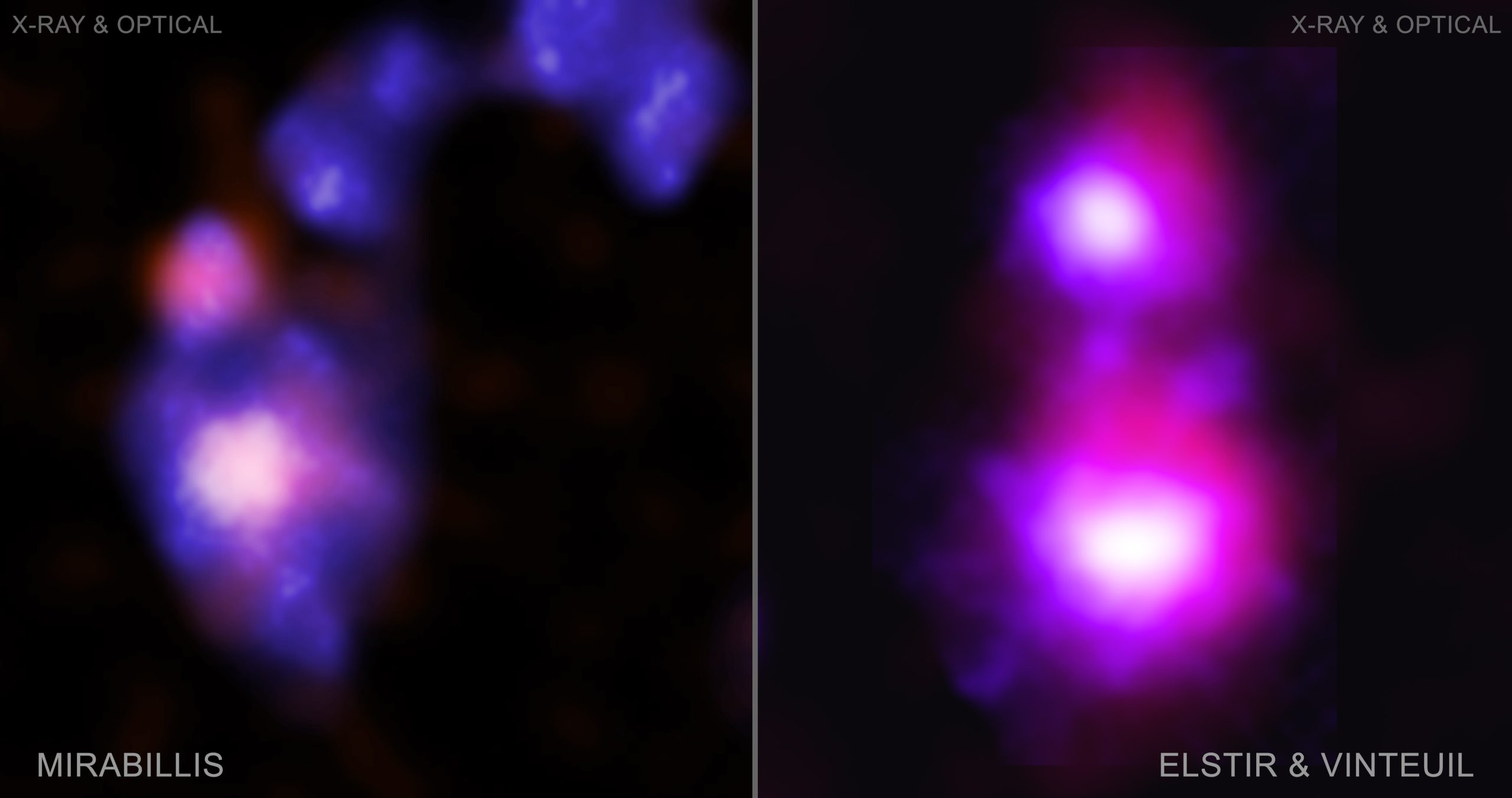
    Evidence for two pairs of supermassive black holes in dwarf galaxies on collision courses has been found with Chandra. The two pairs are shown in X-rays from Chandra and optical light from the Canada-France-Hawaii telescope. The merger on the left is in a late stage and was given the single name of Mirabilis. The other merger is in the early stages and the two dwarf galaxies are named Elstir (bottom) and Vinteuil (top). Astronomers think that dwarf galaxies – those about 20 times less massive than the Milky Way – grow through mergers with others. This is an important process for galaxy growth in the early Universe and this discovery provides examples for scientists to study in greater detail. Credit: X-ray: NASA/CXC/Univ. of Alabama/M. Micic et al.; Optical: International Gemini Observatory/NOIRLab/NSF/AURA

    One pair is in the galaxy cluster Abell 133 located 760 million light-years from Earth, seen in the composite image on the left. Chandra X-ray data is in pink and optical data from CFHT is in blue. This pair of dwarf galaxies appears to be in the late stages of a merger, and shows a long tail caused by tidal effects from the collision. The authors of the new study have nicknamed it “Mirabilis” after an endangered species of hummingbird known for their exceptionally long tails. Only one name was chosen because the merger of two galaxies into one is almost complete. The two Chandra sources show X-rays from material around the black holes in each galaxy.

    Chandra Mirabilis
    X-ray and optical composite of Mirabilis. Credit: X-ray: NASA/CXC/Univ. of Alabama/M. Micic et al.; Optical: International Gemini Observatory/NOIRLab/NSF/AURA

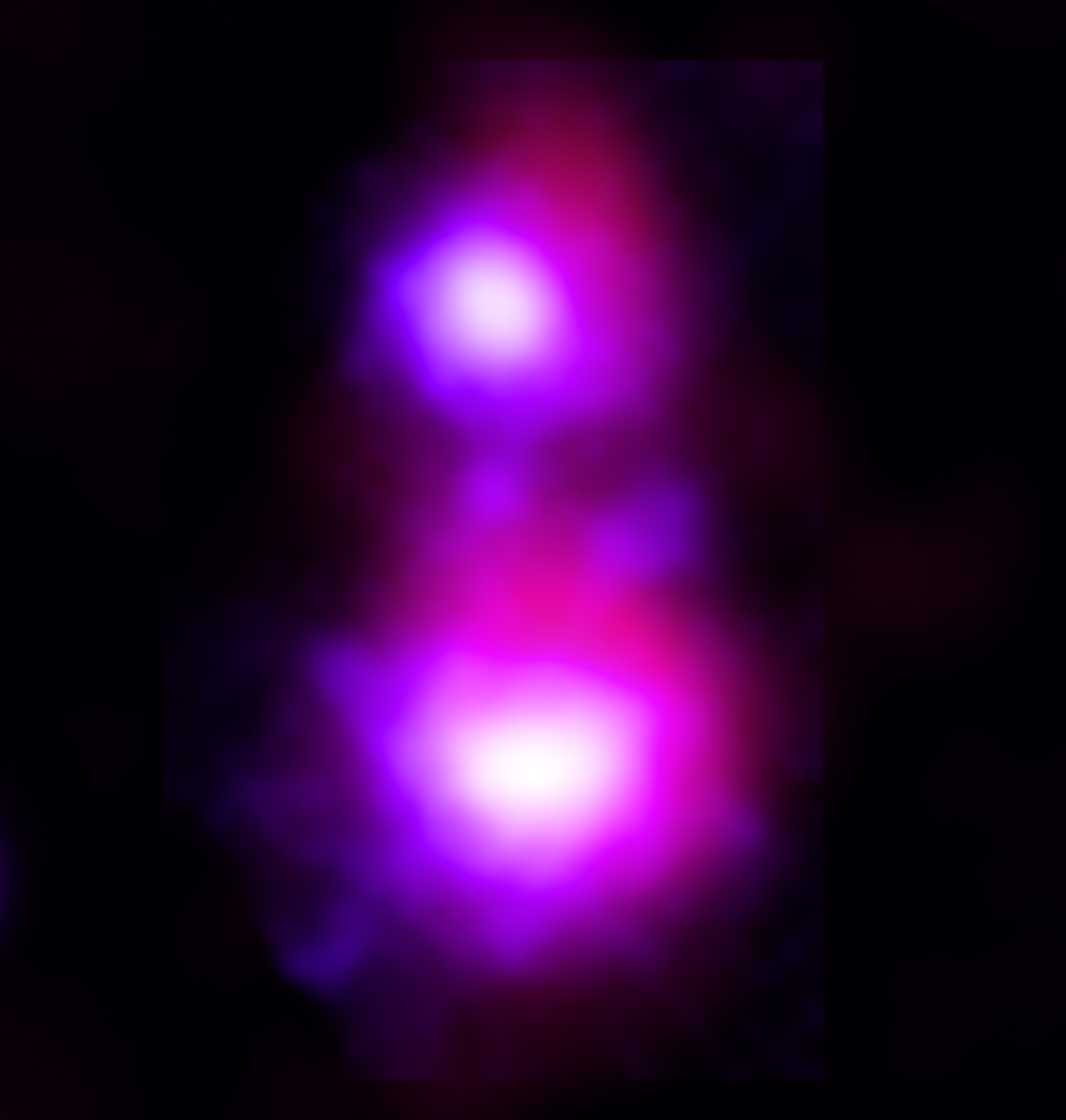
    The other pair was discovered in Abell 1758S, a galaxy cluster about 3.2 billion light-years away. The composite image from Chandra and CFHT is on the right, using the same colors as for Mirabilis. The researchers nicknamed the merging dwarf galaxies “Elstir” and “Vinteuil,” after fictional artists from Marcel Proust’s “In Search of Lost Time”. Vinteuil is the galaxy on the top and Elstir is the galaxy on the bottom. Both have Chandra sources associated with them, again from X-rays from material around the black holes in each galaxy. The researchers think these two have been caught in the early stages of a merger, causing a bridge of stars and gas to connect the two colliding galaxies from their gravitational interaction.
    Chandra Elstir Vinteuil
    X-ray and optical composite of Elstir & Vinteuil. Credit: X-ray: NASA/CXC/Univ. of Alabama/M. Micic et al.; Optical: International Gemini Observatory/NOIRLab/NSF/AURA

    The details of merging black holes and dwarf galaxies may provide insight to our Milky Way’s own past. Scientists think nearly all galaxies began as dwarf or other types of small galaxies and grew over billions of years through mergers. Follow-up observations of these two systems will allow astronomers to study processes that are crucial for understanding galaxies and their black holes in the earliest stages of the Universe.

    A paper describing these results was published in the latest issue of The Astrophysical Journal.

    Reference: “Two Candidates for Dual AGN in Dwarf-Dwarf Galaxy Mergers” by Marko Mićić, Olivia J. Holmes, Brenna N. Wells and Jimmy A. Irwin, 22 February 2023, The Astrophysical Journal.
    DOI: 10.3847/1538-4357/aca1bb

    The authors of the study are Marko Micic, Olivia Holmes, Brenna Wells, and Jimmy Irwin, all from the University of Alabama at Tuscaloosa.

    NASA’s Marshall Space Flight Center manages the Chandra program. The Smithsonian Astrophysical Observatory’s Chandra X-ray Center controls science operations from Cambridge, Massachusetts, and flight operations from Burlington, Massachusetts.

    Never miss a breakthrough: Join the SciTechDaily newsletter.
    Follow us on Google and Google News.

    Astronomy Astrophysics Black Hole Chandra X-ray Observatory NASA Popular
    Share. Facebook Twitter Pinterest LinkedIn Email Reddit

    Related Articles

    X-Ray Echoes Unveil the Hidden 3D Landscape of Our Galaxy’s Heart

    Black Holes Cook Their Own Fuel in a Cosmic Feast

    Black Hole Tears Star to Shreds, Unleashing Cosmic Shockwaves

    Centaurus A’s Massive 13,000 Light-Year Jet Captured in Stunning Detail

    Astronomical Appetite: NASA Telescopes Decode a Supermassive Black Hole’s Snack Schedule

    Telescopes Reveal Rapid Spin of Milky Way’s Black Hole Warping Spacetime

    Astronomers Measure Distant Black Hole’s Spin

    NASA Image of the Day – Black Holes Have Simple Feeding Habits

    NASA Data Suggests Black Holes Abundant Among the Earliest Stars

    1 Comment

    1. Rish on March 21, 2023 4:28 am

      If these two clusters are 760 million and 3.3 billion light years from us respectively, then doesn’t that mean that we are getting 760 million year old and 3.2 billion year old data now?

      Reply
    Leave A Reply Cancel Reply

    • Facebook
    • Twitter
    • Pinterest
    • YouTube

    Don't Miss a Discovery

    Subscribe for the Latest in Science & Tech!

    Trending News

    289-Million-Year-Old Reptile Mummy Reveals Origin of Human Breathing System

    New Brain Discovery Challenges Long-Held Theory of Teenage Brain Development

    Scientists Discover Plants “Scream” – We Just Couldn’t Hear Them Until Now

    Scientists Discover a Surprising Reason Intermittent Fasting Extends Life

    This Simple Fruit Wash Could Make Produce Safer and Last Days Longer

    Scientists Say Adding This Unusual Seafood to Your Diet Could Reverse Signs of Aging

    Scientists Say a Hidden Structure May Exist Inside Earth’s Core

    Doctors Surprised by the Power of a Simple Drug Against Colon Cancer

    Follow SciTechDaily
    • Facebook
    • Twitter
    • YouTube
    • Pinterest
    • Newsletter
    • RSS
    SciTech News
    • Biology News
    • Chemistry News
    • Earth News
    • Health News
    • Physics News
    • Science News
    • Space News
    • Technology News
    Recent Posts
    • Breakthrough Bowel Cancer Trial Leaves Patients Cancer-Free for Nearly 3 Years
    • New Immune Pathway Could Supercharge mRNA Cancer Vaccines
    • Natural Compound Shows Powerful Potential Against Rheumatoid Arthritis
    • 100,000-Year-Old Neanderthal Fossils in Poland Reveal Unexpected Genetic Connections
    • Unexpected Hormone Discovery Could Change How We Treat Arthritis
    Copyright © 1998 - 2026 SciTechDaily. All Rights Reserved.
    • Science News
    • About
    • Contact
    • Editorial Board
    • Privacy Policy
    • Terms of Use

    Type above and press Enter to search. Press Esc to cancel.