
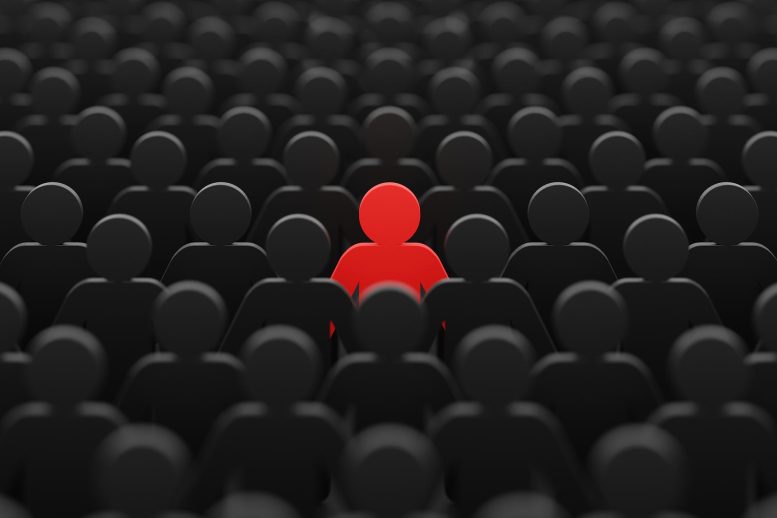
New research suggests that lonely individuals process the world differently than their peers, regardless of their social network size, potentially contributing to their feelings of disconnection.
Common wisdom suggests that a core difference between solitude and loneliness is choice. Whereas a person who appreciates solitude might choose to enjoy a quiet night in or a solo trip abroad, a lonely person may feel disconnected from other people even in a crowded room. New research published in the journal Psychological Science supports this notion, suggesting that lonely people may think differently regardless of the size of their social networks.
“We found that lonely individuals are exceptionally dissimilar to their peers in the way that they process the world around them … even when taking into account the number of friends that they have,” said lead author Elisa C. Baek (University of Southern California) in an interview. Her study showed that lonely individuals’ neural responses differ from those of other people, suggesting that “seeing the world differently than those around you may be a risk factor for loneliness, even if you regularly socialize with them.”
Baek and colleagues Ryan Hyon, Karina López, Meng Du, Mason A. Porter, and Carolyn Parkinson (University of California, Los Angeles [UCLA]) came to this conclusion by comparing the functional magnetic resonance imaging (fMRI) scans of 63 first-year university students.
During each 90-minute scan, participants viewed 14 engaging video clips in the same order. After the scan, they self-reported their feelings of social connection using the UCLA Loneliness Scale. Earlier in the academic year, each participant had also completed a social network survey in which they were asked to list the names of each person with whom they studied, ate meals, or otherwise hung out during their first several months as students.
In order to analyze these data, Baek and colleagues divided participants into two groups: a “lonely” group with participants who scored higher than the median on the loneliness scale and a nonlonely group with participants who scored under the median.
Neural Divergence Among Lonely Individuals
When the researchers compared these participants’ scans, they found that the brain activity of lonely participants was very dissimilar to that of both nonlonely participants and other lonely participants. By comparison, the brain activity of nonlonely participants was similar to that of other nonlonely participants. This was especially true in the default-mode network, in which shared brain activity appears to be associated with interpreting narratives and friendships in a similar manner, and in the reward-processing areas of the brain, the researchers wrote. These findings remained significant even when the researchers controlled for demographic characteristics and the size of participants’ social networks.
“Lonely people process the world idiosyncratically, which may contribute to the reduced sense of being understood that often accompanies loneliness,” the researchers explained.
Additional research is needed in order to determine the underlying cause of these results, however, Baek said.
“One possibility is that lonely individuals do not find value in the same aspects of situations or scenes as their peers,” Baek and colleagues wrote. “This may result in a reinforcing feedback loop in which lonely individuals perceive themselves to be different from their peers, which may in turn lead to further challenges in achieving social connection.”
Another possibility is that loneliness itself could lead people to process information differently, the researchers added.
In either case, learning more about how lonely people think, and how to promote shared understanding, could help identify new pathways for reducing loneliness, Baek said.
Reference: “Lonely Individuals Process the World in Idiosyncratic Ways” by Elisa C. Baek, Ryan Hyon, Karina López, Meng Du, Mason A. Porter and Carolyn Parkinson, 7 April 2023, Psychological Science.
DOI: 10.1177/09567976221145316
Never miss a breakthrough: Join the SciTechDaily newsletter.
Follow us on Google and Google News.
7 Comments
This article just says the same thing over and over in different ways.
I agree
Loneliness is better being with crowded stupid individuals that don’t understand your feelings,in being Lonely you can reach the aims of your mind.
It could be that there is a technological disconnect between a real society and the imagined one we choose to live in every day. To the extent that we label these people as lonely and different is not necessarily a matter of individual consideration but instead is quite referential to the type of society we are actually living in. Perhaps it’s these lonely people who actually have it right and the connection or rather our artificially injected connection that our technology and our infrastructure forces on the individual not wanting to accept this artificiality and insincerity masking itself as a healthy society is the problem. The problem further from this is that we can’t change our society we can only change our own perspectives and it rather becomes fruitless to try to change a society that doesn’t want to change and we can only change ourselves and our own adaptation for survival. When love is directly proportional to the amount of money somebody has and not their human worth, and we build a whole society upon that foundation, perhaps the lonely and isolated individuals who found freedom from this forcibly conditioned society by removing their presence from it in a self-actualizing and self-supporting way actually have the right answer for themselves.
Perhaps we need to go back to an Emersonian approach to self-reliance, and it is this removal of self from larger society that frees the self from the shackles of society.
Your comment was Excellent. Thank you.
Thank you for what you’ve said. You get it.
When you realise that the only explanation why we feel lonely is because most people nowadays are boring and total idiots. POINT. No further research needed.