
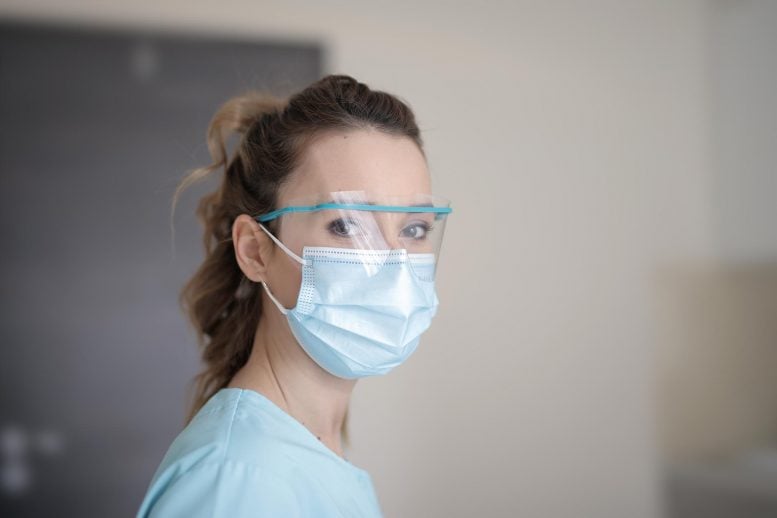
Analysis shows coughing, deep breathing and shouting creates more than 100-fold greater amounts of aerosols than oxygen therapies, potentially increasing risk to frontline staff who wear only surgical masks.
New research published in Anaesthesia (a journal of the Association of Anaesthetists) challenges the guidance that special aerosol precautions are only needed when using oxygen therapies for COVID-19 patients, and raises concerns about safety of staff and patients in hospital wards, if they are not protected from infectious aerosols.
The study set out to examine whether oxygen therapies used for patients with severe COVID-19 produce large amounts of small respiratory particles called aerosols, which can transmit virus and evade routine precautions used in hospital wards. The study found these oxygen therapies do not produce excessive amounts of aerosols and in fact reduce aerosols suggesting these therapies can be made widely available.
Coughing and Breathing Drive Aerosols
The study also showed that respiratory activities such as coughing and deep breathing are a major source of aerosol particles, and this has the potential to expose healthcare workers to an increased risk of infection. Importantly, the authors make clear that this study used 10 healthy volunteers to produce the aerosols measured, not patients infected with SARS-CoV-2.
The authors of the study, who include Dr. Nick Wilson (Royal Infirmary of Edinburgh, NHS Lothian, Scotland), Prof Euan Tovey (University of Sydney), Prof Guy Marks (University of New South Wales, Sydney), and Prof Tim Cook (Royal United Hospitals Bath NHS Foundation Trust, Bath, UK) say that their findings could in part explain why staff working in wards who wear only surgical masks have around two to three times higher rates of infection and hospitalization than those working in ICU where more complete personal protective equipment such as N95/FFP3 respirator masks are used.
The researchers built a new chamber providing extremely clean air, in which 10 healthy volunteers sat. They breathed into a large cone, and the researchers collected the particles that were breathed out and used a specialized machine called an ‘optical particle counter’ to measure the number and size of the particles. In contrast to previous studies the researchers collected almost all particles breathed out and this enabled a clear comparison between the amounts of aerosols generated by respiratory activities and oxygen therapies.
First, the volunteers performed respiratory activities including breathing, talking, shouting, coughing, and exercising, designed to mimic respiratory activity of patients with respiratory infections such as COVID-19. This showed that increased respiratory activity (such as coughing and deep breathing) which is common in patients with COVID-19 increases aerosols by more than 100 times.
The volunteers then repeated the experiments while receiving oxygen therapies commonly used in hospitalized patients with severe COVID-19, first the delivery of oxygen at high flow into the nose (high flow nasal oxygen) and then oxygen delivered under pressure through a tight-fitting facemask (non-invasive ventilation). Aerosol numbers were not increased and during increased respiratory activities and were actually reduced.
Misguided PPE Guidance Under Scrutiny
There is much debate over the role of respiratory particles in guidelines for preventing transmission of COVID-19. Larger particles (larger than 1/200th of a millimeter) are traditionally called ‘droplets’ and are deemed to travel only 1-2 meters from an infected patient before falling to the ground. Aerosols are smaller particles (smaller than 1/200th of a millimeter) and stay floating in the air for prolonged periods, spread further, may accumulate in poorly ventilated spaces, can be inhaled deep into the lungs and bypass looser fitting facemasks. Much current guidance is designed to protect from droplets and infection spread by aerosols is only considered a risk when caused by medical therapies. In this new study, the volunteers produced up to 100 times more aerosol particles with activities such as coughing than they did during treatment with oxygen therapies.
This challenges the current guidelines which state healthcare staff looking after patients with COVID-19 who are coughing and have breathing difficulty only need PPE that protects against the larger droplets. ‘Droplet protection’ includes surgical masks but does not prevent aerosol particles passing around the edges of the masks and being inhaled. N95/FFP3 respirators which are tightfitting and filter better, block more aerosols but guidelines currently recommend these only for staff looking after patients receiving the advanced oxygen therapies.
Study lead author Dr. Nick Wilson explains: “More than 90% of the total number of particles produced by both activities and therapies were the smaller aerosols. Aerosols are important as they can travel long distances in the air, evade loose fitting surgical facemasks and be inhaled deep into the lung. This raises concerns about the safety of those around patients with COVID-19.”
Prof Euan Tovey says: “The coughing and labored breathing common in patients with COVID-19 produces a lot more droplets and aerosols than is produced by patients being treated with oxygen therapies. Surgical facemasks provide inadequate protection against aerosols and staff safety can only be increased by more widespread use of specialized tight-fitting respirators (N95 or FFP3 masks) and increased indoor ventilation. Also, as the respiratory therapies did not significantly increase aerosols, these treatments should be made widely available to patients with COVID-19 who need them.”
Prof Guy Marks says: “The study also has implications beyond hospitals. The generation of both droplets and particularly aerosols by everyday breathing activities reinforces the importance of maintaining social distance, having excellent ventilation in buildings and transport, being outside where possible, and using effective masks both to protect from breathing in virus and reducing the amount of virus they spread when breathing out.”
Prof Tim Cook concludes: “Our findings strongly support the re-evaluation of guidelines to better protect hospital staff, patients and all those on the front line who are dealing with people who have, or are suspected of having, COVID-19.”
Reference: “The effect of respiratory activity, non-invasive respiratory support and facemasks on aerosol generation and its relevance to COVID-19” by N. M. Wilson, G. B. Marks, A. Eckhardt, A. M. Clarke, F. P. Young, F. L. Garden, W. Stewart, T. M. Cook and E. R. Tovey, 30 March 2021, Anaesthesia.
DOI: 10.1111/anae.15475
Never miss a breakthrough: Join the SciTechDaily newsletter.
Follow us on Google and Google News.