
Close Menu
    Facebook X (Twitter) Instagram
    SciTechDaily
    • Biology
    • Chemistry
    • Earth
    • Health
    • Physics
    • Science
    • Space
    • Technology
    Facebook X (Twitter) Pinterest YouTube RSS
    SciTechDaily
    Home»Science»406 Day: Celebrating Galileo Saving Lives
    Science

    406 Day: Celebrating Galileo Saving Lives

    By European Space Agency (ESA)April 8, 2021No Comments5 Mins Read
    Facebook Twitter Pinterest Telegram LinkedIn WhatsApp Email Reddit
    Share
    Facebook Twitter LinkedIn Pinterest Telegram Email Reddit
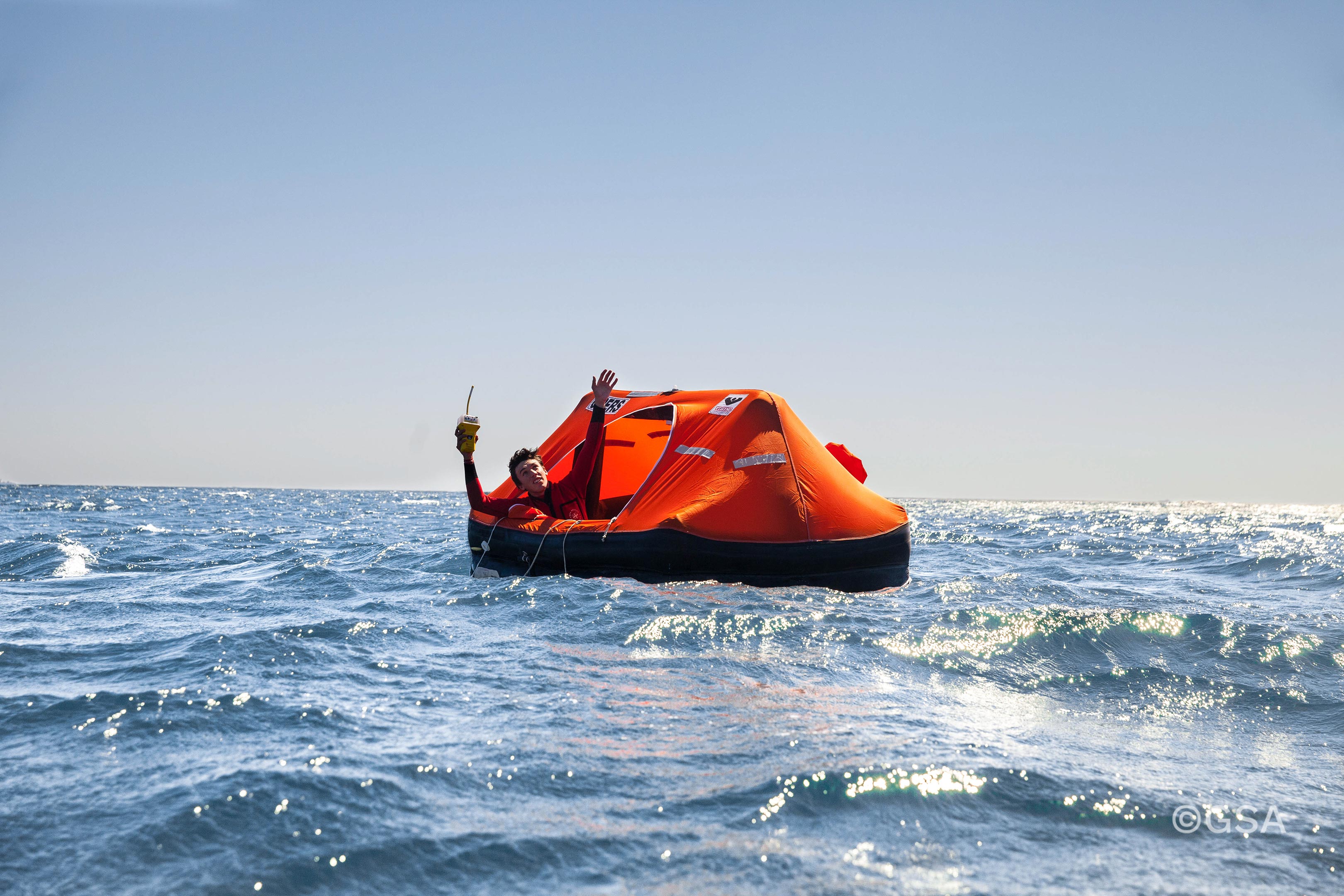
    EPIRB Call for Help Crop
    Stranded sailors in liferaft use an emergency position-indicating radio beacon (EPIRB) to call for help. Credit: ESA

    April 6 was 406 Day – the annual campaigning day to spread awareness of the importance of emergency beacons, and the satellites that pick up their signals, including Europe’s Galileo constellation. As well as letting people across the world find their way, Galileo also serves to detect SOS messages and relay them to authorities, contributing to saving many lives.

    Such detections can happen anytime, but one recent high-profile incident happened in the midst of the Vendée Globe solo round-the-world yacht race. Skipper Kevin Escoffier had his boat smashed to pieces by fierce waves in the Southern Ocean.
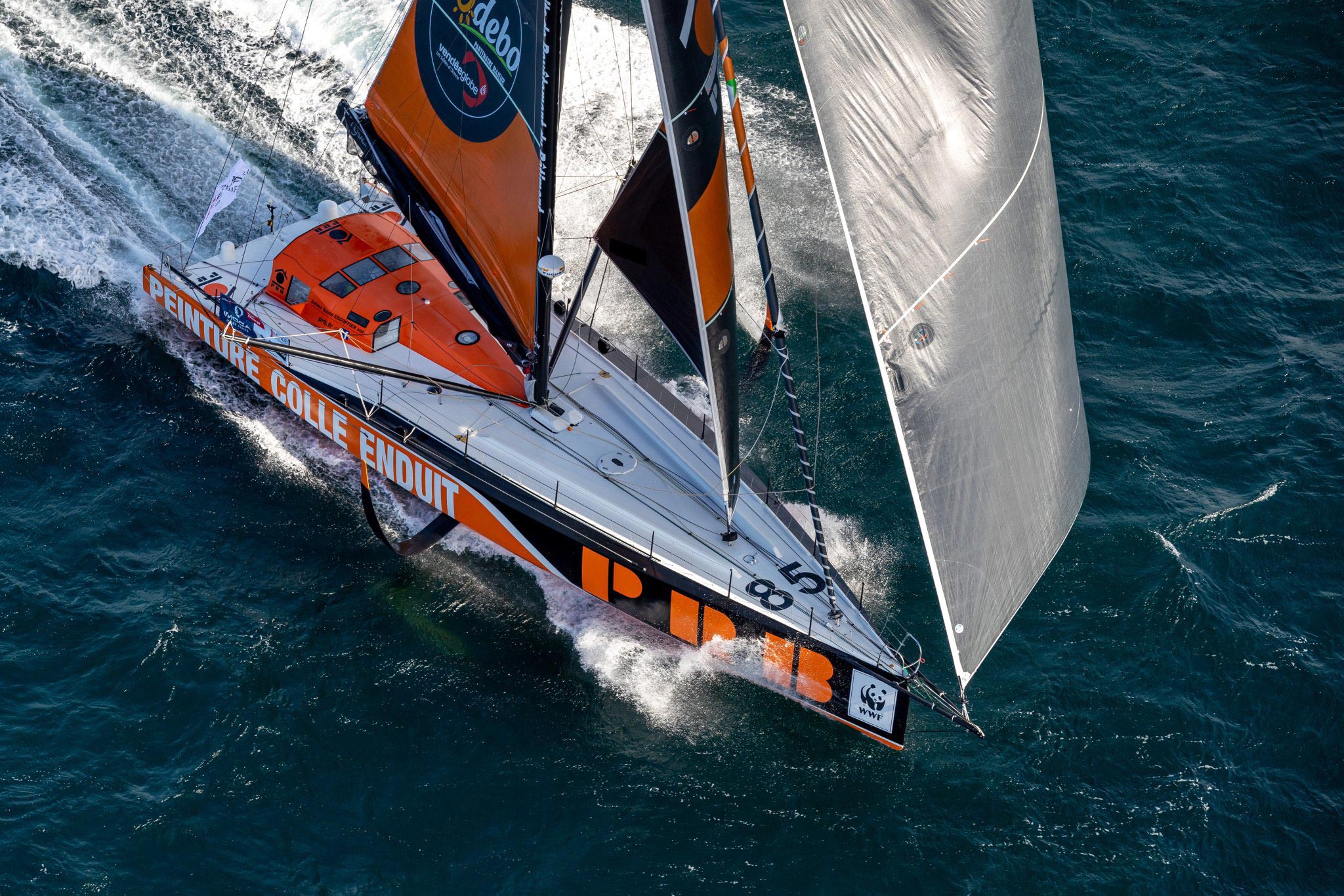
    PRB Yacht
    Vendée Globe race skipper Kevin Escoffier’s PRB yacht was broken up in rough seas on November 30, 2020. The solo yachtsman took to his life raft and was rescued by competitor Jean Le Cam the following day, thanks to an SOS signal that gave his position, relayed by Galileo satellites through the international Cospas-Sarsat system. Credit: Jean-Marie Liot/PRB #VG2020

    He took to his life raft. As it hit the water it automatically activated his rescue beacon, transmitting a 406 MHz SOS signal for automatic pickup by participating satellites, courtesy of the Cospas-Sarsat satellite-based emergency detecting and locating system. The signal allowed the race authorities to localize Kevin’s position within a matter of minutes and send nearby boats to the rescue.

    The only system that can independently locate a beacon anywhere on Earth’s surface, Cospas-Sarsat has helped save thousands of people since it was first established in 1982. Originally the system operated through transponders hosted aboard either low-Earth orbit or geostationary satellites.

    In the last decade Galileo joined Cospas-Sarsat – supported by the European Commission, the system’s owner – driving a significant increase in performance. Because they have such a high orbital altitude, at 23,222 km (14,429 mi) up, while still moving steadily through the sky, Galileo satellites combine broad views of Earth with the ability to facilitate quick determination of the position of a distress signal through a combination of time-based and Doppler ranging.
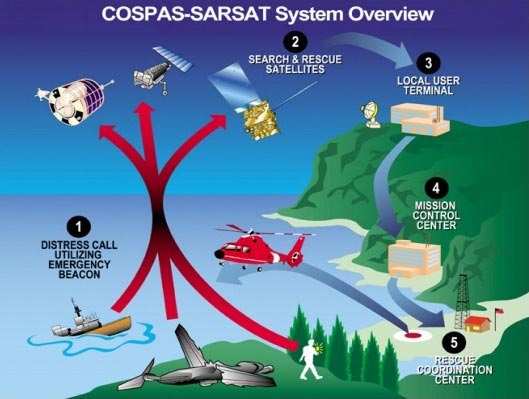
    Cospas Sarsat
    For three decades the Cospas–Sarsat system has used relays on satellites such as Europe’s MSG and MetOp to pick up distress calls from ships and aircraft. Credit: Cospas-Sarsat

    406 Day

    International 406 Day – taking its name from the radio frequency used by Cospas-Sarsat beacons, and the US order of today’s date – seeks to remind beacon users to take care to check their batteries and functionality. Such beacons are used aboard boats and ships, also aboard aircraft, and are also carried by hikers in the wilderness – anywhere beyond the reach of standard phone-based emergency services.

    All the same, an SOS signal can reach the authorities surprisingly swiftly, within a few minutes. First, the signal from the beacon is detected automatically by the search and rescue payload aboard participating satellites – often more than one at once – then pinpoints its source on Earth’s surface.

    Next, this information is relayed – via a set of stations on the corners of Europe, in the case of Galileo-detected signals – then passed to the nearest national rescue center, at which point the rescue can begin.
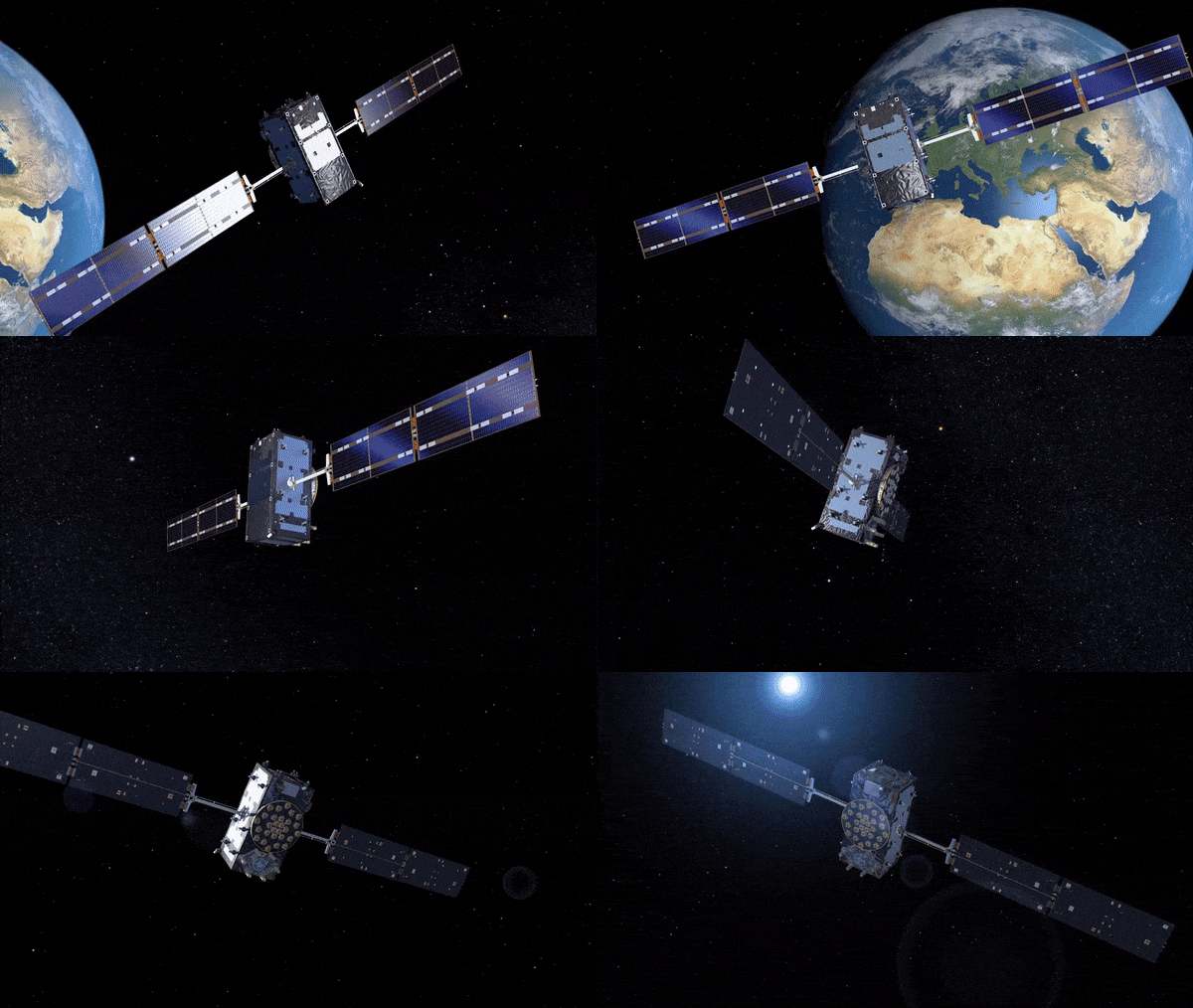
    Galileo Satellite
    Galileo satellites are placed in medium orbits, at 23,222 km (14,429 mi) altitude along three orbital planes so that a minimum of four satellites are visible to user receivers at any point on Earth. The satellites continuously broadcast navigation messages, allowing receivers to pinpoint their position. They also relay search and rescue messages received worldwide. Credit: ESA

    The beacons themselves are surprisingly compact in size, typically the size of a medium-sized flashlight. But the search and rescue payloads carried aboard the Galileo satellites in orbit are similarly modest. At only 8 kg (18 lb) in mass, these life-saving payloads consume just 3% of onboard power, with their receive-transmit repeater housed next to the main navigation antenna.

    All but the first two of the 26 Galileo satellites in orbit carry these payloads, with two more satellites scheduled to add to their number later this year.

    Galileo’s Search and Rescue service is Europe’s contribution to Cospas-Sarsat, operated by the European Global Navigation Satellite System Agency, GSA, and designed and developed by ESA.

    The Cospas-Sarsat satellite repeaters are supplemented by a trio of ground stations at the corners of Europe, known as Medium-Earth Orbit Local User Terminals (MEOLUTs), based in Norway’s Spitsbergen Islands, Cyprus, and Spain’s Canary Islands and coordinated from a control center in Toulouse, France.

    This trio is soon to become a quartet, with a fourth station on France’s La Reunion Island in the Indian Ocean.

    Galileo’s participation in Cospas-Sarsat has led in turn to a service innovation – from last year, Galileo has been replying to SOS signals with ‘return link messages’, assuring those in peril that their signals have been received and help is on the way.

    Never miss a breakthrough: Join the SciTechDaily newsletter.
    Follow us on Google and Google News.

    European Space Agency Safety
    Share. Facebook Twitter Pinterest LinkedIn Email Reddit

    Related Articles

    This Star Exploded – And Came Back Brighter Than Before

    The Invisible Fleet: How AI and Sentinel-1 Exposed 75% of Global Fishing Vessels

    Not Where You Expect – New Study Reveals Where Workplace Accidents Are Most Likely To Occur

    Astronomy & Astrophysics 101: Dark Energy

    Incoming! SpaceX Falcon 9 Rocket on Collision Course With the Moon

    Space Debris: Feel the Burn – Designing Satellites To Fall Apart

    ESAIL Microsatellite Captures 2,000,000 Messages From 70,000 Ships at Sea in a Single Day

    Discovering Hidden Archaeological Sites With AI and Satellite Images

    Genesis of Bizarre Blue Lightning Jetting Into the Stratosphere Detected From International Space Station

    Leave A Reply Cancel Reply

    • Facebook
    • Twitter
    • Pinterest
    • YouTube

    Don't Miss a Discovery

    Subscribe for the Latest in Science & Tech!

    Trending News

    Mezcal “Worm” in a Bottle Mystery: DNA Testing Reveals a Surprise

    New Research Reveals That Your Morning Coffee Activates an Ancient Longevity Switch

    This Is What Makes You Irresistible to Mosquitoes

    Shockingly Powerful Giant Octopuses Ruled the Seas 100 Million Years Ago

    Scientists Stunned by New Organic Molecules Found on Mars

    Rewriting Dinosaur Evolution: Scientists Unearth Remarkable 150-Million-Year-Old Stegosaur Skull

    Omega-3 Supplements Linked to Cognitive Decline in Surprising New Study

    First-of-Its-Kind Discovery: Homer’s Iliad Found Embedded in a 1,600-Year-Old Egyptian Mummy

    Follow SciTechDaily
    • Facebook
    • Twitter
    • YouTube
    • Pinterest
    • Newsletter
    • RSS
    SciTech News
    • Biology News
    • Chemistry News
    • Earth News
    • Health News
    • Physics News
    • Science News
    • Space News
    • Technology News
    Recent Posts
    • New Research Shows Vitamin B12 May Hold the Key to Healthy Aging
    • Scientists Map Thousands of Brain Connections With RNA Barcodes
    • This Gene Tweak Turns Strawberries Into Healthier, Tastier Superfruit
    • This New Chip Could Make GPUs Far More Efficient
    • This Tiny World in the Outer Solar System Should Be Airless, but It Has an Atmosphere
    Copyright © 1998 - 2026 SciTechDaily. All Rights Reserved.
    • Science News
    • About
    • Contact
    • Editorial Board
    • Privacy Policy
    • Terms of Use

    Type above and press Enter to search. Press Esc to cancel.