

A dazzling new Hubble image reveals the spiral galaxy NGC 1309, nestled 100 million light-years away in the constellation Eridanus.
With swirling blue stars, dust lanes, and hundreds of background galaxies, this cosmic scene is not just beautiful—it’s also scientifically significant.
A Galaxy 100 Million Light-Years Away
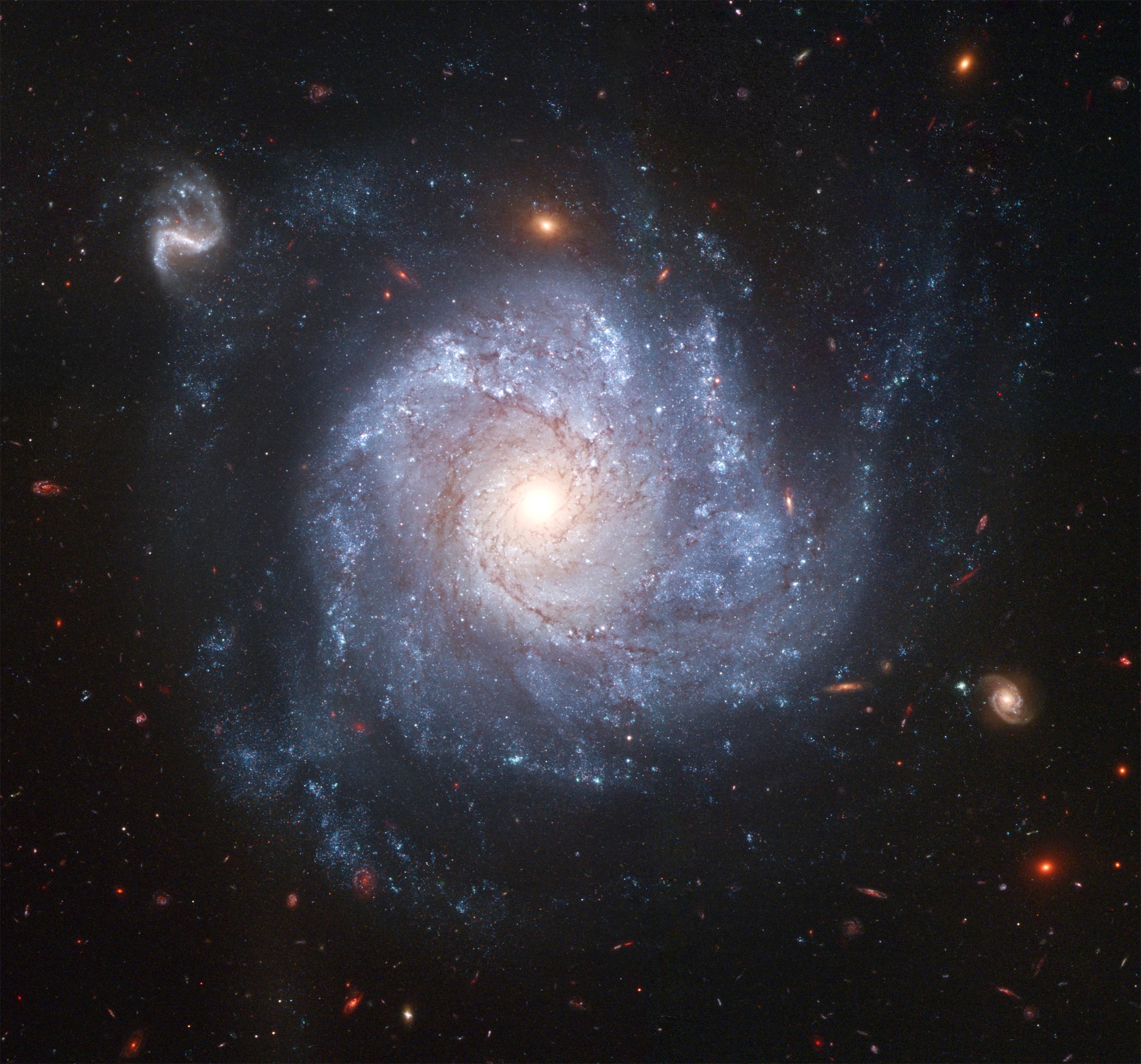
The spiral galaxy NGC 1309 is captured in striking detail in this featured Hubble Space Telescope image. Located roughly 100 million light-years from Earth in the constellation Eridanus, the galaxy is a brilliant example of cosmic structure and beauty.
The image showcases NGC 1309’s vibrant blue stars, swirling dark gas clouds, and a soft, luminous center. Surrounding the galaxy are hundreds of distant galaxies scattered throughout the background. Each small smudge or point of light represents an entire galaxy, with one notable exception. Near the top of the frame is a single star, easily recognized by the diffraction spikes produced by the telescope. This star belongs to our own Milky Way galaxy and lies only a few thousand light-years away.
Supernovae Spark Scientific Interest
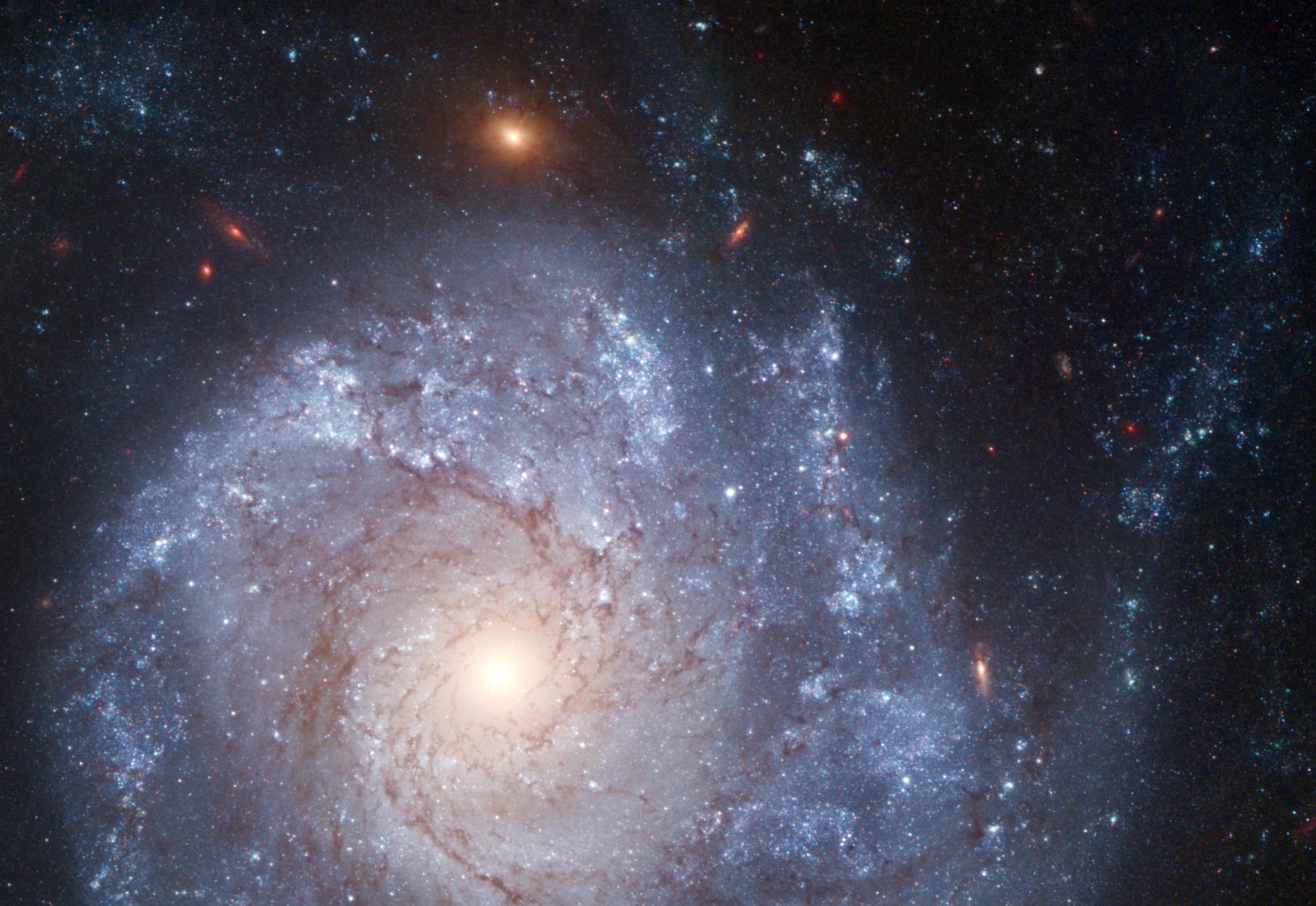
Hubble has observed NGC 1309 multiple times, with earlier images released in 2006 (see image above) and 2014 (see image below). The galaxy drew particular attention due to two notable supernovae: SN 2002fk, observed in 2002, and SN 2012Z, observed in 2012. SN 2002fk was a textbook example of a Type Ia supernova, an event triggered when a white dwarf (the dense core left behind after a star dies) explodes.
The Case of the Zombie Star
SN 2012Z, on the other hand, was a bit of a renegade. It was classified as a Type Iax supernova: while its spectrum resembled that of a Type Ia supernova, the explosion wasn’t as bright as expected. Hubble observations showed that in this case, the supernova did not destroy the white dwarf completely, leaving behind a ‘zombie star’ that shone even brighter than it did before the explosion. Hubble observations of NGC 1309 taken across several years also made this the first time the white dwarf progenitor of a supernova has been identified in images taken before the explosion.
Never miss a breakthrough: Join the SciTechDaily newsletter.
Follow us on Google and Google News.
1 Comment
Note 2507301659_Source1.Reinterpreting [】]
Source 1.
https://scitechdaily.com/this-star-exploded-and-came-back-brighter-than-before/
1.
This star exploded and came back brighter than before
ESA/Hubble Presented July 29, 2025
The breathtakingly beautiful Hubble photo of the spiral galaxy NGC 1309 shows more than just swirling stars and glowing dust. The photo contains the mysteries of the universe.
_Brilliant new images taken by the Hubble Space Telescope reveal the 100 million light-years distant spiral galaxy NGC 1309, located in the constellation Eridan.
_With swirling blue stars, dust bands, and hundreds of background galaxies, this cosmic scene is not only beautiful, but also of scientific significance.
<<>^|^ The local multiverse (our universe) I know and see is a collection of various patterns of matter within the qpeoms.msbase.msoss ⊆ magicsum. The deep world of the sprawling cosmic abyss that Hubble or James Webb still hasn’t seen due to the shape of stars and galaxies with 100 billion light-years thick and dense space-time ems.void is always beautiful. Hmm.
^/\^ No matter how much modern astronomical science pretends to know, if it fails to overcome the limits of astronomical equipment that tries to verify Einstein’s theory of relativity every time, it still looks like it is naming a group of stars from the Paleolithic Age. Hmm.
^|^The perfect magicsum universe theory doesn’t require the genius verification of habitual McCannism, which we try to verify every time. Hmm. You just have to believe in the domain (*).
Some people say that God creates and plans everything and manages everything at every moment. On what basis? The Bible?
It’s nonsense. Everyone makes such claims. But it doesn’t go into the details mathematically. That’s why everyone makes such claims. Do you say that intelligent religion or scientific knowledge creates and manages everything in the world and can be explained by scientific evidence,
>><<<^|^ If you don't know the magicsum, you're nothing.
>^^^Wow! James Brown Wow! God! God. Good..
It’s A Man’s Man’s Man’s World
https://youtu.be/GaB9F3R9cIY?si=S48LiJ14fd35BOhK
2.
a galaxy 100 million light years away
The spiral galaxy NGC 1309 is captured in stunning detail in this photo taken by the Hubble Space Telescope. Located in the constellation Eridanus about 100 million light years from Earth, the galaxy is a great example of the structure and beauty of the universe.
_a]This image shows NGC 1309’s vibrant blue stars, swirling clouds of dark gas, and its soft, bright core. Around the galaxy, hundreds of distant galaxies are scattered throughout the background.
_b] Every small point of light or spot represents the entire galaxy, but there is one notable exception.
Above the frame is a single star that can be easily identified by diffraction spikes generated by telescopes. The star belongs to our galaxy, just thousands of light years away.
This color image taken by the Hubble Space Telescope in 2006 shows stunning details of a front spiral galaxy classified as NGC 1309.
3. Invoke Supernatural Scientific Interest
Hubble has observed NGC 1309 several times, and its previous images were released in 2006 (see image above) and 2014 (see image below).
_The galaxy received particular attention from two notable supernovae, SN 2002fk, observed in 2002, and SN 2012Z, observed in 2012. SN 2002fk was a typical example of a Type Ia supernova, which occurs when a white dwarf star explodes (high-density nuclei left behind after its star dies).
_This image shows the spiral galaxy NGC 1309, which was taken by Hubble in 2014. Astronomers have observed a rare Type Iax supernova on the outskirts of the galaxy.
3-1. Zombie Star Incident
_SN 2012Z, on the other hand, showed a rather unusual appearance. It was classified as a type 1a supernova, whose spectrum was similar to that of a type 1a supernova, but the explosion itself was not as bright as expected.
_Hubble observations show that in this case, the supernova does not completely destroy the white dwarf, leaving only a “zombie star” that shines brighter than before the explosion.
>>>>>>^^A supernova explosion is kind of like a gem. It’s the light of the magicsum of beautiful and utter ruin. With so many flaws, errors and uncertainty, it can’t be such a bright and powerful mass of light.
But the world essentially had an uncertainty principle. Entropy is increasing
The multiple distributions qpeoms.msbase.msoss became a collective unit, increasing the likelihood of a more certain magicsum.100% purity.
Of course, unburned zombies sometimes become brighter.
The pictures of Hubble, which are breathtaking, show more than just the swirling stars and the glowing dust. Most of them are star clusters that have not become the magicsum of galaxies, supernovae like jewels.
_Moreover, Hubble observations of NGC 1309 have been conducted over the years, marking the first time that images taken before the explosion have identified a white dwarf precursor of a supernova.
*For your information, entropy is
It is a thermodynamic quantity representing the state of a material system related to heat and temperature. A measure of how well the temperature is divided and close to undistinguished disorder in the system being considered. Entropy never decreases in a series without the access of matter or heat, but always increases with irreversible changes. It was first introduced by the German physicist Clausius.
In information theory, an amount that represents the degree of uncertainty of information.