
What Are Batteries and How Do They Work?
Batteries and similar devices accept, store, and release electricity on demand. Batteries use chemistry, in the form of chemical potential, to store energy, just like many other everyday energy sources. For example, logs and oxygen both store energy in their chemical bonds until burning converts some of that chemical energy to heat.
Gasoline and oxygen mixtures store chemical potential energy until it is converted to mechanical energy in a car engine. Similarly, for batteries to work, electricity must be converted into a chemical potential form before it can be readily stored.
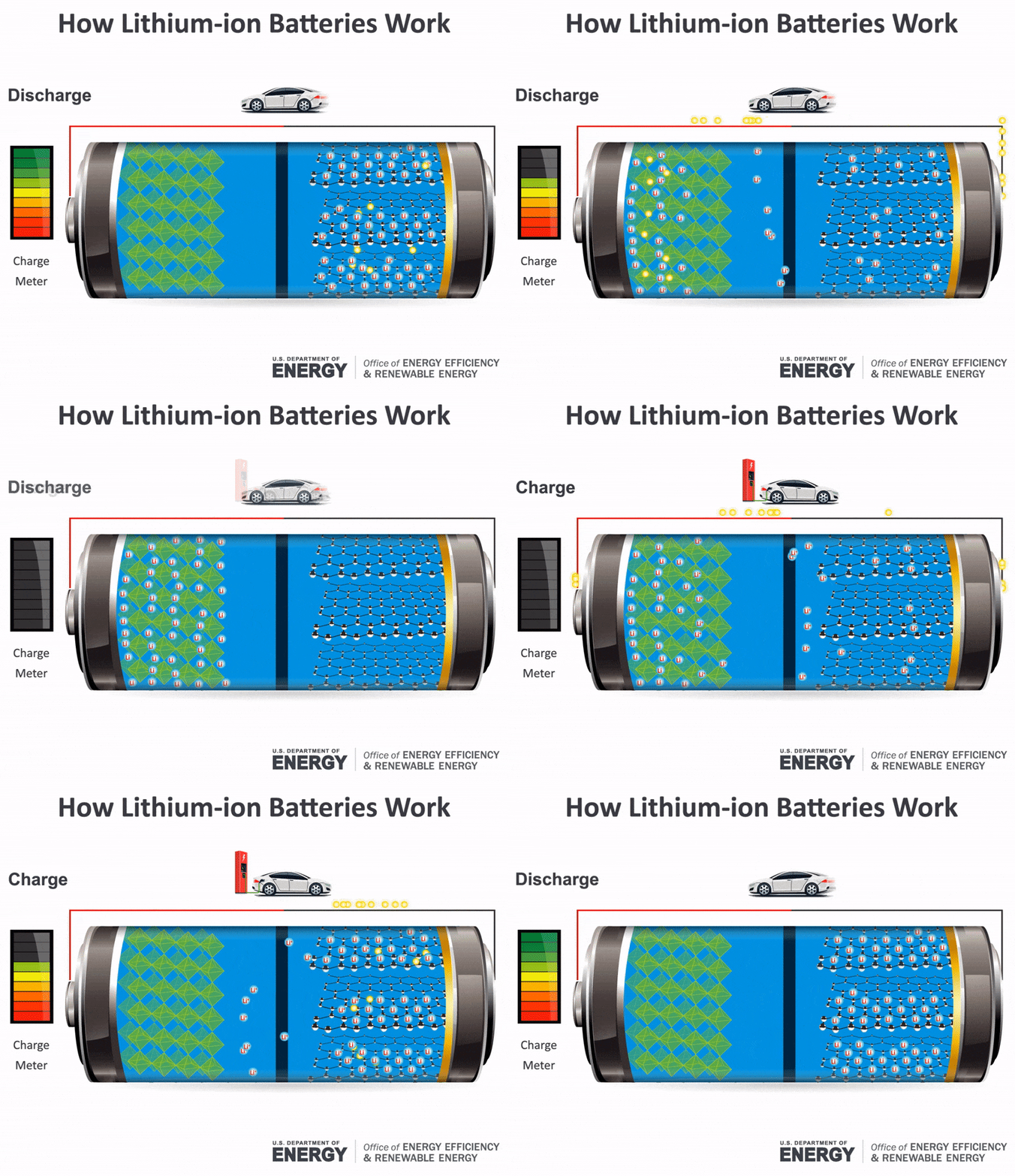
Batteries consist of two electrical terminals called the cathode and the anode, separated by a chemical material called an electrolyte. To accept and release energy, a battery is coupled to an external circuit. Electrons move through the circuit, while simultaneously ions (atoms or molecules with an electric charge) move through the electrolyte.
In a rechargeable battery, electrons and ions can move either direction through the circuit and electrolyte. When the electrons move from the cathode to the anode, they increase the chemical potential energy, thus charging the battery; when they move the other direction, they convert this chemical potential energy to electricity in the circuit and discharge the battery. During charging or discharging, the oppositely charged ions move inside the battery through the electrolyte to balance the charge of the electrons moving through the external circuit and produce a sustainable, rechargeable system. Once charged, the battery can be disconnected from the circuit to store the chemical potential energy for later use as electricity.
Batteries were invented in 1800, but their chemical processes are complex. Scientists are using new tools to better understand the electrical and chemical processes in batteries to produce a new generation of highly efficient, electrical energy storage. For example, they are developing improved materials for the anodes, cathodes, and electrolytes in batteries. Scientists study processes in rechargeable batteries because they do not completely reverse as the battery is charged and discharged. Over time, the lack of a complete reversal can change the chemistry and structure of battery materials, which can reduce battery performance and safety.
Electrical Energy Storage Facts
- The 2019 Nobel Prize in Chemistry was awarded jointly to John B. Goodenough, M. Stanley Whittingham, and Akira Yoshino “for the development of lithium-ion batteries.”
- The Electrolyte Genome at JCESR has produced a computational database with more than 26,000 molecules that can be used to calculate key electrolyte properties for new, advanced batteries.
DOE Office of Science & Electrical Energy Storage
Research supported by the DOE Office of Science, Office of Basic Energy Sciences (BES) has yielded significant improvements in electrical energy storage. But we are still far from comprehensive solutions for next-generation energy storage using brand-new materials that can dramatically improve how much energy a battery can store. This storage is critical to integrating renewable energy sources into our electricity supply. Because improving battery technology is essential to the widespread use of plug-in electric vehicles, storage is also key to reducing our dependency on petroleum for transportation.
BES supports research by individual scientists and at multi-disciplinary centers. The largest center is the Joint Center for Energy Storage Research (JCESR), a DOE Energy Innovation Hub. This center studies electrochemical materials and phenomena at the atomic and molecular scale and uses computers to help design new materials. This new knowledge will enable scientists to design energy storage that is safer, lasts longer, charges faster, and has greater capacity. As scientists supported by the BES program achieve new advances in battery science, these advances are used by applied researchers and industry to advance applications in transportation, the electricity grid, communication, and security.
Never miss a breakthrough: Join the SciTechDaily newsletter.
Follow us on Google and Google News.
2 Comments
… when I start to think about an electric issue, I like to imagine mechanical system that is equivalent to an electric one and start from something that is easy to understand.
Could all mechanical systems be represented by some electrical and vice versa, now I struggle to find an equivalent to the Tesla valve…
i was in the library and i was looking at the shelve and what do i see a science fair