
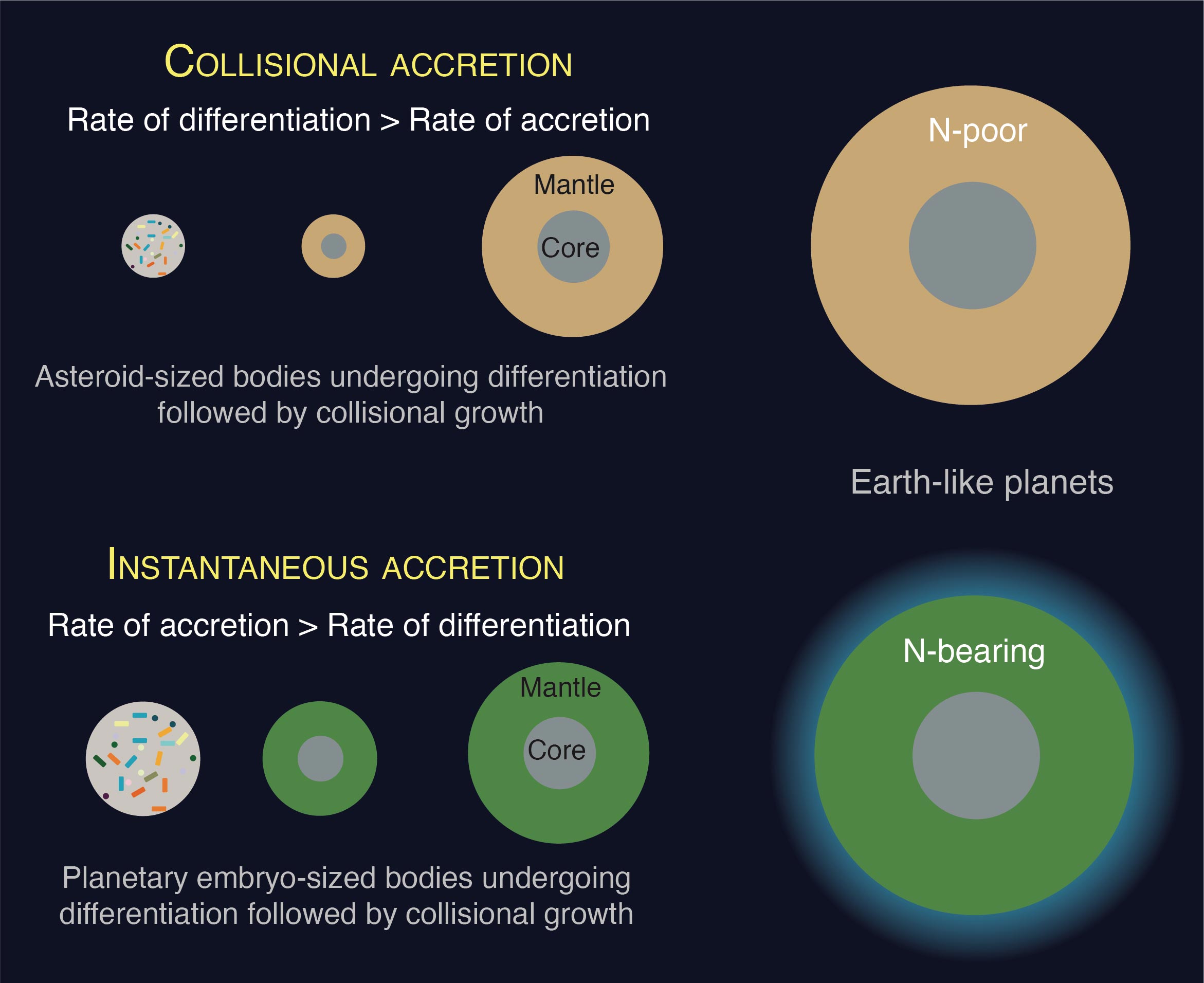
Earth’s nitrogen attributed to rapid growth of moon- to Mars-sized bodies.
According to Rice University scientists, the possibilities for life on a particular planet rely not only on where it originates but also on how it forms.
Planets like Earth that orbit within a solar system’s Goldilocks zone, with conditions supporting liquid water and a rich atmosphere, are more likely to harbor life. As it turns out, how that planet came together also determines whether it captured and retained certain volatile elements and compounds, including nitrogen, carbon, and water, that give rise to life.
In a study published in the journal Nature Geoscience on May 10, 2021, Rice graduate student and lead author Damanveer Grewal and Professor Rajdeep Dasgupta show the competition between the time it takes for material to accrete into a protoplanet and the time the protoplanet takes to separate into its distinct layers — a metallic core, a shell of silicate mantle and an atmospheric envelope in a process called planetary differentiation — is critical in determining what volatile elements the rocky planet retains.
Nitrogen Loss During Early Planet Formation
Using nitrogen as proxy for volatiles, the researchers showed most of the nitrogen escapes into the atmosphere of protoplanets during differentiation. This nitrogen is subsequently lost to space as the protoplanet either cools down or collides with other protoplanets or cosmic bodies during the next stage of its growth.
This process depletes nitrogen in the atmosphere and mantle of rocky planets, but if the metallic core retains enough, it could still be a significant source of nitrogen during the formation of Earth-like planets.
Dasgupta’s high-pressure lab at Rice captured protoplanetary differentiation in action to show the affinity of nitrogen toward metallic cores.
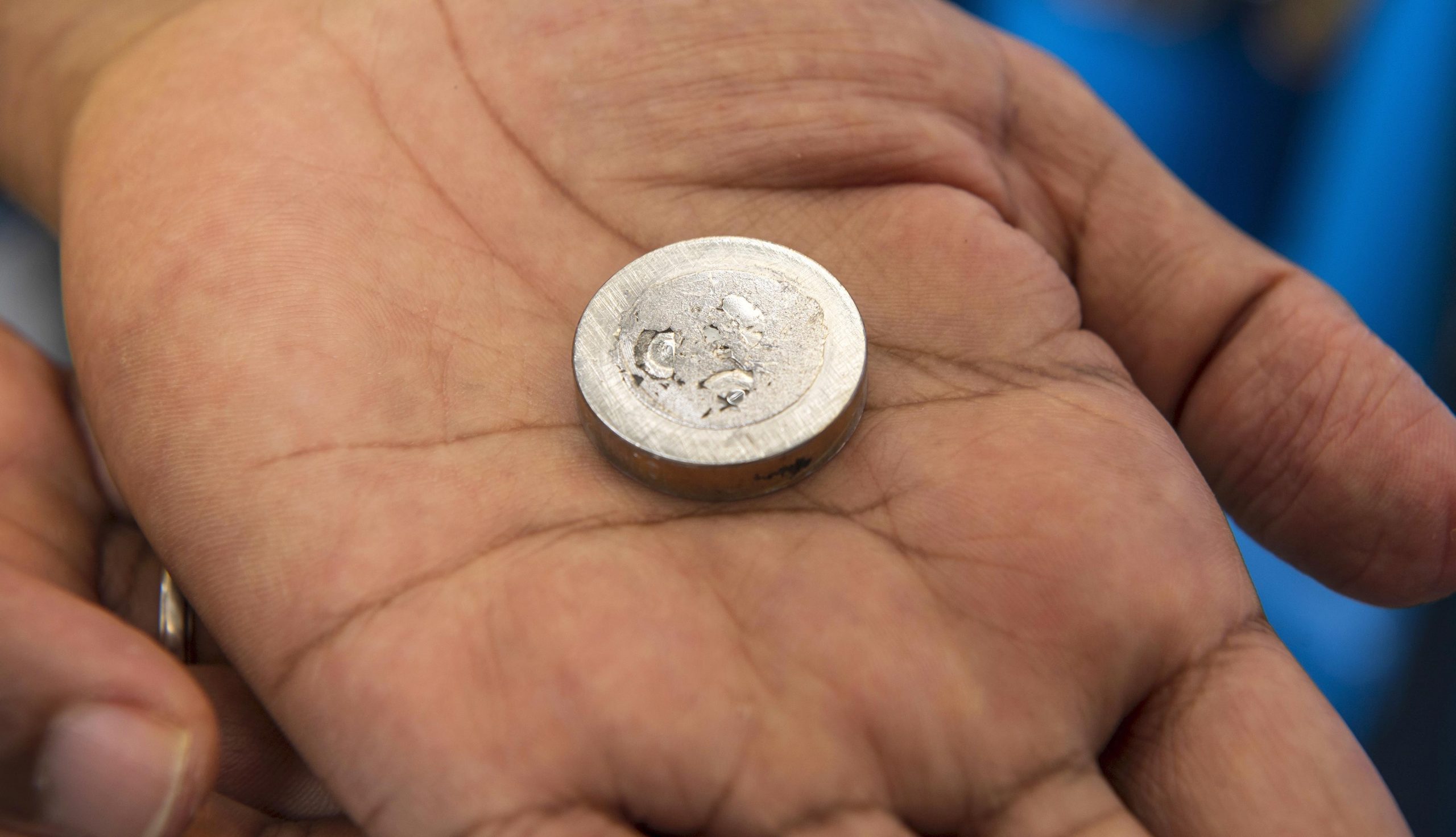
“We simulated high pressure-temperature conditions by subjecting a mixture of nitrogen-bearing metal and silicate powders to nearly 30,000 times the atmospheric pressure and heating them beyond their melting points,” Grewal said. “Small metallic blobs embedded in the silicate glasses of the recovered samples were the respective analogs of protoplanetary cores and mantles.”
Using this experimental data, the researchers modeled the thermodynamic relationships to show how nitrogen distributes between the atmosphere, molten silicate and core.
“We realized that fractionation of nitrogen between all these reservoirs is very sensitive to the size of the body,” Grewal said. “Using this idea, we could calculate how nitrogen would have separated between different reservoirs of protoplanetary bodies through time to finally build a habitable planet like Earth.”
Rapid Accretion Key to Earth’s Volatile Element Budget
Their theory suggests that feedstock materials for Earth grew quickly to around moon- and Mars-sized planetary embryos before they completed the process of differentiating into the familiar metal-silicate-gas vapor arrangement.
In general, they estimate the embryos formed within 1-2 million years of the beginning of the solar system, far sooner than the time it took for them to completely differentiate. If the rate of differentiation was faster than the rate of accretion for these embryos, the rocky planets forming from them could not have accreted enough nitrogen, and likely other volatiles, critical to developing conditions that support life.
“Our calculations show that forming an Earth-size planet via planetary embryos that grew extremely quickly before undergoing metal-silicate differentiation sets a unique pathway to satisfy Earth’s nitrogen budget,” said Dasgupta, the principal investigator of CLEVER Planets, a NASA-funded collaborative project exploring how life-essential elements might have come together on rocky planets in our solar system or on distant, rocky exoplanets.
“This work shows there’s much greater affinity of nitrogen toward core-forming metallic liquid than previously thought,” he said.
The study follows earlier works, one showing how the impact by a moon-forming body could have given Earth much of its volatile content, and another suggesting that the planet gained more of its nitrogen from local sources in the solar system than once believed.
Nitrogen Came from Both Inner and Outer Solar System
In the latter study, Grewal said, “We showed that protoplanets growing in both inner and outer regions of the solar system accreted nitrogen, and Earth sourced its nitrogen by accreting protoplanets from both of these regions. However, it was unknown as to how the nitrogen budget of Earth was established.”
“We are making a big claim that will go beyond just the topic of the origin of volatile elements and nitrogen, and will impact a cross-section of the scientific community interested in planet formation and growth,” Dasgupta said.
Reference: “Rates of protoplanetary accretion and differentiation set nitrogen budget of rocky planets” by Damanveer S. Grewal, Rajdeep Dasgupta, Taylor Hough and Alexandra Farnell, 10 May 2021, Nature Geoscience.
DOI: 10.1038/s41561-021-00733-0
Rice undergraduate intern Taylor Hough and research intern Alexandra Farnell, then a student at St. John’s School in Houston and now an undergraduate at Dartmouth College, are co-authors of the study.
NASA grants, including one via the FINESST program, and a Lodieska Stockbridge Vaughn Fellowship at Rice supported the research.
Never miss a breakthrough: Join the SciTechDaily newsletter.
Follow us on Google and Google News.
1 Comment
… interesting topic for real, but short in time, … I will get back to it…