

Close Menu
    Facebook X (Twitter) Instagram
    SciTechDaily
    • Biology
    • Chemistry
    • Earth
    • Health
    • Physics
    • Science
    • Space
    • Technology
    Facebook X (Twitter) Pinterest YouTube RSS
    SciTechDaily
    Home»Space»NASA’s Twisted Discovery: First Observation of a Polar Cyclone on Uranus
    Space

    NASA’s Twisted Discovery: First Observation of a Polar Cyclone on Uranus

    By Jet Propulsion LaboratoryMay 24, 2023No Comments4 Mins Read
    Facebook Twitter Pinterest Telegram LinkedIn WhatsApp Email Reddit
    Share
    Facebook Twitter LinkedIn Pinterest Telegram Email Reddit
    Polar Cyclone on Uranus
    NASA scientists used microwave observations to spot the first polar cyclone on Uranus, seen here as a light-colored dot to the right of center in each image of the planet. The images use wavelength bands K, Ka, and Q, from left. To highlight cyclone features, a different color map was used for each. Credit: NASA/JPL-Caltech/VLA

    Scientists used ground-based telescopes to get unprecedented views, thanks to the giant planet’s position in its long orbit around the Sun.

    For the first time, NASA scientists have strong evidence of a polar cyclone on Uranus. By examining radio waves emitted from the ice giant, they detected the phenomenon at the planet’s north pole. The findings confirm a broad truth about all planets with substantial atmospheres in our solar system: Whether the planets are composed mainly of rock or gas, their atmospheres show signs of a swirling vortex at the poles.

    Scientists have long known that Uranus’ south pole has a swirling feature. NASA’s Voyager 2 imaging of methane cloud tops there showed winds at the polar center spinning faster than over the rest of the pole. Voyager’s infrared measurements observed no temperature changes, but the new findings, published in the journal Geophysical Research Letters, do.

    Uranus Voyager 2
    This is an image of the planet Uranus taken by the spacecraft Voyager 2 in 1986. Uranus is the seventh planet from the Sun in our solar system. It’s a gas giant known for its distinctive pale-blue appearance due to methane in its atmosphere, and its unique tilted axis of rotation, which causes it to spin nearly on its side. Discovered by Sir William Herschel in 1781, Uranus was the first planet found with a telescope. Credit: NASA/JPL-Caltech

    Using huge radio antenna dishes of the Very Large Array in New Mexico, they peered below the ice giant’s clouds, determining that the circulating air at the north pole seems to be warmer and drier – the hallmarks of a strong cyclone. Collected in 2015, 2021, and 2022, the observations went deeper into Uranus’ atmosphere than any before.

    “These observations tell us a lot more about the story of Uranus. It’s a much more dynamic world than you might think,” said lead author Alex Akins of NASA’s Jet Propulsion Laboratory in Southern California. “It isn’t just a plain blue ball of gas. There’s a lot happening under the hood.”

    Uranus is showing off more these days, thanks to the planet’s position in orbit. It’s a long haul around the solar system for this outer planet, taking 84 years to complete a full lap, and for the last few decades the poles weren’t pointed toward Earth. Since about 2015, scientists have had a better view and have been able to look deeper into the polar atmosphere.
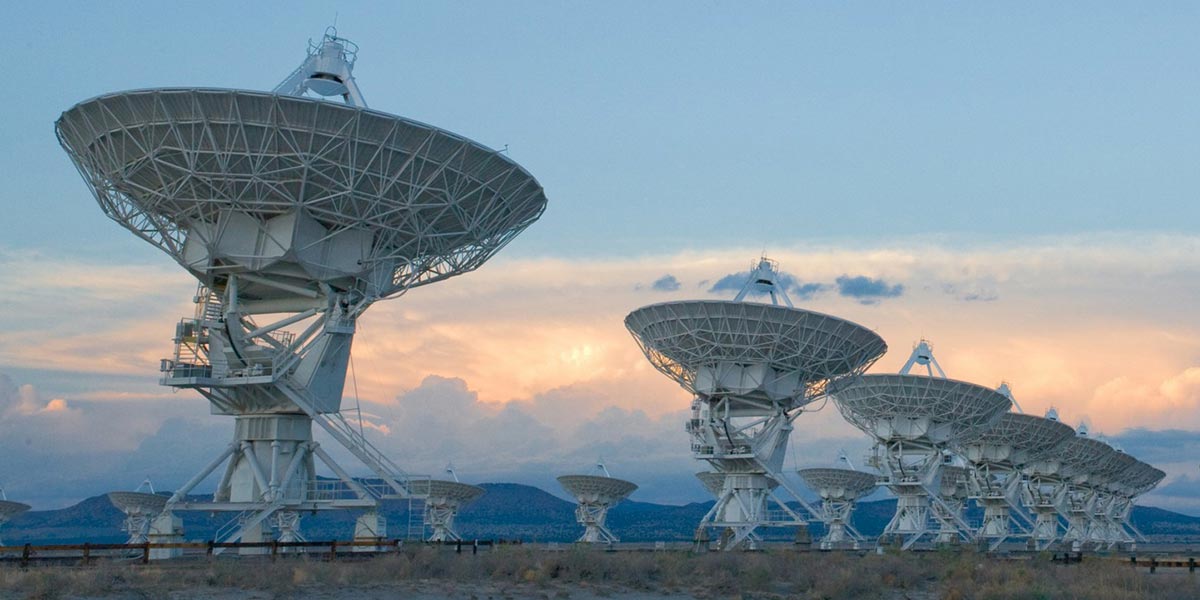
    Very Large Array (VLA) Panorama
    The Very Large Array (VLA) is a collection of 27 radio antennas located at the NRAO site in Socorro, New Mexico. Each antenna in the array measures 25 meters (82 feet) in diameter and weighs about 230 tons. Credit: Alex Savello

    Ingredients for a Cyclone

    The cyclone on Uranus, compactly shaped with warm and dry air at its core, is much like those spotted by NASA’s Cassini at Saturn. With the new findings, cyclones (which rotate in the same direction their planet rotates) or anti-cyclones (which rotate in the opposite direction) have now been identified at the poles on every planet in our solar system except for Mercury, which has no substantial atmosphere.

    But unlike hurricanes on Earth, cyclones on Uranus and Saturn aren’t formed over water (neither planet is known to have liquid water), and they don’t drift; they’re locked at the poles. Researchers will be watching closely to see how this newly discovered Uranus cyclone evolves in the coming years.

    “Does the warm core we observed represent the same high-speed circulation seen by Voyager?” Akins asked. “Or are there stacked cyclones in Uranus’ atmosphere? The fact that we’re still finding out such simple things about how Uranus’ atmosphere works really gets me excited to find out more about this mysterious planet.”

    The National Academies’ 2023 Planetary Science and Astrobiology Decadal Survey prioritized exploring Uranus. In preparation for such a mission, planetary scientists are focused on bolstering their knowledge about the mysterious ice giant’s system.

    Reference: “Evidence of a Polar Cyclone on Uranus From VLA Observations” by Alex Akins, Mark Hofstadter, Bryan Butler, A. James Friedson, Edward Molter, Marzia Parisi and Imke de Pater, 23 May 2023, Geophysical Research Letters.
    DOI: 10.1029/2023GL102872

    Never miss a breakthrough: Join the SciTechDaily newsletter.
    Follow us on Google and Google News.

    Atmospheric Science Geophysics JPL Karl G. Jansky Very Large Array NASA Planets Popular Uranus
    Share. Facebook Twitter Pinterest LinkedIn Email Reddit

    Related Articles

    NASA’s 38-Year-Old Voyager 2 Data Finally Solves Uranus’s Perplexing Mysteries

    Mars’ Bizarre “Spiders” Now Crawling in a NASA Lab

    NASA’s Juno Spacecraft Discovers Jupiter’s Winds Penetrate the Planet in Cylindrical Layers

    NASA’s Perseverance Rover Captures 200-Foot-Wide Dust Devil Tearing Across Mars

    Vast, Hidden Oceans Discovered on Four of Uranus’ Large Moons

    NASA’s NuSTAR Spots Highest-Energy Light Ever Detected From Jupiter – And Solves a Decades-Old Mystery

    NASA’s Juno Spacecraft Spots Signs That “Sprites” or “Elves” Frolic in Jupiter’s Atmosphere

    NASA Scientists Find Secret in Decades-Old Voyager 2 Data About the Ice Giant Uranus

    Saturn’s Moon Phoebe Has Planet-Like Qualities

    Leave A Reply Cancel Reply

    • Facebook
    • Twitter
    • Pinterest
    • YouTube

    Don't Miss a Discovery

    Subscribe for the Latest in Science & Tech!

    Trending News

    The Universe Is Expanding Too Fast and Scientists Can’t Explain Why

    “Like Liquid Metal”: Scientists Create Strange Shape-Shifting Material

    Early Warning Signals of Esophageal Cancer May Be Hiding in Plain Sight

    Common Blood Pressure Drug Shows Surprising Power Against Deadly Antibiotic-Resistant Superbug

    Scientists Uncover Dangerous Connection Between Serotonin and Heart Valve Disease

    Scientists Discover a “Protector” Protein That Could Help Reverse Hair Loss

    Bone-Strengthening Discovery Could Reverse Osteoporosis

    Scientists Uncover Hidden Trigger Behind Stem Cell Aging

    Follow SciTechDaily
    • Facebook
    • Twitter
    • YouTube
    • Pinterest
    • Newsletter
    • RSS
    SciTech News
    • Biology News
    • Chemistry News
    • Earth News
    • Health News
    • Physics News
    • Science News
    • Space News
    • Technology News
    Recent Posts
    • Scientists Overcome Major Quantum Bottleneck, Potentially Transforming Teleportation and Computing
    • Quantum Physics’ Strangest Problem May Hold the Key to Time Itself
    • Scientists Create “Liquid Gears” That Spin Without Touching
    • The Simple Habit That Could Help Prevent Cancer
    • Forgotten Medicinal Plant Shows Promise in Fighting Dangerous Superbugs
    Copyright © 1998 - 2026 SciTechDaily. All Rights Reserved.
    • Science News
    • About
    • Contact
    • Editorial Board
    • Privacy Policy
    • Terms of Use

    Type above and press Enter to search. Press Esc to cancel.