
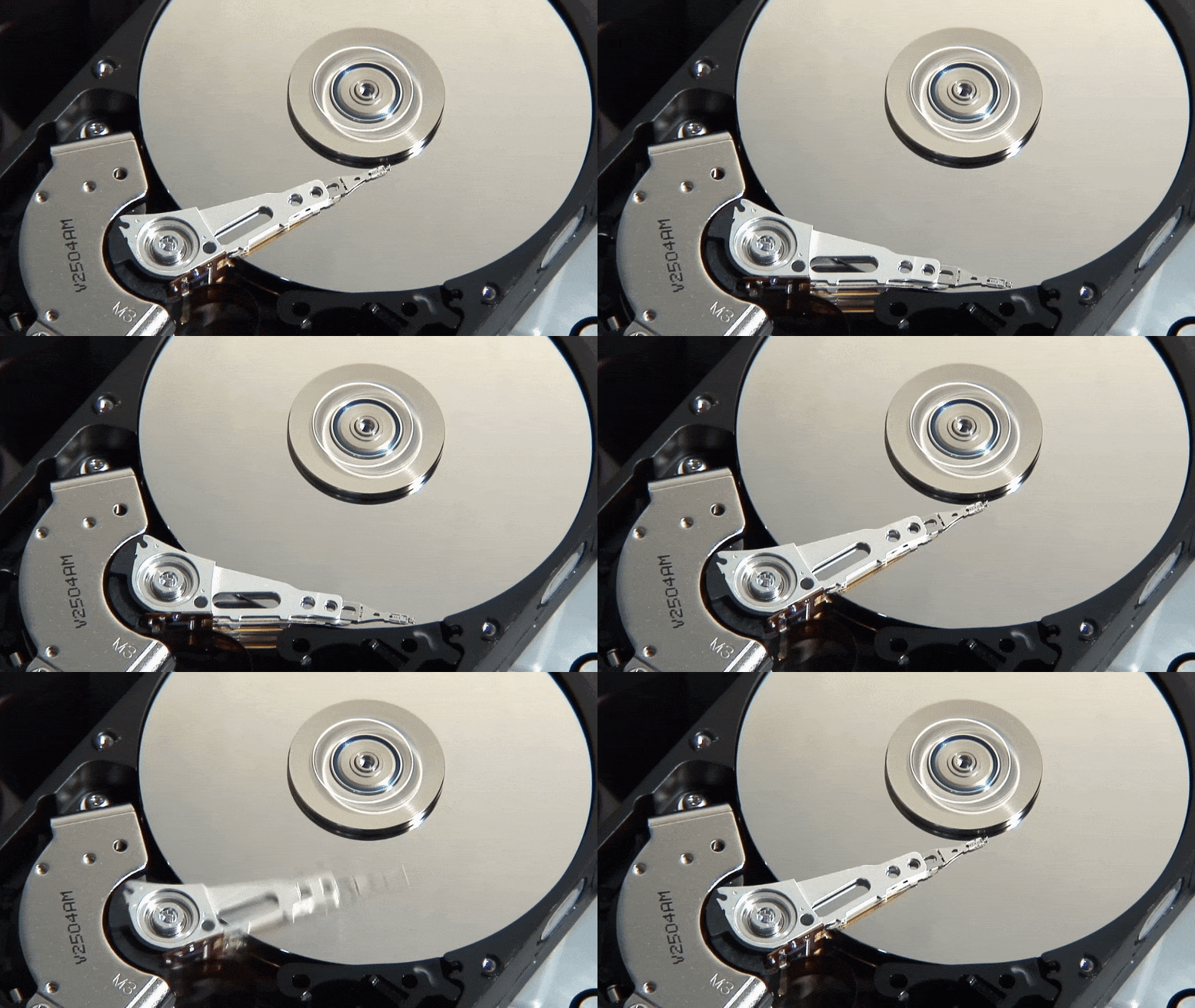
Graphene can be used for ultra-high density hard disk drives (HDD), with up to a tenfold jump compared to current technologies, researchers at the Cambridge Graphene Centre have shown.
The study, published in Nature Communications, was carried out in collaboration with teams at the University of Exeter, India, Switzerland, Singapore, and the US.
HDDs first appeared in the 1950s, but their use as storage devices in personal computers only took off in the mid-1980s. They have become ever smaller in size, and denser in terms of the number of stored bytes. While solid-state drives are popular for mobile devices, HDDs continue to be used to store files in desktop computers, largely due to their favorable cost to produce and purchase.
HDDs contain two major components: platters and a head. Data are written on the platters using a magnetic head, which moves rapidly above them as they spin. The space between the head and the platter is continually decreasing to enable higher densities.
“Considering that in 2020, around 1 billion terabytes of fresh HDD storage was produced, these results indicate a route for mass application of graphene in cutting-edge technologies.” Andrea Ferrari
Replacing COCs with Graphene Layers
Currently, carbon-based overcoats (COCs) – layers used to protect platters from mechanical damages and corrosion – occupy a significant part of this spacing. The data density of HDDs has quadrupled since 1990, and the COC thickness has reduced from 12.5nm to around 3nm, which corresponds to one terabyte per square inch. Now, graphene has enabled researchers to multiply this by ten.
The Cambridge researchers have replaced commercial COCs with one to four layers of graphene, and tested friction, wear, corrosion, thermal stability, and lubricant compatibility. Beyond its unbeatable thinness, graphene fulfills all the ideal properties of an HDD overcoat in terms of corrosion protection, low friction, wear resistance, hardness, lubricant compatibility, and surface smoothness.
Graphene enables a two-fold reduction in friction and provides better corrosion and wear resistance than state-of-the-art solutions. In fact, one single graphene layer reduces corrosion by 2.5 times.
Cambridge scientists transferred graphene onto hard disks made of iron-platinum as the magnetic recording layer, and tested Heat-Assisted Magnetic Recording (HAMR) – a new technology that enables an increase in storage density by heating the recording layer to high temperatures. Current COCs do not perform at these high temperatures, but graphene does. Thus, graphene, coupled with HAMR, can outperform current HDDs, providing an unprecedented data density, higher than 10 terabytes per square inch.
“Demonstrating that graphene can serve as protective coating for conventional hard disk drives and that it is able to withstand HAMR conditions is a very important result. This will further push the development of novel high areal density hard disk drives,” said Dr Anna Ott from the Cambridge Graphene Centre, one of the co-authors of this study.
A Sustainable Leap in Data Storage
A jump in HDDs’ data density by a factor of ten and a significant reduction in wear rate are critical to achieving more sustainable and durable magnetic data recording. Graphene-based technological developments are progressing along the right track towards a more sustainable world.
Professor Andrea C. Ferrari, Director of the Cambridge Graphene Centre, added: “This work showcases the excellent mechanical, corrosion and wear resistance properties of graphene for ultra-high storage density magnetic media. Considering that in 2020, around 1 billion terabytes of fresh HDD storage was produced, these results indicate a route for mass application of graphene in cutting-edge technologies.”
Reference: “Graphene overcoats for ultra-high storage density magnetic media” by N. Dwivedi, A. K. Ott, K. Sasikumar, C. Dou, R. J. Yeo, B. Narayanan, U. Sassi, D. De Fazio, G. Soavi, T. Dutta, O. Balci, S. Shinde, J. Zhang, A. K. Katiyar, P. S. Keatley, A. K. Srivastava, S. K. R. S. Sankaranarayanan, A. C. Ferrari and C. S. Bhatia, 17 May 2021, Nature Communications.
DOI: 10.1038/s41467-021-22687-y
Never miss a breakthrough: Join the SciTechDaily newsletter.
Follow us on Google and Google News.