
Close Menu
    Facebook X (Twitter) Instagram
    SciTechDaily
    • Biology
    • Chemistry
    • Earth
    • Health
    • Physics
    • Science
    • Space
    • Technology
    Facebook X (Twitter) Pinterest YouTube RSS
    SciTechDaily
    Home»Space»Space Chemistry Billions of Years Ago: Polymers in Meteorites Provide Clues to Early Solar System
    Space

    Space Chemistry Billions of Years Ago: Polymers in Meteorites Provide Clues to Early Solar System

    By American Institute of PhysicsJuly 6, 20211 Comment3 Mins Read
    Facebook Twitter Pinterest Telegram LinkedIn WhatsApp Email Reddit
    Share
    Facebook Twitter LinkedIn Pinterest Telegram Email Reddit
    Polymers in Meteorites
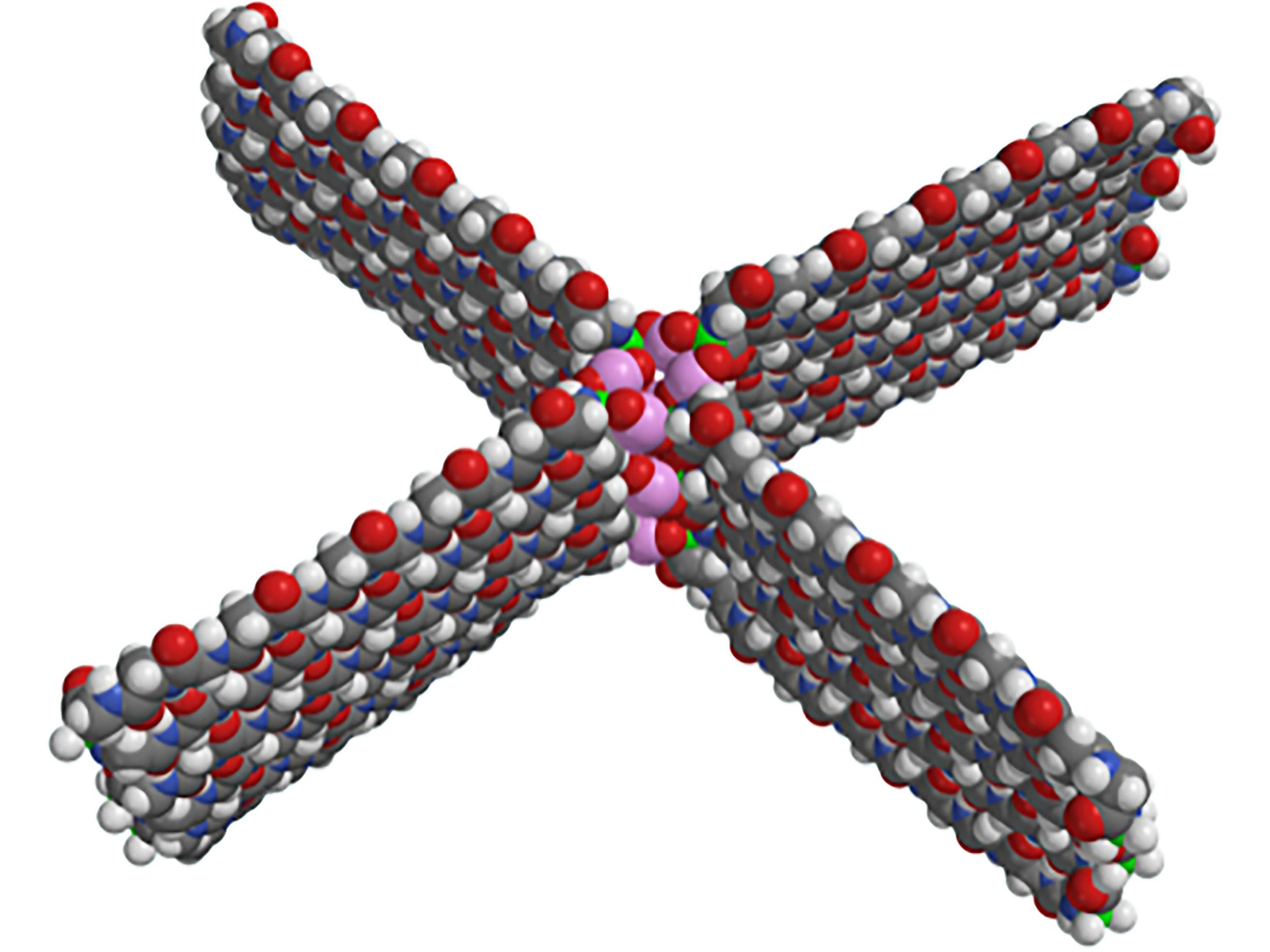
    Three layers of hydrogen-bonded edge-to-edge polymer. Each layer has four polymer rods bonded at a central vertex. Atoms are colored as follows: hydrogen white, carbon black, nitrogen blue, oxygen red, silicon pink, and iron green. Credit: Julie Elizabeth Mary McGeoch and Malcolm William McGeoch

    A group of polymers across several members of the oldest meteorite class, the CV3 type, shed light on space chemistry as early as 12.5 billion years ago.

    Many meteorites, which are small pieces from asteroids, do not experience high temperatures at any point in their existence. Because of this, these meteorites provide a good record of complex chemistry present when or before our solar system was formed 4.57 billion years ago.

    For this reason, researchers have examined individual amino acids in meteorites, which come in a rich variety and many of which are not in present-day organisms.

    Amino Acid Polymers in CV3 Meteorites

    In Physics of Fluids, by AIP Publishing, researchers from Harvard University show the existence of a systematic group of amino acid polymers across several members of the oldest meteorite class, the CV3 type. The polymers form organized structures, including crystalline nanotubes and a space-filling lattice of regular diamond symmetry with density estimated to be 30 times less than water.

    “Because the elements required to form our polymers were present as early as 12.5 billion years ago, and there appears to be a gas phase route to their formation, it is possible that this chemistry was and is present throughout the universe,” said author Julie McGeoch.

    Preventing terrestrial contamination was a top priority for the researchers. They devised a clean room method using a clean stepper motor with vacuum-brazed diamond bits to drive several millimeters into the meteorite sample before retrieving newly etched material from only the bottom of the hole. Several drill bits were used in a single etch, all being cleaned with ultrasonification.

    The resulting micron scale meteorite particles were then placed in tubes and stored at minus 16 degrees Celsius. Polymers were induced to diffuse out of the micron particles via Folch extraction, which involves two chemical phases related to different solvents with different densities.

    Mass spectrometry revealed the existence of the polymers, which were composed of chains of glycine, the simplest amino acid, with additional oxygen and iron. They had a very high deuterium-to-hydrogen-isotope ratio that confirmed their extraterrestrial origin.

    This research was inspired by observations on a small, highly conserved biological protein that entrapped water. That finding suggested if such a molecule could form in gas phase space, it would aid early chemistry by supplying bulk water.

    Quantum Chemistry Supports Extraterrestrial Polymerization

    The researchers employed quantum chemistry to show amino acids should be able to polymerize in space within molecular clouds, retaining water of polymerization. Many experiments followed using meteorites as the source of polymer culminating in 3D structures.

    Going forward, the researchers hope to get more detail of the glycine rods via continued X-ray analysis. Other polymers in the same class remain to be characterized and could reveal the energetics of polymer formation.

    Reference: “Structural organization of space polymers” by Julie E. M. McGeoch and Malcolm W. McGeoch, 29 June 2021, Physics of Fluids.
    DOI: 10.1063/5.0054860

    Never miss a breakthrough: Join the SciTechDaily newsletter.
    Follow us on Google and Google News.

    American Institute of Physics Astrophysics Meteorites
    Share. Facebook Twitter Pinterest LinkedIn Email Reddit

    Related Articles

    Oldest Material on Earth Discovered: 7-Billion-Year-Old Stardust Found in Meteorite

    New Method Uses Meteorites to Investigate Supernovae

    Researchers Develop New Technique to Forecast Geomagnetic Storms

    Primitive Meteorite Brings Scientists Closer to Understanding Solar Evolution

    Hypatia Stone Contains Mineral Compounds Unlike Anything on Earth, Known Meteorites or Comets

    Surface of Ceres Consists of Billions of Years Worth of Meteorite Material

    Scientists Use Meteorite to Measure Ancient Solar Nebula Magnetic Fields

    3D Model Provides New Insight into the Turbulent Death Throes of Supernovas

    Grains of Sand from Core-Collapse Supernova Found in Meteorites

    1 Comment

    1. Aleksandr7364 on July 6, 2021 10:53 am

      Life is a chemical reaction controlled by electronic processors. In the figure we see part of the electronic circuit with silicon transistors in the center.

      Reply
    Leave A Reply Cancel Reply

    • Facebook
    • Twitter
    • Pinterest
    • YouTube

    Don't Miss a Discovery

    Subscribe for the Latest in Science & Tech!

    Trending News

    Scientists Discover How Coffee Impacts Memory, Mood, and Gut Health

    Why Did the Neanderthals Disappear? Scientists Reveal Humans Had a Hidden Advantage

    Physicists Propose Strange Experiment Where Time Goes Quantum

    Magnesium Magic: New Drug Melts Fat Even on a High-Fat, High-Sugar Diet

    Weight-Loss Drugs Like Ozempic May Come With an Unexpected Cost

    Mezcal “Worm” in a Bottle Mystery: DNA Testing Reveals a Surprise

    New Research Reveals That Your Morning Coffee Activates an Ancient Longevity Switch

    This Is What Makes You Irresistible to Mosquitoes

    Follow SciTechDaily
    • Facebook
    • Twitter
    • YouTube
    • Pinterest
    • Newsletter
    • RSS
    SciTech News
    • Biology News
    • Chemistry News
    • Earth News
    • Health News
    • Physics News
    • Science News
    • Space News
    • Technology News
    Recent Posts
    • Harvard Scientists Reveal Secret Structure Behind How You Smell
    • Scientists Just Discovered the Hidden Trick That Keeps Your Cells Alive
    • This Simple Movement Could Be Secretly Cleaning Your Brain
    • Male Birth Control Breakthrough: Scientists Find Way To Turn Sperm Production Off and Back On
    • A Common Vitamin Could Hold the Key to Treating Fatty Liver Disease
    Copyright © 1998 - 2026 SciTechDaily. All Rights Reserved.
    • Science News
    • About
    • Contact
    • Editorial Board
    • Privacy Policy
    • Terms of Use

    Type above and press Enter to search. Press Esc to cancel.