
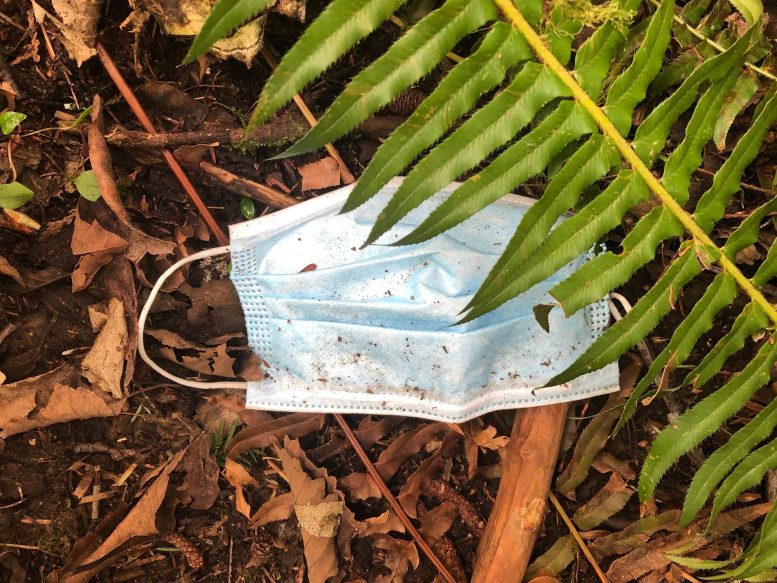
A new study calculates the waste generated by N95 usage and suggests possible ways to reduce it.
Since the COVID-19 pandemic began last year, face masks and other personal protective equipment have become essential for health care workers. Disposable N95 masks have been in especially high demand to help prevent the spread of SARS-CoV-2, the virus that causes COVID-19.
All of those masks carry both financial and environmental costs. The COVID-19 pandemic is estimated to generate up to 7,200 tons of medical waste every day, much of which is disposable masks. And even as the pandemic slows down in some parts of the world, health care workers are expected to continue wearing masks most of the time.
That toll could be dramatically cut by adopting reusable masks, according to a new study from MIT that has calculated the financial and environmental cost of several different mask usage scenarios. Decontaminating regular N95 masks so that health care workers can wear them for more than one day drops costs and environmental waste by at least 75 percent, compared to using a new mask for every encounter with a patient.

“Perhaps unsurprisingly, the approaches that incorporate reusable aspects stand to have not only the greatest cost savings, but also a significant reduction in waste,” says Giovanni Traverso, an MIT assistant professor of mechanical engineering, a gastroenterologist at Brigham and Women’s Hospital, and the senior author of the study.
The study also found that fully reusable silicone N95 masks could offer an even greater reduction in waste. Traverso and his colleagues are now working on developing such masks, which are not yet commercially available.
Jacqueline Chu, a physician at Massachusetts General Hospital, is the lead author of the study, which appears in the British Medical Journal Open.
Reduce and Reuse
In the early stages of the Covid-19 pandemic, N95 masks were in short supply. At many hospitals, health care workers were forced to wear one mask for a full day, instead of switching to a new one for each patient they saw. Later on, some hospitals, including MGH and Brigham and Women’s Hospital in Boston, began using decontamination systems that use hydrogen peroxide vapor to sterilize masks. This allows one mask to be worn for a few days.
Last year, Traverso and his colleagues began developing a reusable N95 mask that is made of silicone rubber and contains an N95 filter that can be either discarded or sterilized after use. The masks are designed so they can be sterilized with heat or bleach and reused many times.
“Our vision was that if we had a reusable system, we could reduce the cost,” Traverso says. “The majority of disposable masks also have a significant environmental impact, and they take a very long time to degrade. During a pandemic, there’s a priority to protect people from the virus, and certainly that remains a priority, but for the longer term, we have to catch up and do the right thing, and strongly consider and minimize the potential negative impact on the environment.”
Throughout the pandemic, hospitals in the United States have been using different mask strategies, based on the availability of N95 masks and access to decontamination systems. The MIT team decided to model the impacts of several different scenarios, which encompassed usage patterns before and during the pandemic, including: one N95 mask per patient encounter; one N95 mask per day; reuse of N95 masks using ultraviolet decontamination; reuse of N95 masks using hydrogen peroxide sterilization; and one surgical mask per day.
They also modeled the potential cost and waste generated by the reusable silicone mask that they are now developing, which could be used with either disposable or reusable N95 filters.
According to their analysis, if every health care worker in the United States used a new N95 mask for each patient they encountered during the first six months of the pandemic, the total number of masks required would be about 7.4 billion, at a cost of $6.4 billion. This would lead to 84 million kilograms of waste (the equivalent of 252 Boeing 747 airplanes).
They also found that any of the reusable mask strategies would lead to a significant reduction in cost and waste generated. If each health care worker were able to reuse N95 masks that were decontaminated with hydrogen peroxide or ultraviolet light, costs would drop to $1.4 billion to $1.7 billion over six months, and 13 million to 18 million kilograms of waste would result (the equivalent of 39 to 56 747s).
Those numbers could potentially be reduced even further with a reusable, silicone N95 mask, especially if the filters were also reusable. The researchers estimated that over six months, this type of mask could reduce costs to $831 million and waste to 1.6 million kilograms (about five 747s).
“Masks are here to stay for the foreseeable future, so it’s critical that we incorporate sustainability into their use, as well as the use of other disposable personal protective equipment that contribute to medical waste,” Chu says.
Environmental Burden
The data the researchers used for this study were gathered during the first six months of the pandemic in the United States (late March 2020 to late September 2020). Their calculations are based on the total number of health care workers in the United States, the number of Covid-19 patients at the time, and the length of hospital stay per patient, among other factors. Their calculations do not include any data on mask usage by the general public.
“Our focus here was on health care workers, so it’s likely an underrepresentation of the total cost and environmental burden,” Traverso notes.
While vaccination has helped to reduce the spread of Covid-19, Traverso believes health care workers will likely continue to wear masks for the foreseeable future, to protect against not only Covid-19 but also other respiratory diseases such as influenza.
He and others have started a company called Teal Bio that is now working on further refining and testing their reusable silicone mask and developing methods for mass manufacturing it. They plan to seek regulatory approval for the mask later this year. While cost and environmental impact are important factors to consider, the effectiveness of the masks also needs to be a priority, Traverso says.
“Ultimately, we want the systems to protect us, so it’s important to appreciate whether the decontamination system is compromising the filtering capacity or not,” he says. “Whatever you’re using, you want to make sure you’re using something that’s going to protect you and others.”
Reference: “Thinking green: modelling respirator reuse strategies to reduce cost and waste” by Jacqueline Chu, Omkar Ghenand, Joy Collins, James Byrne, Adam Wentworth, Peter R. Chai, Farah Dadabhoy, Chin Hur and Giovanni Traverso, 18 July 2021, BMJ Open.
DOI:
The research was funded by the MIT Undergraduate Research Opportunities Program, the National Institutes of Health, and MIT’s Department of Mechanical Engineering. Other authors of the paper include Omkar Ghenand, an MIT undergraduate; Joy Collins, a senior clinical research coordinator at Brigham and Women’s Hospital and a former MIT technical associate; James Byrne, a radiation oncologist at Brigham and Women’s Hospital and research affiliate at MIT’s Koch Institute for Integrative Cancer Research; Adam Wentworth, a research engineer at Brigham and Women’s Hospital and a research affiliate at the Koch Institute; Peter Chai, an emergency medicine physician at Brigham and Women’s Hospital; Farah Dadabhoy, an MIT research affiliate; and Chin Hur, a professor of medicine and epidemiology at Columbia University.
Never miss a breakthrough: Join the SciTechDaily newsletter.
Follow us on Google and Google News.
1 Comment
I can agree, I see hundreds of masks in Portland oregon, everywhere, everyday. Shocking coming from such a liberal tree hugging state that wants to be clean.