
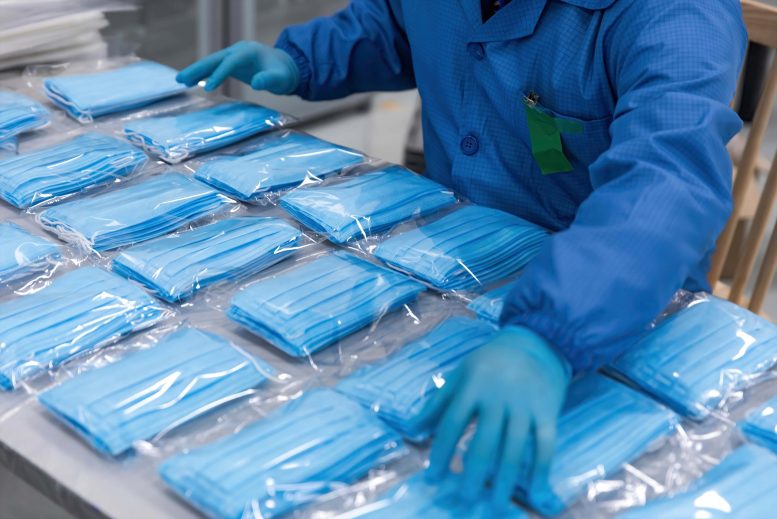
A new NSF-funded project is developing a model to help manufacturers pivot and produce personal protective equipment.
At the beginning of the COVID-19 crisis, the state of Massachusetts assembled a manufacturing emergency response team as part of its efforts to respond to the desperate need for personal protective equipment (PPE), particularly masks and gowns. The Massachusetts Emergency Response Team (M-ERT) — aided by MIT faculty, students, staff, and alumni — helped local manufacturers produce more than 9 million pieces of PPE as well as large volumes of hand sanitizer, disinfectants, and test swabs.
Building on the experiences and knowledge gained through the work of M-ERT, a new project, which was recently awarded funding from the National Science Foundation (NSF), is developing a network collaboration model designed to help ecosystems organize and enable manufacturers to rapidly “pivot,” in an emergency, from producing their standard products to producing PPE or other urgently needed goods. Elisabeth Reynolds, executive director of the MIT Task Force on the Work of the Future and the MIT Industrial Performance Center, John Hart, professor of mechanical engineering and director of the Laboratory for Manufacturing and Productivity, Ben Linville-Engler, industry and certificate director of the System Design and Management program, and Haden Quinlan, program manager for MIT’s Center for Additive and Digital Advanced Production Technologies, are collaborating with researchers from the University of Massachusetts at Lowell and the Worcester Polytechnic Institute, as well as the Massachusetts Technology Collaborative.
“The Massachusetts manufacturing ecosystem proved to be extremely valuable in response to COVID-19,” says Reynolds, “and it was activated in an important way because of the M-ERT collaboration.”
The NSF grant will allow researchers to gather and learn from the data from the recent emergency manufacturing effort, and also design a network and collaboration model applicable to manufacturing in future crises. The RESPOND network (Rapid Execution for Scaling Production Of Needed Designs) will support the establishment of a multidisciplinary, diverse stakeholder ecosystem that can help support the production of new products in large volumes during times of crises.
“This grant allows us to retrospectively study what we’ve done [with M-ERT],” says Linville-Engler, “so we can look at doing this proactively in the future, undertaking efforts of ecosystem engineering and manufacturing. We can look at how people operate in a network of information like this.”
Linville-Engler describes this type of network modeling as looking at the “network of networks,” with evolving uncertainties, needs, and demands across the different nodes.
“This project highlights important opportunities to use digital tools to advance manufacturing in the regional and national spheres,” says Hart. “We hope to implement our learnings at scale, and help impart agility in the manufacturing ecosystem.”
In addition to the RESPOND network project, a number of other MIT-based manufacturing efforts have recently received federal funding. A new, online agile manufacturing course is being designed and taught by Hart, Linville-Engler, and Quinlan. Reynolds, along with Julie Shah, associate professor in the Department of Aeronautics and Astronautics and the Computer Science and Artificial Intelligence Laboratory, and Paul Osterman, professor of human resources and management at MIT Sloan, also received an NSF planning grant toward understanding the human-technology frontier as part of research related to the MIT Task Force on the Work of the Future.
“These efforts represent a renewed commitment to manufacturing in this country,” says Reynolds. “We’re at a time of a real inflection point in the world of advanced manufacturing, punctuated by new data and new challenges.”
Never miss a breakthrough: Join the SciTechDaily newsletter.
Follow us on Google and Google News.