
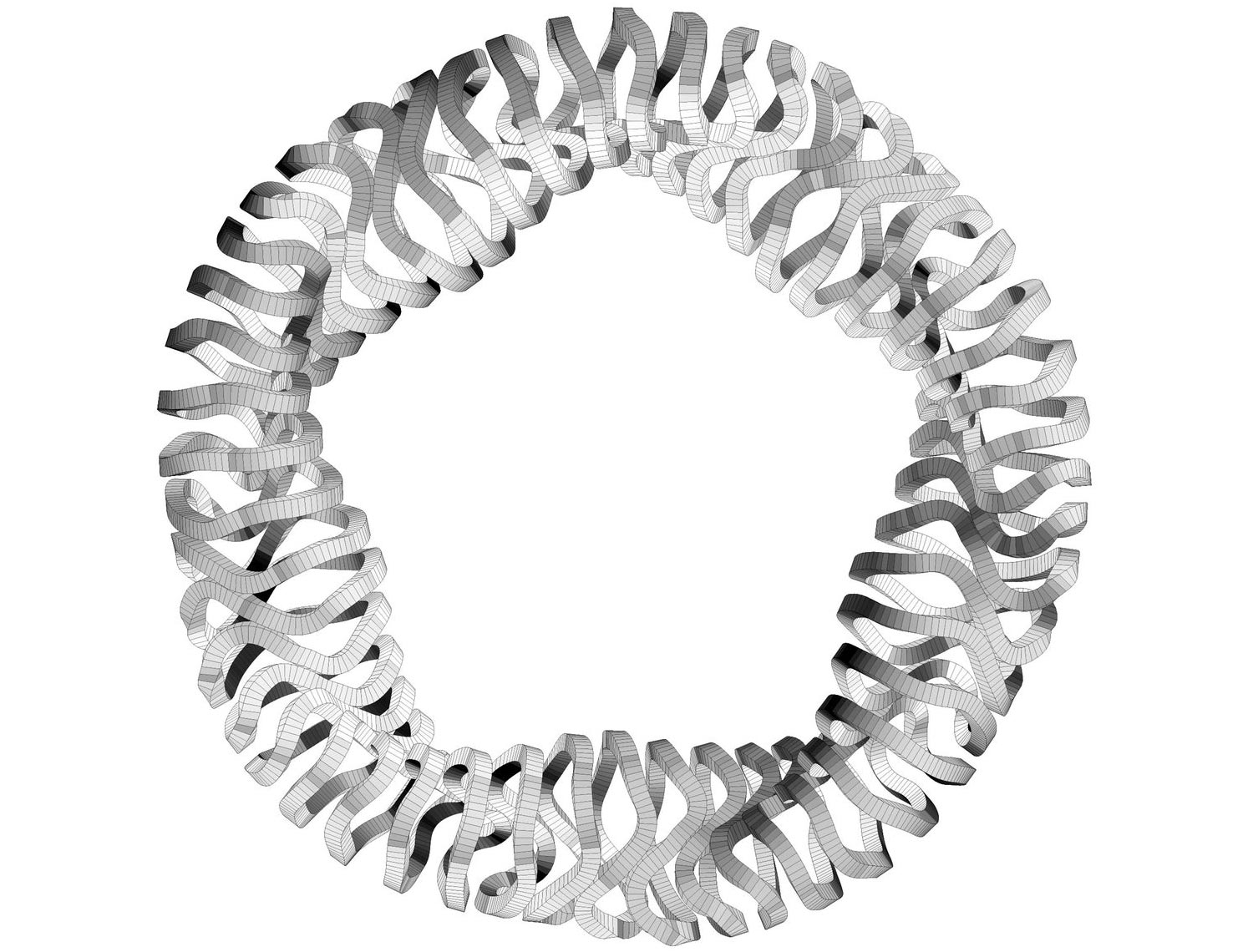
Part of the optimization strategy experimentally confirmed / energy losses of the plasma reduced.
One of the most important optimization goals underlying the Wendelstein 7-X fusion device at Max Planck Institute for Plasma Physics (IPP) in Greifswald has now been confirmed. An analysis by IPP scientists in the journal Nature shows: In the optimized magnetic field cage, the energy losses of the plasma are reduced in the desired way. Wendelstein 7-X is intended to prove that the disadvantages of earlier stellarators can be overcome and that stellarator-type devices are suitable for power plants.
The optimized Wendelstein 7-X stellarator, which went into operation five years ago, is intended to demonstrate that stellarator-type fusion plants are suitable for power plants. The magnetic field, which encloses the hot plasma and keeps it away from the vessel walls, was planned with great theoretical and computational effort in such a way that the disadvantages of earlier stellarators are avoided. One of the most important goals was to reduce the energy losses of the plasma, which are caused by the ripple of the magnetic field. This is responsible for plasma particles drifting outwards and being lost despite being bound to the magnetic field lines.
Unlike in the competing tokamak-type devices, for which this so-called “neo-classical” energy and particle loss is not a major problem, it is a serious weakness in conventional stellarators. It causes the losses to increase so much with rising plasma temperature that a power plant designed on this basis would be very large and thus very expensive.
Matching Tokamak Performance
In tokamaks, on the other hand – thanks to their symmetrical shape – the losses due to the magnetic field ripple are only small. Here, the energy losses are mainly determined by small vortex movements in the plasma, by turbulence – which is also added as a loss channel in stellarators. Therefore, in order to catch up with the good confinement properties of the tokamaks, lowering the neoclassical losses is an important task for stellarator optimization. Accordingly, the magnetic field of Wendelstein 7-X was designed to minimize those losses.
In a detailed analysis of the experimental results of Wendelstein 7-X, scientists led by Dr. Craig Beidler from IPP’s Stellarator Theory Division have now investigated whether this optimization leads to the desired effect (see Nature, DOI 10.1038/s41586-021-03687-w). With the heating devices available so far, Wendelstein 7-X has already been able to generate high-temperature plasmas and set the stellarator world record for the “fusion product” at high temperature. This product of temperature, plasma density and energy confinement time indicates how close you get to the values for a burning plasma.
Such a record plasma has now been analyzed in detail. At high plasma temperatures and low turbulent losses, the neoclassical losses in the energy balance could be well detected here: they accounted for 30 percent of the heating power, a considerable part of the energy balance.
The effect of neoclassical optimization of Wendelstein 7-X is now shown by a thought experiment: It was assumed that the same plasma values and profiles that led to the record result in Wendelstein 7-X were also achieved in plants with a less optimized magnetic field. Then the neoclassical losses to be expected there were calculated – with a clear result: they would be greater than the input heating power, which is a physical impossibility. “This shows,” says Professor Per Helander, head of the Stellarator Theory Division, “that the plasma profiles observed in Wendelstein 7-X are only conceivable in magnetic fields with low neoclassical losses. Conversely, this proves that optimizing the Wendelstein magnetic field successfully lowered the neoclassical losses.”
However, the plasma discharges have so far only been short. To test the performance of the Wendelstein concept in continuous operation, a water-cooled wall cladding is currently being installed. Equipped in this way, the researchers will gradually work their way up to 30-minute-long plasmas. Then it will be possible to check whether Wendelstein 7-X can also fulfill its optimization goals in continuous operation – the main advantage of the stellarators.
Reference: “Demonstration of reduced neoclassical energy transport in Wendelstein 7-X” by C. D. Beidler, H. M. Smith, A. Alonso, T. Andreeva, J. Baldzuhn, M. N. A. Beurskens, M. Borchardt, S. A. Bozhenkov, K. J. Brunner, H. Damm, M. Drevlak, O. P. Ford, G. Fuchert, J. Geiger, P. Helander, U. Hergenhahn, M. Hirsch, U. Höfel, Ye. O. Kazakov, R. Kleiber, M. Krychowiak, S. Kwak, A. Langenberg, H. P. Laqua, U. Neuner, N. A. Pablant, E. Pasch, A. Pavone, T. S. Pedersen, K. Rahbarnia, J. Schilling, E. R. Scott, T. Stange, J. Svensson, H. Thomsen, Y. Turkin, F. Warmer, R. C. Wolf, D. Zhang and the W7-X Team, 11 August 2021, Nature.
DOI: 10.1038/s41586-021-03687-w
Background
The aim of fusion research is to develop a climate- and environmentally-friendly power plant. Similar to the sun, it is to generate energy from the fusion of atomic nuclei. Because the fusion fire only ignites at temperatures above 100 million degrees, the fuel – a low-density hydrogen plasma – must not come into contact with cold vessel walls. Held by magnetic fields, it floats almost contact-free inside a vacuum chamber.
The magnetic cage of Wendelstein 7-X is created by a ring of 50 superconducting magnetic coils. Their special shapes are the result of sophisticated optimisation calculations. With their help, the quality of plasma confinement in a stellarator is to reach the level of competing tokamak-type facilities.
Never miss a breakthrough: Join the SciTechDaily newsletter.
Follow us on Google and Google News.
20 Comments
The advantage of the stellerator design is that it does not have a central electromagnet of the classic Tokamak designs which generates the current in the plasma that has a field strength that varies from the coil to the outer edge of the plasma, which leads to instabilities of the plasma at the outer edges and loss of energy. This Wendelstein 7-X may have its own plasma instability challenges, but these are less than those of a Tokamak with a central electromagnet.
LET’S HOPE THAT THIS VERSION OF A FUSION REACTOR CAN BE MADE TO WORK. BUT THE LIBERAL MOB’S HYSTERICAL, IRRATIONAL, AND ACTUALLY INSANE OBJECTIONS TO ANY SORT OF NUCLEAR POWER WOULD STILL HAVE TO BE OVERCOME.
THE CONSERVATIVE MOB’S HYSTERICAL, IRRATIONAL AND FACTUALLY INSANE CALLS FOR MASS VACCINATIONS STILL HAS TO BE OVERCOME… BEFORE IT DESTROYS OUR ENERGY-USING SOCIETY!
Good response to ‘The_Mad_Bomber’s’ comment.
You are either a) not American b) have a strange since of sarcasm, or c) an idiot. I know of no Conservative that have requested mandatory vaccination. The Fascist/Marxist left falsely think that fossil fuels are cause out of control global warming and the anything other than wind or solar power is not acceptable. Unless its involves going to Europe on a jet.
The research, described in the above article, only involved a very narrow aspect of fusion energy research. Savvy readers should note that there was no mention of a break-even fusion reaction, or the use of radioactive tritium in the plasma experiments. Also no fusion neutrons were generated. There remains numerous roadblocks to implementing practical levels of fusion electrical energy production. All proponents assume that we have 2-3 decades to reach practical fossil energy replacement levels of fusion energy production. Such fans typically have no interest in following critical analysis of these technologies, such as contained in the following description.
ITER is a showcase … for the drawbacks of fusion energy
https://thebulletin.org/2018/02/iter-is-a-showcase-for-the-drawbacks-of-fusion-energy
UN chief: World has less than 2 years to avoid ‘runaway climate change’
https://thehill.com/policy/energy-environment/406291-un-chief-the-world-has-less-than-2-years-to-avoid-runaway-climate
Yeah its not gonna work. Even Tokamaks are unliky to be able to breed enough tritium to commercialize it. I see no where for a lithium blanket to be installed. Even if you could, would it produce enough to commercialize it? Or are they goung to try D-D? That at least would almost be some sort of progress.
The real objection to this kind of power is where we are with it and where we would need to be with no real answer as to what the intervening steps might be. They talk DEMO while ITER is supposedly the way to solve all the problems but not knowing if enough tritium can be bred and with a design that has a 100MW deficit to net energy. Meanwhile they slickly talk about net gain and pretend thats enough. The margins producible on earth compared to whats possible on the sun, may never be enough. The ITER boondoggle was supposed to cost 22b, now its at 65b or more if you count in kind contributions. Anyone think in won’t hit 100B? So are these fusion projects just the snake oil of the 21st century? A grand science experiment? Or a path to comercialization of fusion energy? Hey physicists need pensions too!
So…the plasma disapates on contact with anything….how is this going to produce electicity (presumably by heat transfer back to water, steam, turbine, generator) or is that the problem for the next 30-40years?
I can’t pretend to know a great deal about any particular subject. Only that the more I know the less I know. But my query is this. Magnets lose their properties when exposed to heat. I’m sure these magnets aren’t the type you hold macaroni doodles on the fridge with. But even rare earth magnets are gonna falter with high temperature. And when I say high I mean very low in comparison. Like less than 2000 degrees. 100 million? What’s gonna make the magnets fucntion? Are electromagnets different?
I’m pretty liberal i guess, but love nuclear power and fusion research…in fact I think nuclear l ear power might yet save us from climate change, another nutty liberal idea…
This is so far away from being a source of power, it scarcely merits acknowledgement. There aren’t nearly enough plain old PWR’s supplying power. These esoteric gains in the world of fusion seem wholly abstract.
I’m pretty sure they need to be away from any major gravitational force like the earth to make fusion work with that shape. Every 1 likes to forget we dont know what gravity is exactly. In plasma form its a whole new ball game when it comes to gravity. Even in a magnetic field. Cant have an external force such as the earth’s gravity tugging at the reaction if u want it to work with the donut shape. There has to be a different shape to make the splasma flow if we want it to work on earth. Maybe multiply layers of different density in the plasma
I’ve always been partial to the idea of inertial electrostatic confinement, but they might just make this one work. I like Rube Goldberg stuff anyway.
Fusion power research is a sad waste of resources when there are planet wide crisis in the offing. Far better to build gigantic containment facilities for centralized fission power plants. There is no time to figure out fusion anymore. Put those gigaminds to the task of engineering mega fission plants.
@Zac, Tokamaks are quite unique places in the universe, where you get 100 million degrees in the core, and close to absolute zero a few centimetres away, where the superconducting magnets are. I do not know where else such a temperature gradient can be found, but it explains how the magnets can work.
will have we enough time to make working fusion reactors taking account of the global warming ( and also the end of the high availability of carbon based fossil materials ) ?
Maybe standard safety enhanced nuclear power plan ( using fast neutron super-generation ) could be the intermediate solution , as renewable power plan will have huge impact in term of surface needed and also expenses.
I am a Bernie Sanders supporter and I am all in on this nuclear power! Lol, fossil fuel old white Fascist Republicans will be so heartbroken! 😅
This needs to be devwloped and used outaide the earths magnetosphere sp there is no guassian impedence. Otherwise this is where ai application vome into play. Let the ai engineer the perfect design of the magnetic plasma containent array. It wound be ironic if it were in a mobius shape.
In the end… no sugar coating can change the fundamental problem… these magnets and other nearby structures getting irradiated and end up producing nuclear waste… that will “hang around” for 100,000+ years… Too late… when you can achieve much much more by looking at the sky… The Sun.. and just focus on harnessing it’s “free energy” using Solar Panels on using AgriVoltaics on just 7.5% of the Global Farmland for the World’s GL9BAL ENERY NEEDS IN 2050… 180,000 TWhrs/yr… no time to fool aroubd as millions die annually and hundreds of millions suffer from the “fallout” of Fossil and other Fuels.. POLLUTION !!!