
Researchers are closing in on the potential of nuclear fusion, the process that powers the stars, as a clean and inexhaustible energy source.
At the heart of this effort is the tokamak reactor design, which uses magnetic fields to confine plasma and maintain the necessary conditions for fusion. A critical challenge has been managing the plasma edge instabilities, but recent breakthroughs in understanding how energetic particles interact with these instabilities suggest promising methods for improving reactor performance.
Sustainable Energy and Nuclear Fusion
Developing sustainable energy sources capable of meeting global energy demand is one of today’s most pressing scientific challenges. Among the potential solutions, nuclear fusion — the process that powers the stars — stands out as a clean, virtually limitless energy source.
The most promising approach to fusion energy is the tokamak reactor, which uses magnetic fields to confine plasma. High plasma confinement is critical for the success of nuclear fusion power plants and is the ultimate goal of ITER, the world’s largest tokamak, currently being constructed in Cadarache, France. A key factor in achieving this is maintaining plasma edge stability, which plays a vital role in effective confinement.
In current tokamaks, edge instabilities, known as Edge Localized Modes (ELMs), cause significant particle and energy losses, much like solar flares erupting at the Sun’s surface. These losses can lead to erosion and extreme heat fluxes on the reactor’s plasma-facing components—conditions that would be unsustainable for future fusion power plants.
Role of Energetic Particles in Fusion Reactors
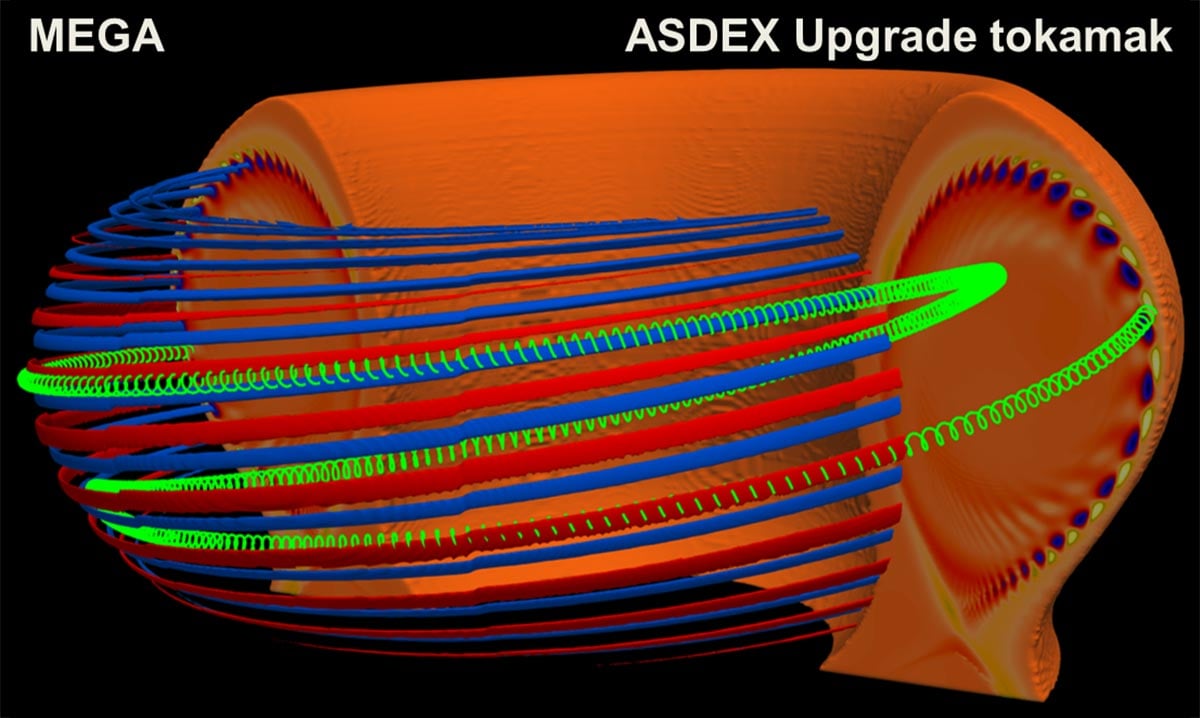
Energetic (suprathermal) particles constitute an essential source of momentum and energy, especially in future burning plasmas. They must be well confined to guarantee a self-sustaining fusion reaction. An international collaboration has studied the impact of energetic ions on these ELMs. They have combined experiments, modeling, and simulations to understand the behavior of ELMs in the presence of energetic particles. The measurements were obtained by the team at the ASDEX Upgrade tokamak, a fusion device located at the Max Planck Institute for Plasma Physics (Garching, Germany). The simulations were done using a hybrid code named MEGA, which calculates the self-consistent interaction between the ELMs and energetic particles. Comparison of the modeling results to the experimental data provides a new physics understanding of ELMs in the presence of energetic particles. The results indicate that the spatio-temporal structure of ELMs is largely affected by the energetic particle population and indicate that the interaction mechanism between ELMs and energetic particles is a resonant energy exchange between them.
New Insights from Fusion Research
This interaction mechanism helps to qualitatively understand the striking similarities between the experimental signatures of ELMs visible in magnetic diagnostics and in fast-ion loss detectors. This experimental and computational work, which has been done within the framework of the European fusion consortium EUROfusion, has recently been published in Nature Physics.
“In our publication, we demonstrate that energetic ion kinetic effects can alter the spatio-temporal structure of the edge localized modes. The effect is analogous to a surfer riding the wave. The surfer leaves footprints on the wave when riding it. In a plasma, the energetic particle interacts with the MHD wave (the ELM) and can change its spatio-temporal pattern. Our results can have important implications for the optimization of ELM control techniques. For instance, we could use energetic particles as active actuator in the control of these MHD waves “, says main author Jesús José Domínguez-Palacios Durán.
This is a groundbreaking work, that provides, for the first time, a detailed understanding of the interaction between energetic ions and ELMs. The results indicate that, for ITER, a strong energy and momentum exchange between ELMs and energetic ions is expected.
Reference: “Effect of energetic ions on edge-localized modes in tokamak plasmas” by J. Dominguez-Palacios, S. Futatani, M. Garcia-Munoz, A. Jansen van Vuuren, E. Viezzer, J. Gonzalez-Martin, M. Toscano-Jimenez, P. Oyola, Y. Todo, Y. Suzuki, L. Sanchis, J. Rueda-Rueda, J. Galdon-Quiroga, J. Hidalgo-Salaverri, H. Chen, J. F. Rivero-Rodriguez, L. Velarde, the ASDEX Upgrade Team and the EuroFUSION MST1 Team, 6 January 2025, Nature Physics.
DOI: 10.1038/s41567-024-02715-6
This work has received funding from the European Research Council, EUROfusion Consortium, Spanish Ministry of Science, Innovation and Universities and Junta de Andalucía.
Never miss a breakthrough: Join the SciTechDaily newsletter.
Follow us on Google and Google News.
37 Comments
Unfortunately, tokamak is not the optimal choice.
According to the Topological Vortex Theory (TVT), the energy of stars should be considered in the context of the entire galaxy or even the universe, only by mastering the topology vortex intelligent battery can humans truly achieve energy independence and freedom.
Scientific research guided by correct theories can enable researchers to think more.
According to the Topological Vortex Theory (TVT), spins create everything, spins shape the world. There are substantial distinctions between Topological Vortex Theory (TVT) and traditional physical theories. Grounded in the inviscid and absolutely incompressible spaces, TVT introduces the concept of topological phase transitions and employs topological principles to elucidate the formation and evolution of matter in the universe, as well as the impact of interactions between topological vortices and anti-vortices on spacetime dynamics and thermodynamics.
Within TVT, low-dimensional spacetime matter serves as the foundation for high-dimensional spacetime matter, and the hierarchical structure of matter and its interaction mechanisms challenge conventional macroscopic and microscopic interpretations. The conflict between Quantum Physics and Classical Physics can be attributed to their differing focuses: Quantum Physics emphasizes low-dimensional spacetime matter, whereas Classical Physics centers on high-dimensional spacetime matter.
Subatomic particles in the quantum world often defy the familiar rules of the physical world. The fact repeatedly suggests that the familiar rules of the physical world are pseudoscience. In the familiar rules of the physical world, two sets of cobalt-60 can form the mirror image of each other by rotating in opposite directions, and can receive heavy rewards.
Please witness the grand performance of physics today. https://scitechdaily.com/microscope-spacecrafts-most-precise-test-of-key-component-of-the-theory-of-general-relativity/#comment-854286.
If the researchers are truly interested in science, please read: The Application of Inviscid and Absolutely Incompressible Spaces in Engineering Simulation (https://scitechdaily.com/microscope-spacecrafts-most-precise-test-of-key-component-of-the-theory-of-general-relativity/#comment-870077).
ITER is an experimental fusion reactor and never designed to produce usable power. A colossal failure in my opinion. Old Fusion reactors as far as I know require significant quantities of tritium which is extremely expensive and difficult to produce. I have read one company is pursuing Fusion using hydrogen and boron which would obviate the need for tritium.
Not ‘old’, ALL!
1. Hydrogen-boron-11 fusion has 1/2,000th the reaction cross-section of deuterium-tritium and requires 8 times the ignition temperature. Hydrogen-boron-11 fusion is not practical with any near-future reactor designs.
2. Tritium breeding is technically straight forward: expose light elements (lithium, carbon, nitrogen, boron, etc.) to a neutron flux. D-T fusion reactors generate an enormous neutron flux, which is why most upcoming reactor designs feature a breeding blanket. One of ITER’s goals is demonstrating different tritium breeding blanket designs.
3. ITER’s lack of electrical generation capacity is not a failure, it’s a simplification of a research reactor designed to answer a lot of “practical” problems about reactor design. ITER is meant to:
a. sustain fusion reactions for minutes at a time rather than milliseconds
b. demonstrate a steady state Q value over 5 (vs a current record of 1.5 in NIF, which definitely doesn’t work in a steady state)
c. Verify tritium breeding techniques
d. Develop practical maintenance and operation procedures for fusion power plants
e. Refine neutron shielding and heat conversion technologies
f. Demonstrate effective containment of “burning” plasmas
g. Demonstrate a means of cleaning helium “ash” out of the plasma with various diverter designs.
Trying to solve those problems is enough for ITER. The answers will shape the various successor designs (DEMO and PROTO), which will generate electricity.
Scientific research guided by correct theories can enable researchers to think more.
Lovely comment mike! Keeping the comment section clean and effective.
Again with the word games. Not matter how stable, at 2 percent efficiency it ain’t gonna work..
Energetic ion kinetic effects can alter the spatio-temporal structure of the edge localized modes.
WHY?
Certain high-impact journals such as PRL, Nature, and Science should been criticized for the insistence on maintaining and promoting pseudoscientific content.
These so-called academic publications (such as PRL, Nature, and Science) do not show adequate respect to authors, readers, and science.
We urge continued scrutiny of these so-called academic publications and their adherents based on factual evidence. Please witness the grand collaborative performance of them. https://scitechdaily.com/microscope-spacecrafts-most-precise-test-of-key-component-of-the-theory-of-general-relativity/#comment-854286.
Energetic ion kinetic effects can alter the spatio-temporal structure of the edge localized modes.
WHY?
Certain high-impact journals such as PRL, Nature, and Science should been criticized for the insistence on maintaining and promoting pseudoscientific content.
These so-called academic publications (such as PRL, Nature, and Science) do not show adequate respect to authors, readers, and science.
We urge continued scrutiny of these so-called academic publications and their adherents based on factual evidence. Please witness the grand collaborative performance of them. https://scitechdaily.com/microscope-spacecrafts-most-precise-test-of-key-component-of-the-theory-of-general-relativity/#comment-854286.
The engine block of the 1973 Chev Biscaine 350 V8 is the optimal shape. Who knew?
I have been following fusion since I was a kid and it is about time it is returning more then is being put into its
I knew it when I read it, but that headline is wildly inaccurate.
But we clicked anyways Lol
Harmonic oscillation at a specific frequency to eather speed up or slow down the ion to the diffusion collision .
Better to crack the code than the reactor.
I think that as with everything in life man thinks he knows best , even now they. are saying that they have not solved the mysteries of the universe and dark matter and they think they got the assumptions wrong yet they are willing to play with power that could literally rip the world apart , this we are not ready for and mankind goes too far in their quest , one day maybe we will be ready , as we are always looking to run before walking everything takes time and patience we are not ready for fusion power as yet as every kind of power comes at a cost
A fusion reaction stops like the moment confinement of the plasma is broken, it’s one of the least dangerous kinds of power to use. There is literally no way it can explode and the worst that can happen is that some components get damaged. Please inform yourself before spreading nonsense which may hurt progress for no reason.
What happens when we are able to lite her up and what will keep it from splitting other atoms and the chain keeps happening and where would that stop?and what mechanism is in place that if we get it going I t won’t then continue to grow off other atoms?would there be a plug to pull if something like that happened?
Is it possible for AI and the new quantum computer to solve this problem?or do we have to set A.I free to solve it?
All commercial reactors today do nuclear fission – the splitting of atoms. Fusion reactors don’t – instead they build bigger atoms by fusing smaller atoms.
I’m not trying to insult you, but you may want to study how fusion and fission work. The fear of a ‘runaway reaction’ was dismissed after the first successful test in the Manhattan Project. (May have been before that, but I’m going off the top of my head without looking it up)
Fission (splitting atoms) will always stop when the fuel runs out or the control rods are inserted and the reactor is shut down. Nuclear meltdowns can and do occur in fission power plants, and even the waste material can achieve meltdown if it is not handled and stored properly.
Fusion (fusing atoms together) reactors cease working practically the *instant* the plasma stream becomes unstable. Like someone else pointed out: the worst that happens with fusion reactors failing is perhaps some of the components of the reactor are damaged and will need replacing. Fusion reactors generate *zero* radioactive waste products, and provide enormous amounts of energy. Fusion can be far superior to fission, once we solve more of the issues of stability in the confined plasma streams.
Toroidal perturbation is one technique recently shown to increase the frequency and stability of fission reactions, for example.
Very very very expensive coponents.
There is a lot of interest in the subatomic level, but until mankind makes a major leap of understanding, new technologies must be put on hold until there are no objections. Technology review is vital to our survival. Mankind seems to be moving forward very quickly, but we are moving backwards in many ways because a solution that seems so logical can wipe mankind off the planet, and there is the drive to ignore the protests.
Technology is supposed to solve problems, but there is a sense of duality in technology. It can be used for peaceful purposes or as a weapon. How about coming up with new technologies that can only be used for peaceful purposes. It is possible to do that. Also, once something is created, there is no way to uncreate something. We are facing existential threats, yet the potential solutions can be making the crisis worse, such as seabed mining. It must be banned and so must nuclear power. Atoms are actually Universes, and every atom is subject to Universal Law, so by destroying atoms, which are Universes, we will destroy ourselves, and that is a problem because we cannot uncreate ourselves. We will just become a failed experiment, never reaching our potential.
So I assume that you are also appalled by the geopolitical(wars,coups,bloodshed for oil etc) not just by the environmental consequences of most humans’ almost junkie-like addiction to gasoline and the internal combustion engine? Most people have been conditioned to “see no evil” when it comes to their beloved gas+combustion cars and never include combustion technology in their technophobic arguments.
Check Ignition & may God’s love be with you
I gathered more useful information and resources from these comments than I did from the last 12 “scientific articles” I read regarding advances in fusion reactor stabilization techniques. Keep your eyes and minds open.
Currently, it is challenging for the purported academic community to maintain the same level of sobriety and openness to criticism that you exhibit.
Some so-called academic publications (including PRL, Nature, and Science) have beautifully written articles that are as captivating as mythological stories. Additionally, add a few mathematical formulas. It seems perfect. However, what is detestable is that it is a pure pseudoscience and dogma. This is already the norm and greatest misfortune in the scientific community today.
These so-called academic publications (including PRL, Nature, and Science) are obsessed with their own small circles, overflowing with filth and ugliness. They hardly realize what is shame. They neither respect the author, nor the reader, nor the science, and even do not know where the boundary between science and pseudoscience lies. The rigor of science is naturally non-existent in their view, but self righteous.
Every word your type is pure pseudoscience. Are you even trying anymore or just want spam every STD article with random gibberish about vortex BS? Got make your own scientific paper about it and see how it goes.
Dear Kndlin Sir or Madam,
Some so-called academic publications (including PRL, Nature, and Science) have beautifully written articles that are as captivating as mythological stories. However, it is a pure pseudoscience and dogma. Subatomic particles in the quantum world often defy the familiar so-called rules of so-called academic publications. The fact repeatedly suggests that the familiar so-called rules of them are pseudoscience. In the familiar so-called rules of them, two sets of cobalt-60 can form the mirror image of each other by rotating in opposite directions, and can receive heavy rewards.
Your performance is the greatest contribution of these so-called academic publications to science and society. Pseudo scientific publications published in the name of science are far more harmful to society and science than any popular publication.
Bao-hua ZHANG STRIKES AGAIN! another plethora of random gibberish. I swear he has these posts copied somewhere for quick pasting on every fusion and quantum article STD releases.
You are too naive. My theory is excluded from the dogmas of these so-called academic publications. The response from Nature magazine has been rude enough to remove the ID number and title of the manuscript. Nature journals no longer possess the qualities and demeanor that academic journals should have. Is this the scientific publication you appreciate? Uncovering their appearances and skins, in reality, they are all the filth and ugliness of interest groups.
The so-called academic publications (including PRL, Nature, and Science) stubbornly believe that two sets of cobalt 60 rotating in opposite directions can become mirror images of each other. The so-called academic publications (including PRL, Nature, and Science) stubbornly believe that the theory endorsed by the Nobel Prize must be a scientific theory. This is a public insult to the normal intelligence of the public. They almost don’t know how to distinguish science from pseudoscience but consider themselves academic publications. Do they know what shame is?
Pay attention bro. It’s AI.
why cant we just contact those UFO and get the tech scoop ?
hailing frequency is ? lower or upper side band ? 73
To what extent is (massively over-hyped?!) Artificial Intelligence being used to accelerate fusion advances?