
Plasma Physicists From Ukraine, Germany and Japan Collaborate to Spark Fusion Power
Despite being forced to evacuate the Kharkiv Institute of Physics and Technology due to the Russia-Ukraine war, lead author Yurii Victorovich Kovtun has collaborated with Kyoto University to create stable plasmas using microwaves. Plasmas must be maintained at the correct density, temperature, and duration for nuclear fusion to occur. The research team, including the Max Planck Institute for Plasma Physics, has identified three critical steps in plasma production and utilized the Heliotron J device to study fusion plasma discharges. They discovered that blasting 2.45-GHz microwaves without alignment of the magnetic field produced a dense plasma, which could potentially simplify fusion research in the future.
Lead author Yurii Victorovich Kovtun, despite being forced to evacuate the Kharkiv Institute of Physics and Technology amid the current Russia-Ukraine war, has continued to work with Kyoto University to create stable plasmas using microwaves.
The Critical Role of Plasma in Nuclear Fusion
Getting plasma just right is one of the hurdles to harnessing the massive amounts of energy promised by nuclear fusion.
Plasmas — soups of ions and electrons — must be held at the right density, temperature, and duration for atomic nuclei to fuse together to achieve the desired release of energy.
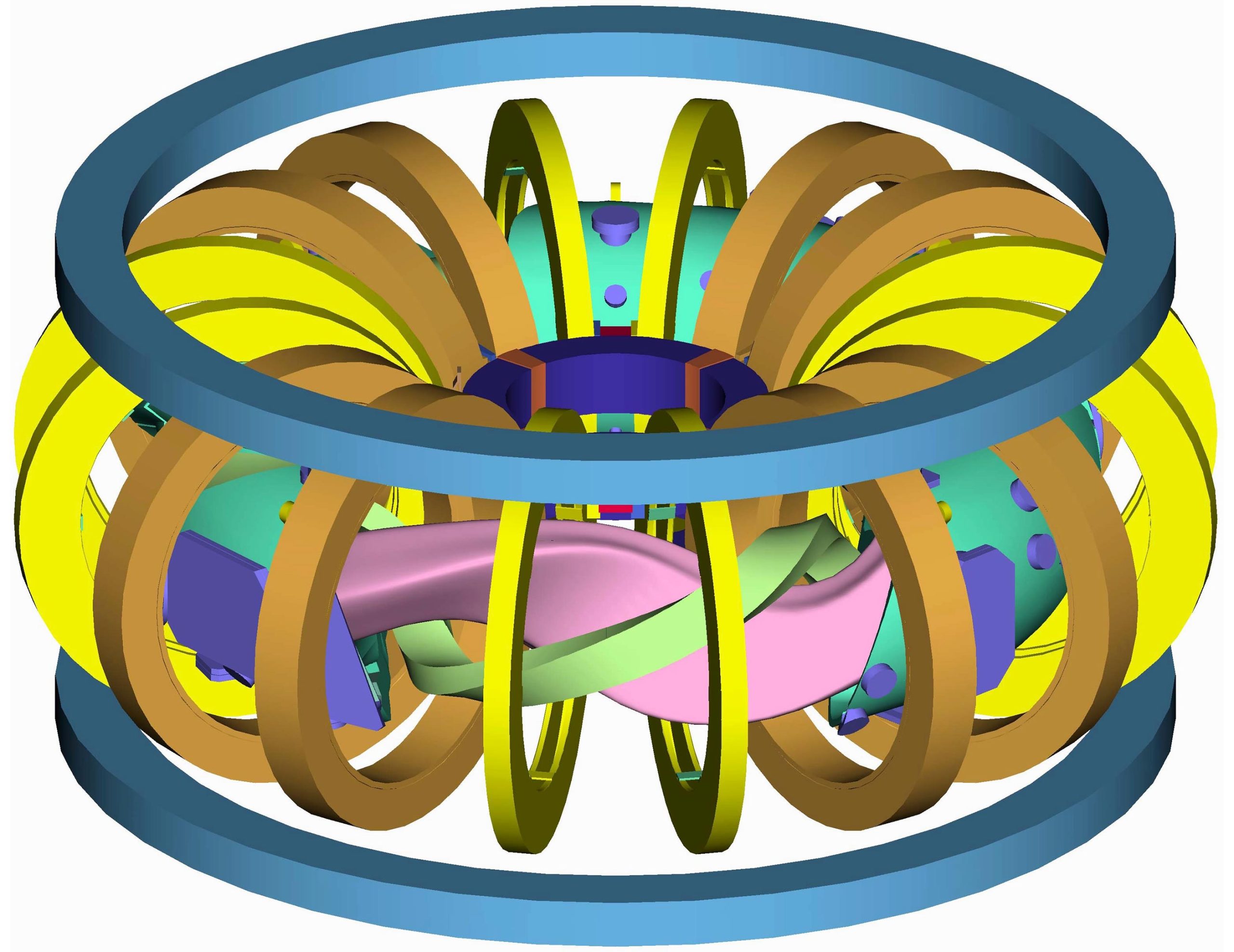
One recipe involves the use of large, donut-shaped devices with powerful magnets that contain a plasma while carefully aligned microwave generators heat the atomic mixture.

Now, the Institute of Advanced Energy at Kyoto University, together with the Kharkiv Institute and the Max Planck Institute for Plasma Physics have collaborated to create plasmas with fusion-suitable densities, using microwave power with low frequency.
The research team has identified three important steps in the plasma production: lightning-like gas breakdown, preliminary plasma production, and steady-state plasma. The study is being conducted using Heliotron J, the latest iteration of experimental fusion plasma devices at the Institute of Advanced Energy, located on KyotoU’s Uji campus in south Kyoto.
Surprising Phenomena: Plasma Without Cyclotron Resonance
“Initially, we did not expect these phenomena in Heliotron J but were surprised to find that plasmas were forming without cyclotron resonance,” group leader Kazunobu Nagasaki explains.
Building on decades of experience, Nagasaki’s team is exploring the fusion plasma discharges in Heliotron J.
The team injected intense bursts of 2.45-GHz microwave power into a feed gas. Microwave ovens in the home operate at this same frequency but Heliotron J is around 10 times more powerful and concentrated over a few gas atoms.
“Unexpectedly, we found that blasting the microwaves without alignment of Heliotron J’s magnetic field created a discharge that ripped electrons from their atoms and produced an especially dense plasma,” marvels Nagasaki.
“We are extremely grateful that our colleague could continue supporting the study, despite the war in Ukraine. Our findings about this method to generate plasmas using microwave discharge may simplify fusion research in the future.”
Reference: “Non-Resonant Microwave Discharge Start-Up in Heliotron J” by Yu.V. Kovtun, K. Nagasaki, S. Kobayashi, T. Minami, S. Kado, S. Ohshima, Y. Nakamura, A. Ishizawa, S. Konoshima, T. Mizuuchi, H. Okada, H. Laqua and T. Stange, 23 February 2023, Problems of Atomic Science and Technology.
DOI: 10.46813/2023-143-003
Funding: NIFS Collaborative Research Program
Interesting Facts About Fusion Power
- Fusion vs. Fission: Fusion power is based on the process of nuclear fusion, where atomic nuclei combine to form a heavier nucleus, releasing energy in the process. This is different from nuclear fission, currently used in nuclear power plants, where heavy atomic nuclei are split into lighter nuclei, also releasing energy.
- The Sun’s power: Fusion is the process that powers the Sun and other stars, where hydrogen nuclei (protons) combine to form helium, releasing enormous amounts of energy in the form of light and heat.
- Fuel abundance: Fusion power primarily uses isotopes of hydrogen, deuterium, and tritium, as fuel. Deuterium can be extracted from seawater, making it an abundant resource, while tritium can be bred from lithium, another relatively abundant element.
- No long-lived radioactive waste: One of the major advantages of fusion power is that it produces very little long-lived radioactive waste, unlike fission reactors. The primary waste product is helium, an inert gas with many commercial uses.
- High energy density: Fusion reactions have a much higher energy density compared to chemical reactions or nuclear fission, meaning that a small amount of fusion fuel can potentially generate a large amount of energy.
- ITER: The International Thermonuclear Experimental Reactor (ITER) is a large-scale scientific project aimed at demonstrating the feasibility of fusion power. It is being built in France, with collaboration from 35 countries, and is expected to achieve first plasma in the late 2020s.
- Tokamak reactors: Most fusion research currently focuses on the tokamak design, a doughnut-shaped magnetic confinement device that uses powerful magnetic fields to contain and control the plasma (a hot, ionized gas) in which fusion occurs.
- Inertial confinement fusion (ICF): Another approach to achieving fusion power is ICF, which involves using powerful lasers or other means to compress and heat a small fuel pellet, causing it to implode and trigger fusion reactions.
- Breakeven point: The breakeven point in fusion research is when the energy generated from fusion reactions equals the energy input required to sustain the reaction. Researchers are working to achieve and surpass this point in order to make fusion power a viable energy source.
- Fusion’s potential: If successfully developed and commercialized, fusion power could provide a virtually limitless, clean, and sustainable energy source, with the potential to greatly reduce greenhouse gas emissions and help mitigate climate change.
Never miss a breakthrough: Join the SciTechDaily newsletter.
Follow us on Google and Google News.