
Close Menu
    Facebook X (Twitter) Instagram
    SciTechDaily
    • Biology
    • Chemistry
    • Earth
    • Health
    • Physics
    • Science
    • Space
    • Technology
    Facebook X (Twitter) Pinterest YouTube RSS
    SciTechDaily
    Home»Science»Atomic Bond Types Clearly Discernible Thanks to Single-Molecule Images
    Science

    Atomic Bond Types Clearly Discernible Thanks to Single-Molecule Images

    By SciTechDailySeptember 18, 2012No Comments3 Mins Read
    Facebook Twitter Pinterest Telegram LinkedIn WhatsApp Email Reddit
    Share
    Facebook Twitter LinkedIn Pinterest Telegram Email Reddit
    atomic-bonds
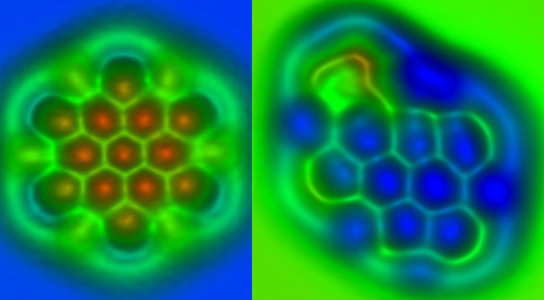
    Images of single molecules are so detailed that they reveal the types of atomic bonds between their atoms.

    A team from IBM in Zürich has released images they captured of single molecules that are so detailed that the type of atomic bonds between their atoms can be discerned.

    The scientists published their findings in the journal Science. The same IBM team took the first ever single-molecule images in 2009 and most recently published the images of the pentacene, the molecule shaped like the Olympic rings.

    afm-atomic-bonds-molecule

    These new images will allow scientists to study the imperfections of graphene or plotting where electrons go during chemical reactions.

    The team included French and Spanish collaborators, and they used a variant of a technique called atomic force microscopy (AFM). AFM uses a tiny metal tip that passes over a surface, where even tinier deflections are measured as the tip is scanned as it moves to and fro over a sample.

    The pentacene molecule was scanned by using a carbon monoxide molecule, which acted like a recording needle, allowing for unprecedented accuracy of the surfaces of atoms.

    The experiments themselves must be isolated from any kind of vibrations. Room temperatures themselves induce movements of the AFM’s constituent molecules, which would blur the image, so the actual apparatus must be kept at -268 °C (-450 °F).

    The tiny distortions in the regular hexagonal pattern of carbon bonds are what interested the researchers. Fullerenes and polyaromatic hydrocarbons, which have linked rings of carbon atoms at their cores, were the focus of this study.

    The images showcased how long the atomic bonds are. The bright and dark spots correspond to higher and lower densities of electrons. There are different physical properties of different bonds.

    Bond Order Discrimination
    Animation showing the last cooper atom of the tip of the Atomic Force Microscope (top) where a carbon-monoxide molecule is terminated. The carbon atoms are blue and the oxygen atom is red. This tip oscillates with a tiny amplitude above the C60, known as a buckyball, and the forces are measured between of the two molecules, to create an image. The carbon-monoxide termination of the tip acts as a powerful magnifying glass to reveal the atomic structure of the molecule, including its bonds. Credit: IBM Research

    Reference: “Bond-Order Discrimination by Atomic Force Microscopy” by Leo Gross, Fabian Mohn, Nikolaj Moll, Bruno Schuler, Alejandro Criado, Enrique Guitián, Diego Peña, André Gourdon and Gerhard Meyer, 14 September 2012, Science.
    DOI: 10.1126/science.1225621

    Never miss a breakthrough: Join the SciTechDaily newsletter.
    Follow us on Google and Google News.

    IBM Imaging Molecules Neurology Popular
    Share. Facebook Twitter Pinterest LinkedIn Email Reddit

    Related Articles

    New Method of Measuring Brain Activity Could Lead to “Mind-Reading” Devices

    Scientists Establish Functional Brain-to-Brain Interface between Human and Animal

    Drug-Loaded Nanoparticles Offer New Approach to Treating Brain Cancer

    NitroMemantine Restores Brain Connections in Models of Alzheimer’s

    Scientists Develop a Tool for Reading the Minds of Mice in Real-Time

    Photos of Einstein’s Brain Show Unique Features

    Methane Hydrate Cages, The Key to Using Methane as a Clean Energy Source?

    Researchers Use FDDNP–PET Scanning to Predict Cognitive Decline

    Size Does Matter When Determining Alzheimer’s Risk

    Leave A Reply Cancel Reply

    • Facebook
    • Twitter
    • Pinterest
    • YouTube

    Don't Miss a Discovery

    Subscribe for the Latest in Science & Tech!

    Trending News

    Study Finds a Surprising Link Between Gut Microbes and Aging

    Frequent Cannabis Users Wake Up With More “Stress Hormone”

    Scientists Reveal Hidden DNA Traces in the Shroud of Turin

    Giant Alien World Found Hiding in Plain Sight for 11 Years

    Scientists Link Heavy TV Watching to Brain Changes Decades Later

    Did T. rex Leave These Mysterious Marks on Dinosaur Bones?

    Quantum Computers Could Freeze Like Ordinary PCs

    Scientists Reversed Autism-Like Symptoms in Adult Mice Within Two Hours

    Follow SciTechDaily
    • Facebook
    • Twitter
    • YouTube
    • Pinterest
    • Newsletter
    • RSS
    SciTech News
    • Biology News
    • Chemistry News
    • Earth News
    • Health News
    • Physics News
    • Science News
    • Space News
    • Technology News
    Recent Posts
    • These “Good” Immune Cells Could Hold the Key to Spinal Cord Regeneration
    • New Research Questions Decades of Low-Fat Dairy Advice
    • Researchers Solve Mystery Behind Contradictory Weight-Loss Drug Paradox
    • Forgotten Autobiography Rewrites the Story of a War of 1812 Soldier
    • Ancient Egyptian Princesses Were Trained Warriors, Their Bones Reveal
    Copyright © 1998 - 2026 SciTechDaily. All Rights Reserved.
    • Science News
    • About
    • Contact
    • Editorial Board
    • Privacy Policy
    • Terms of Use

    Type above and press Enter to search. Press Esc to cancel.