
Close Menu
    Facebook X (Twitter) Instagram
    SciTechDaily
    • Biology
    • Chemistry
    • Earth
    • Health
    • Physics
    • Science
    • Space
    • Technology
    Facebook X (Twitter) Pinterest YouTube RSS
    SciTechDaily
    Home»Biology»Silurian Fossil of Dibasterium Durgae Untangles Horseshoe Crab Past
    Biology

    Silurian Fossil of Dibasterium Durgae Untangles Horseshoe Crab Past

    By SciTechDailyOctober 4, 2012No Comments2 Mins Read
    Facebook Twitter Pinterest Telegram LinkedIn WhatsApp Email Reddit
    Share
    Facebook Twitter LinkedIn Pinterest Telegram Email Reddit
    horseshoe-crab
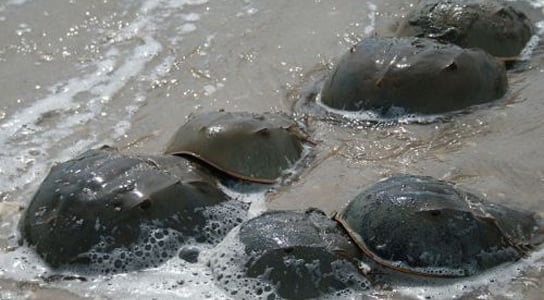
    Horseshoe crabs mating.

    Paleontologists have discovered that horseshoe crabs haven’t had an entirely static evolutionary history. A new fossil has helped elucidate the mystery of the horseshoe crabs, which have been around for about 510 million years.

    The researchers published their findings in the journal Proceedings of the National Academy of Sciences. The fossil recorded a critical transformation in its evolutionary history. The 425-million-year-old fossil was discovered at a well-preserved site in Herefordshire, England. This new genus is called Dibasterium durgae.

    Archaic arthropods originated during the Cambrian Explosion and had double-branched limbs, which were multi-functional. One branch was used for feeding and walking, while the other was used for breathing. In time, some arthropod lineages developed unbranched limbs that became dedicated to specific uses.

    D. durgae is a midpoint between the modern horseshoe crab and their Cambrian forebears. It had four double-branched appendages, but each branch derived from a separate origin of the body. This could provide a clue to what happened to the now-missing branch among modern horseshoe crabs.

    Previously it was thought that they lost one of their limb branches when the back legs transformed into book gills, but D. durgae indicates that 425 million years ago the two leg branches had begun to separate. After the divide between the leg branches was drawn, the now-missing half started to winnow away.

    Reference: “Silurian horseshoe crab illuminates the evolution of arthropod limbs” by Derek E. G. Briggs, Derek J. Siveter, David J. Siveter, Mark D. Sutton, Russell J. Garwood and David Legg, 11 September 2012, Proceedings of the National Academy of Sciences.
    DOI: 10.1073/pnas.1205875109

    Never miss a breakthrough: Join the SciTechDaily newsletter.
    Follow us on Google and Google News.

    Evolutionary Biology Fossils Horseshoe Crab Paleontology
    Share. Facebook Twitter Pinterest LinkedIn Email Reddit

    Related Articles

    New Insight Into the Evolution of Sight From 54 Million Year-Old Fossil

    Newly Discovered Dinosaur (Mansourasaurus shahinae) Links Africa and Europe

    New Approach to Studying Biomarkers Helped Solve 500-Million-Year-Old Mystery

    Habelia Optata – A 508-Million-Year-Old Sea Creature

    Inner Ears of Living Aquatic Animals Resemble Those of Extinct Sea Monsters

    Fossil Shows Transition From Life on Land to Life in the Sea

    Pentecopterus – A Giant Sea Scorpion from the Prehistoric Seas

    Discovery of ‘Bird-Dinosaur’ Eosinopteryx Challenges Bird Evolution Theory

    Pegomastax Africanus, A Miniature Dinosaur That Thrived in Southern Africa

    Leave A Reply Cancel Reply

    • Facebook
    • Twitter
    • Pinterest
    • YouTube

    Don't Miss a Discovery

    Subscribe for the Latest in Science & Tech!

    Trending News

    Scientists Built a Programmable Chip That Can Slow Light on Command

    The Backyard “Silly Sprinkler” That Cracked One of Physics’ Biggest Puzzles

    This Common Sleep Habit Could Be Making You Gain Weight

    Mathematician Offers New Solution to a Fundamental Cosmic Paradox

    Scientists Turn Plastic Waste Into Clean Hydrogen Fuel

    Long COVID Brain Scans Reveal Damage to Dopamine Neurons

    Scientists Warn a Silent Oxygen Crisis Is Spreading Through Earth’s Waters

    James Webb Telescope Discovers Hidden Giant Planet in Famous Star System

    Follow SciTechDaily
    • Facebook
    • Twitter
    • YouTube
    • Pinterest
    • Newsletter
    • RSS
    SciTech News
    • Biology News
    • Chemistry News
    • Earth News
    • Health News
    • Physics News
    • Science News
    • Space News
    • Technology News
    Recent Posts
    • Scientists Test Natural Compounds Against Sarcoma: Which One Shows the Most Promise?
    • Singapore Has the World’s Longest, Healthiest Lives – but It Comes With a Hidden Cost
    • Scientists Discover the First Contagious Cancer in a Freshwater Animal
    • NASA Astronaut Comes Home After 3,856 Orbits of Earth
    • A Rare and Deadly Cancer May Have an Unexpected New Vulnerability
    Copyright © 1998 - 2026 SciTechDaily. All Rights Reserved.
    • Science News
    • About
    • Contact
    • Editorial Board
    • Privacy Policy
    • Terms of Use

    Type above and press Enter to search. Press Esc to cancel.