
Close Menu
    Facebook X (Twitter) Instagram
    SciTechDaily
    • Biology
    • Chemistry
    • Earth
    • Health
    • Physics
    • Science
    • Space
    • Technology
    Facebook X (Twitter) Pinterest YouTube RSS
    SciTechDaily
    Home»Biology»Growth in Brain’s White Matter Tracts Could Predict Literacy
    Biology

    Growth in Brain’s White Matter Tracts Could Predict Literacy

    By SciTechDailyOctober 9, 2012No Comments3 Mins Read
    Facebook Twitter Pinterest Telegram LinkedIn WhatsApp Email Reddit
    Share
    Facebook Twitter LinkedIn Pinterest Telegram Email Reddit
    myelination
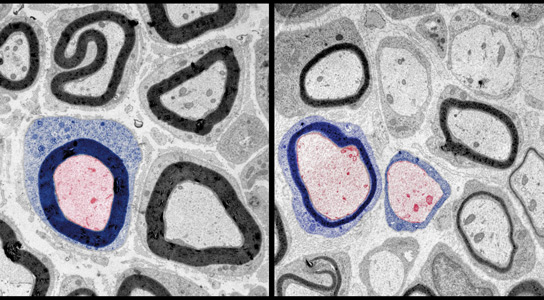
    Section through nerve fibers within the sciatic nerve as seen under the electron microscope: the axons (nerve cell projections, pink) are only poorly surrounded by a myelin sheath (generated by Schwann cells, colored blue) following inactivation of the gene encoding BACE1, which controls the myelination process (right panel). The nerve fibers in a control animal (left panel, BACE1 gene is intact) are in contrast surrounded by thick myelin sheaths (dark rings). Credit: Dr. Alistair Garratt/Copyright: MDC

    Brain connectivity can predict reading skills, thanks to brain scans and the examination of the growth of long-range connections in the brain. These allow researchers to predict how a child’s reading skills will develop.

    The scientists published their findings in the Proceedings of the National Academy of Sciences. Literacy requires the integration of brain activity in the areas associated with vision, hearing and language, which are distributed throughout the brain. Efficient communication between them is essential for children to become proficient readers.
    white-matter-bundles
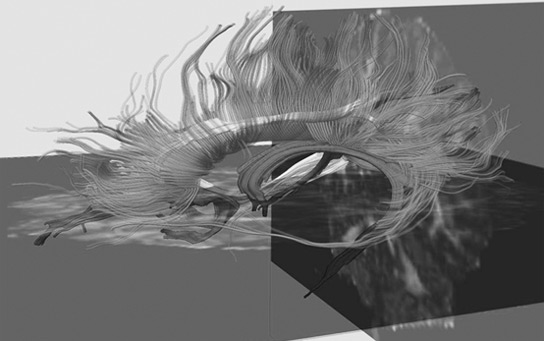
    Some of the major white matter bundles identified through diffusion tensor imaging (DTI) tractography. DTI detects the diffusion of water along nerve fibers to map out the communication highways between brain regions. Credit: Courtesy of Sylvain Bouix, Psychiatry Neuroimaging Laboratory, Brigham & Women’s Hospital

    Jason Yeatman, a neuroscientist at Stanford University in California, et al. studied how the development of reading ability relates to the growth in the brain’s white-matter tracts, the bundles of fibers that connect distant regions of the brain.

    The scientists tested how the reading skills of 55 children between the ages of 7 and 12 developed over a three-year period. There were big differences in the children’s reading ability, and these differences persisted throughout the term of the study with weak readers remaining weaker than others at the end of three years.

    The scientists also scanned the brains of 39 children at least three times during the same period, visualizing the growth of two major white-matter tracts: the arcuate fasciculus that connects the brain’s language centers, and the inferior longitudinal fasciculus that links the language centers with parts of the brain which process visual information

    The differences in the growth of both tracts could predict the variation in the children’s reading ability. Strong readers started off with a weak signal in both tracts on the left side of the brain, which eventually got stronger over three years. Weaker readers exhibited the opposite pattern and the signal got weaker over the three year period.

    The growth of these white-matter tracts is governed by pruning, the process by which extraneous nerve fibers and neuronal connections are eliminated, and by myelination, individual nerve fibers in the tracts are enveloped by fatty, insulating tissues that increases the speed of transmission. Both processes are influenced by experience and occur at different rates and times in different people.

    The relative timing of pruning and myelination differs between strong and weak readers, states Yeatman. In good readers, both processes are unfolding together at an even rate. In poor readers, the two processes are out of sync.

    The findings could help researchers understand the relationship between the strength of connections and reading skill. If they are able to determine exactly when pruning takes place, children might find it easier to read at this stage of the development, when there is greater potential for remodeling in the brain.

    Reference: “Development of white matter and reading skills” by Jason D. Yeatman, Robert F. Dougherty, Michal Ben-Shachar and Brian A. Wandell, 8 October 2012, Proceedings of the National Academy of Sciences.
    DOI: 10.1073/pnas.1206792109

    Never miss a breakthrough: Join the SciTechDaily newsletter.
    Follow us on Google and Google News.

    Brain Brain Activity Learning Neurology Neuroscience Reading
    Share. Facebook Twitter Pinterest LinkedIn Email Reddit

    Related Articles

    Brain’s Reading Centers Are Culturally Universal No Matter What Language

    Brain Scans of Rappers During Improvisation Show Creativity At Work

    Study Shows Broca’s Area Has Multiple Roles

    Life Long Learning and Experiences Are Good for the Brain

    Von Economo Neuron Discovered in the Insula of Macaque Monkeys

    Researchers Use FDDNP–PET Scanning to Predict Cognitive Decline

    Neuroscientists Create Model to Study Burst Suppression and Brain States

    Researchers Use fMRI to Study How Humor Activates Kids’ Brain Regions

    Mother’s Nurturing Results in Larger Hippocampus in Children

    Leave A Reply Cancel Reply

    • Facebook
    • Twitter
    • Pinterest
    • YouTube

    Don't Miss a Discovery

    Subscribe for the Latest in Science & Tech!

    Trending News

    This Copper Drug Clears Alzheimer’s Brain Toxins and Boosts Memory

    Adults Over 65 Lost Massive Amounts of Weight With Ozempic

    How Flocking Birds “Defy” One of Physics’ Most Fundamental Laws

    Physicists Create a New Kind of Schrödinger’s Cat State From Exotic Quantum Building Blocks

    Your Diet Could Be Missing the Key Ingredient for Heart Protection

    Researchers Warn Widely Prescribed Blood Pressure Drugs Could Be Harming Diabetic Kidneys

    James Webb Spots Something Strange Between Day and Night on an Alien Planet

    How Ancient People Moved a 6-Ton Stone 700 Kilometers to Stonehenge

    Follow SciTechDaily
    • Facebook
    • Twitter
    • YouTube
    • Pinterest
    • Newsletter
    • RSS
    SciTech News
    • Biology News
    • Chemistry News
    • Earth News
    • Health News
    • Physics News
    • Science News
    • Space News
    • Technology News
    Recent Posts
    • Near Absolute Zero, This Transistor Starts Acting Like a Brain Cell
    • Beyond DNA: Scientists Discover Inheritance That Breaks the Rules of Genetics
    • A Surprising Discovery Challenges What Scientists Thought DNA Methylation Was For
    • This New DNA Test Solves Rare Disease Mysteries That Standard Genetics Misses
    • Scientists Just Discovered the Eye Defies a Long-Held Rule of Vision
    Copyright © 1998 - 2026 SciTechDaily. All Rights Reserved.
    • Science News
    • About
    • Contact
    • Editorial Board
    • Privacy Policy
    • Terms of Use

    Type above and press Enter to search. Press Esc to cancel.