
Study shows damp masks still stop respiratory droplet penetration.
After studying the effectiveness of varying layers of masks in stopping respiratory droplets from escaping face masks, a team of international researchers has now turned their attention to modeling what happens to droplets when they come in contact with wet masks. Their results show that damp masks are still effective at stopping these droplets from escaping the mask and being atomized into smaller, easier-to-spread aerosolized particles.
This study only investigated the effects of wet masks on droplet penetration; the researchers note that people should follow public health guidance to change their mask if it is wet, since wet masks are harder to breathe through, less efficient at filtering inhaled air, and can vent more around the edge of the mask than dry masks.
“While the efficacies of various dry face masks have been explored, a comprehensive investigation of wet masks is lacking. Yet, users wear masks for long periods of time, and during this time the mask matrix becomes wet due to respiratory droplets released from breathing, coughing, sneezing, etc,” wrote the team of engineers from the University of California San Diego, Indian Institute of Science, and University of Toronto. The researchers presented their findings on November 21 at the American Physical Society’s 74th Annual Meeting of the APS Division of Fluid Dynamics. The same paper will be published in Physical Review Fluids on December 7.
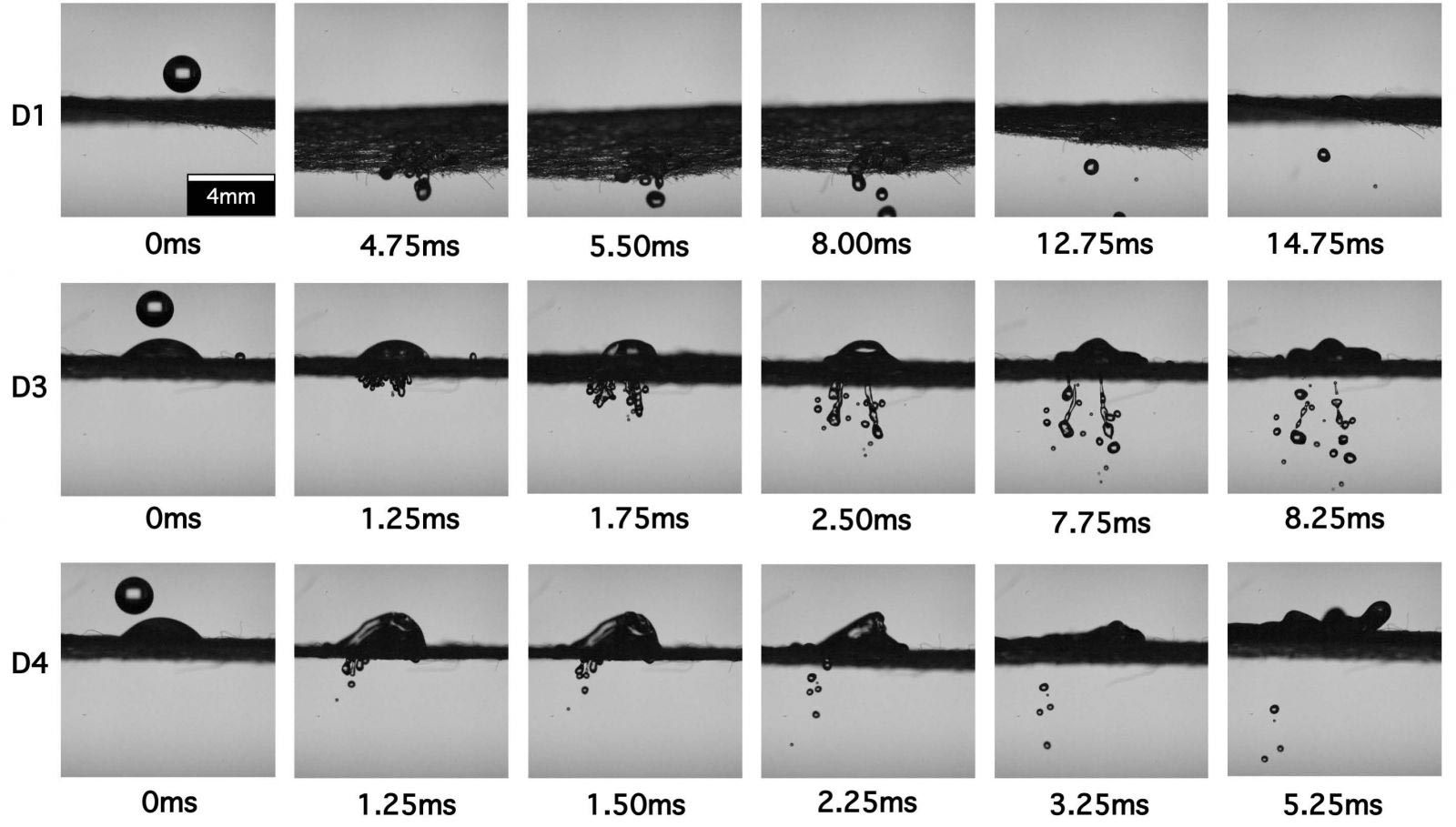
They found that, perhaps counterintuitively, wet masks actually make it more difficult for these respiratory droplets to penetrate and escape the mask, splintering into smaller, aerosolized particles; research has shown that these smaller particles are more likely to spread the SARS-CoV-2 virus by lingering in the air longer than the larger droplets that fall to the ground. In modeling the physics behind why this happens, they discovered that two very different mechanisms are present for hydrophobic masks like common surgical masks, versus hydrophilic masks like the cloth varieties.
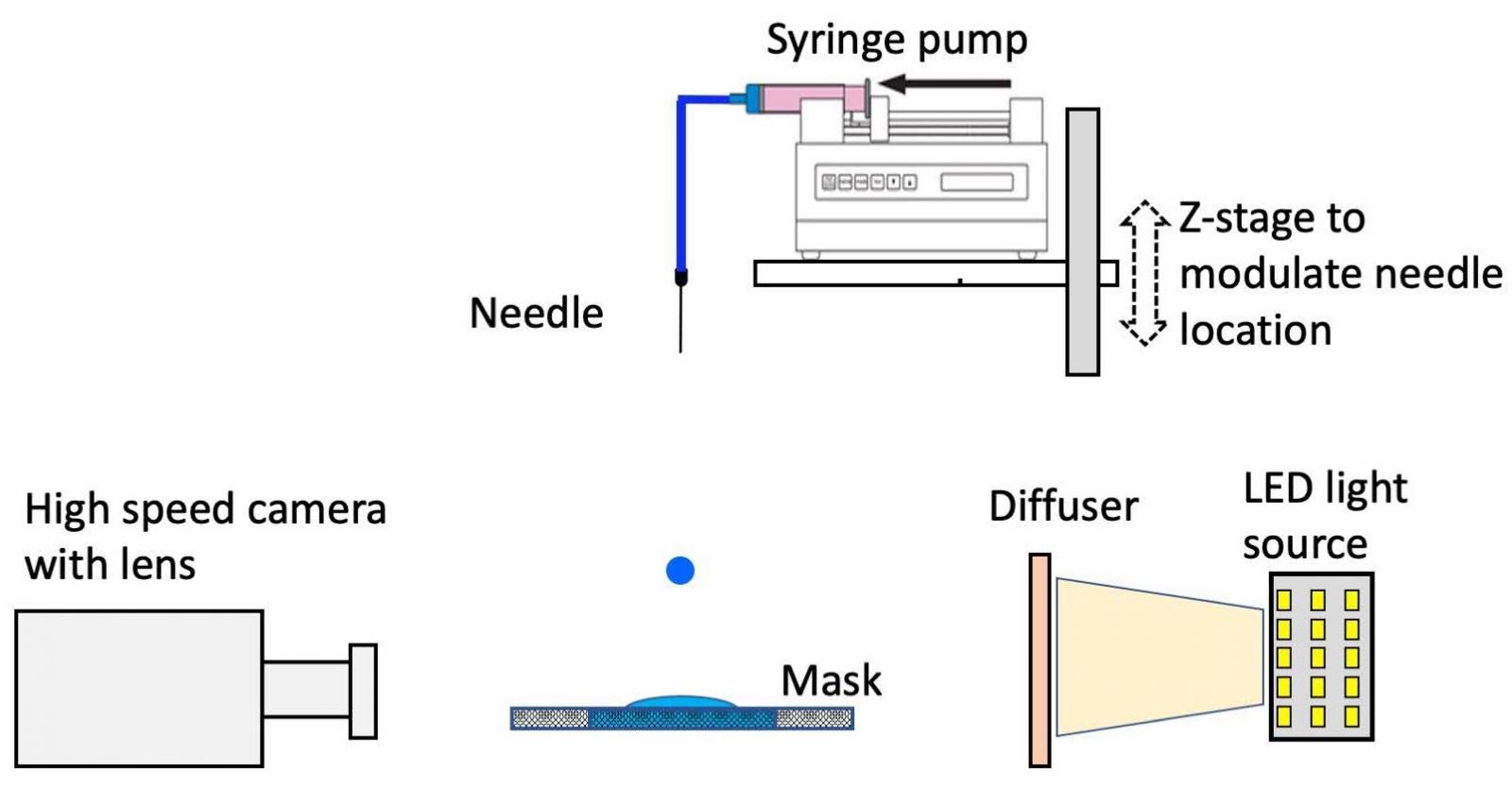
To study exactly how wetness impacts droplet penetration, the researchers generated mock respiratory droplets using a syringe pump, which slowly pushed liquid through a needle and onto one of three types of mask materials: a surgical mask, and two cloth masks of different thicknesses. The researchers recorded what happened as the droplets hit the mask using a high-speed camera capturing the impact at 4,000 frames per second, and continued to study it as the mask became damp.
Hydrophobic vs. Hydrophilic Mask Behavior
They found that droplets from a cough or sneeze have to be traveling at a higher velocity to be pushed through a mask when wet, compared to when it’s dry. On hydrophobic masks with low absorptivity, like surgical masks, the respiratory droplets form small beads on the mask’s surface, providing additional resistance for the impacted droplets against possible penetration.
The hydrophilic cloth masks do not exhibit this beading; instead, the cloth absorbs the liquid, with the wetted area spreading as the mask absorbs more volume. The porous matrix of these cloth masks become filled with liquid, and the droplets are therefore required to displace a larger volume of liquid to penetrate the mask. Due to this additional resistance, penetration is weaker.
Key Findings and Considerations
“In summary, we showed that wet masks are capable of restricting ballistic respiratory droplets better than dry masks,” said Sombuddha Bagchi, first author of the paper and a mechanical engineering PhD student at the Jacobs School of Engineering at UC San Diego.
“However, we also need to pay attention to side leakage and breathability of wet masks, which were not investigated in our study”, added Abhishek Saha, a co-author, and professor of Mechanical and Aerospace Engineering at UC San Diego.
The team of engineers— which also includes Professors Swetaprovo Chaudhuri from University of Toronto, and Saptarshi Basu of the Indian Institute of Science— were well-versed in this type of experiment and analysis, though they were used to studying the aerodynamics and physics of droplets for applications including propulsion systems, combustion, or thermal sprays. They turned their attention to respiratory droplet physics last year when the COVID-19 pandemic started, and since then, have been studying the transport of these respiratory droplets and their roles in transmission of Covid-19 type diseases.
In March 2021, this same team published a paper in Science Advances detailing the effectiveness of dry masks of one, two, and three layers in stopping respiratory droplets from penetrating the mask. Using a similar methodology to this wet mask experiment, they showed that three-layered surgical masks are most effective at stopping large droplets from a cough or sneeze from getting atomized into smaller droplets. These large cough droplets can penetrate through the single- and double-layer masks and atomize to much smaller droplets, which is particularly crucial since these smaller aerosol droplets are able to linger in the air for longer periods of time.
Reference: “Penetration and secondary atomization of droplets impacted on wet facemasks” by Sombuddha Bagchi, Saptarshi Basu, Swetaprovo Chaudhuri and Abhishek Saha, 23 November 2021, Physical Review Fluids.
DOI: 10.1103/PhysRevFluids.6.110510
Never miss a breakthrough: Join the SciTechDaily newsletter.
Follow us on Google and Google News.
1 Comment
This study proves that it is nothing more than Make Work so the government’s increase funding vs decreasing for fiscal year 2022. Any bonehead who carries around a squirt bottle or suggest same to keep their mask moist should be locked up period. No ifs or buts about it. You’ve lost your mind & a good long a very long stay in a Psychic hospital is your only hope. Think of it as a vacation from the other crazies.