
In Samuel Arbesman’s new book The Half-Life of Facts: Why Everything We Know Has an Expiration Date, the applied mathematician examines why in the modern world, facts change all of the time.
Arbesman is a senior scholar at the Kaufmann Foundation and an expert in scientometrics. He also writes for Wired Science’s Social Dimension and in this new book, he examines how facts are made and remade. As fact-making speeds up, he’s concerned that most of us don’t keep updated and therefore won’t make decisions on the new truths.

Scientometrics is the science of measuring and analyzing science, and it began in 1947 when mathematician Derek J. de Solla Price was asked to store a complete set of The Philosophical Transactions of the Royal Society temporarily in his house. He stacked them in order and noticed that the height of the stacks fit an exponential curve. Price then started to analyze all sorts of scientific data and concluded in 1960 that scientific knowledge had been growing steadily at a rate of 4.7% annually since the 17th century. Scientific data was doubling every 15 years. In 1965, he realized that the growth was a factor of 10 every half-century.
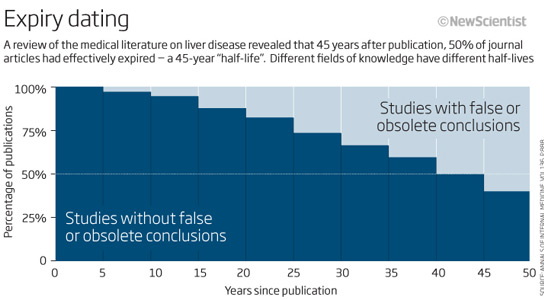
Arbesman wanted to discover the half-life of the scientific facts we know. The decay in truth of clinical knowledge about cirrhosis and hepatitis is about 45 years. Half of what physicians thought they knew about liver diseases was wrong or obsolete 45 years later.
Facts are being manufactured all of the time, and many of them turn out to be wrong. There were 845,175 articles published in 2009 and recorded in PubMed. How many of them were replicated? Not many. In 2011, a study in the journal Nature reported that a team of researchers had been able to reproduce only six out of 53 landmark papers in preclinical cancer research.
Lots of this new information will be overlooked. Arbesman illustrates this by talking about when Harvard researchers decided to go back and look at all of the prior randomized control trials relating to heart attacks and the drug streptokinase between 1959 and 1988. In 1988, a trial showed that streptokinase was effective in treating heart attacks.
The researchers concluded that scientists could have easily found a statistically significant result in 1973 rather than 1988. The efficiency of streptokinase remained hidden in scientific literature for 15 years. These days, there are data combing companies working on ensuring that previous studies aren’t lost.
“We persist in only adding facts to our personal store of knowledge that jibe with what we already know, rather than assimilate new facts irrespective of how they fit into our worldview.” Samuel Arbesman
In order to keep facts actuated, people should always seek out new information. Instead of memorizing facts, something that could eventually be outsourced to the cloud, people should continually learn. The current growth rates will also have to slow down, as they could imply that everyone on the planet will one day be a scientist.
Reference: “Raise standards for preclinical cancer research” by C. Glenn Begley and Lee M. Ellis, 28 March 2012, Nature.
DOI: 10.1038/483531a
Never miss a breakthrough: Join the SciTechDaily newsletter.
Follow us on Google and Google News.