
By analyzing isotopes of potassium and rubidium in carbonaceous chondrites, researchers discovered that shockwaves in the early solar nebula stripped volatiles from primitive dust. This finding overturns older theories of evaporation and helps explain Earth’s unusual geochemical composition.
Meteorites are remnants of the building blocks that formed Earth and the other planets orbiting our Sun. Recent analysis of their isotopic makeup led by Carnegie’s Nicole Nie and published in Science Advances settles a longstanding debate about the geochemical evolution of our Solar System and our home planet.
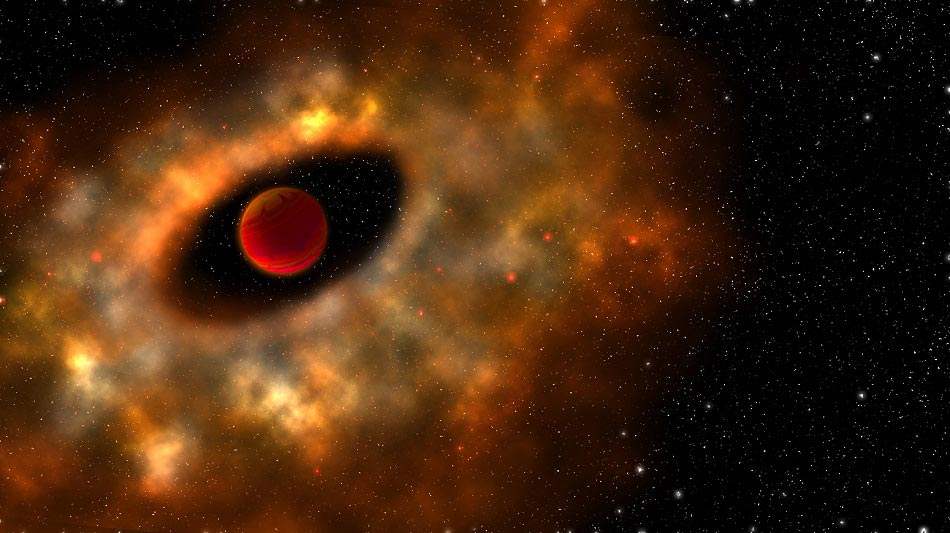
In their youth, stars are surrounded by a rotating disk of gas and dust. Over time, these materials aggregate to form larger bodies, including planets. Some of these objects are broken up due to collisions in space, the remnants of which sometimes hurtle through Earth’s atmosphere as meteorites.
By studying a meteorite’s chemistry and mineralogy, researchers like Nie and Carnegie’s Anat Shahar can reveal details about the conditions these materials were exposed to during the Solar System’s tumultuous early years. Of particular interest is why so-called moderately volatile elements are more depleted on Earth and in meteoritic samples than the average Solar System, represented by the Sun’s composition. They are named because their relatively low boiling points mean they evaporate easily.
It’s long been theorized that periods of heating and cooling resulted in the evaporation of volatiles from meteorites. Nie and her team showed that an entirely different phenomenon is the culprit in the case of the missing volatiles.
Carbonaceous Chondrites: Primitive Records of Solar History
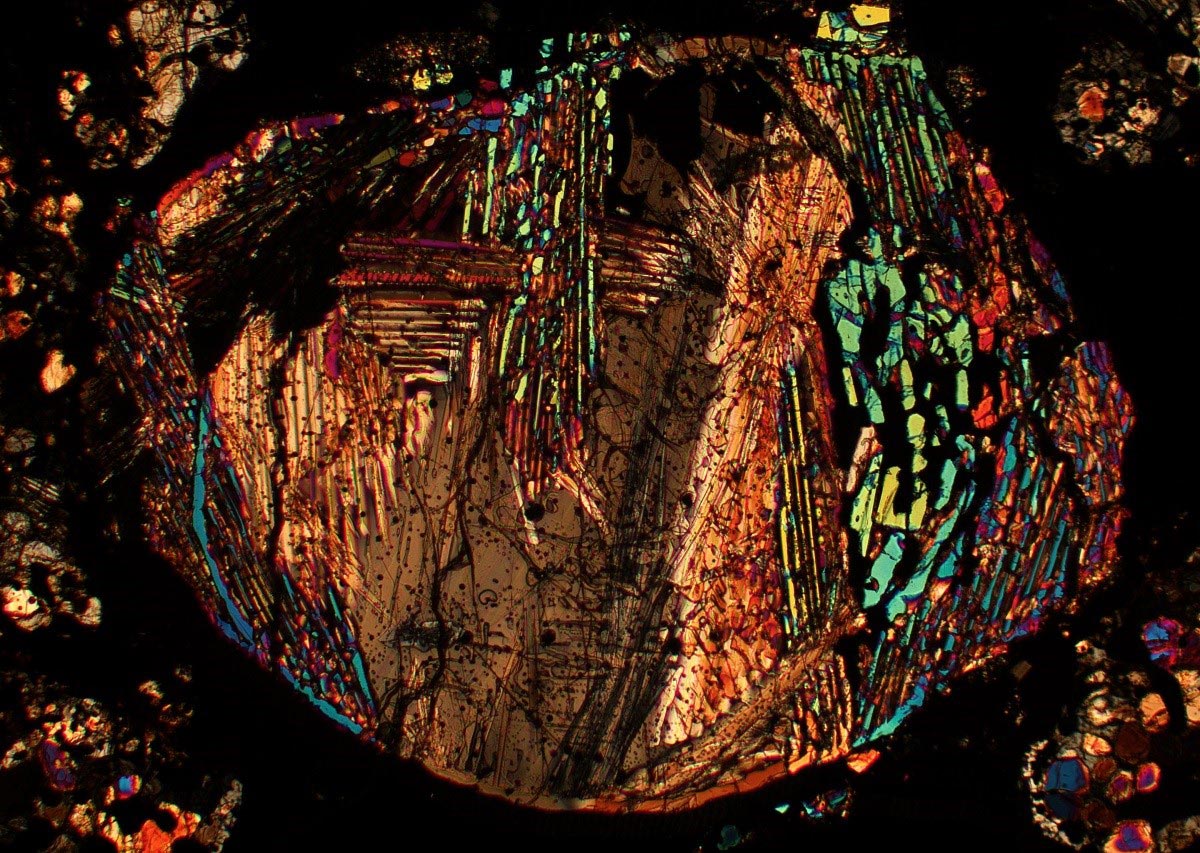
Solving the mystery involved studying a particularly primitive class of meteorites called carbonaceous chondrites that contain crystalline droplets, called chondrules, which were part of the original disk of materials surrounding the young Sun. Because of their ancient origins, these beads are an excellent laboratory for uncovering the Solar System’s geochemical history.
“Understanding the conditions under which these volatile elements are stripped from the chondrules can help us work backward to learn the conditions they were exposed to in the Solar System’s youth and all the years since,” Nie explained.
She and her co-authors set out to probe the isotopic variability of potassium and rubidium, two moderately volatile elements. The research team included Shahar and colleagues from The University of Chicago, where Nie was a graduate student prior to joining Carnegie—Timo Hopp, Justin Y. Hu, Zhe J. Zhang, and Nicolas Dauphas—as well as Xin-Yang Chen and Fang-Zhen Teng from University of Washington Seattle.
How Isotopes Reveal Ancient Cosmic Processes
Each element contains a unique number of protons, but its isotopes have varying numbers of neutrons. This means that each isotope has a slightly different mass than the others. As a result, chemical reactions discriminate between the isotopes, which, in turn, affects the proportion of that isotope in the reaction’s end products.
“This means that the different kinds of chemical processing that the chondrules experienced will be evident in their isotopic composition, which is something we can probe using precision instruments,” Nie added.
Their work enabled the researchers to settle the debate about how and when in their lifespans the chondrules lost their volatiles. The isotopic record unveiled by Nie and her team indicates that the volatiles were stripped as a result of massive shockwaves passing through the material circling the young Sun that likely drove melting of the dust to form the chondrules. These types of events can be generated by gravitational instability or by larger baby planets moving through the nebular gas.
“Our findings offer new information about our Solar System’s youth and the events that shaped the geochemistry of the planets, including our own,” Nie concluded.
“The revelation that shockwaves modified the material from which the planets were born has major implications for Earth science as well,” added Carnegie Earth and Planets Laboratory Director Richard Carlson. “Once a planet gets as big as ours, its gravity is sufficient that losing most volatile elements becomes very difficult. Knowing that moderately volatile elements were stripped from the planetary building blocks themselves answers fundamental questions about Earth’s geochemical evolution.”
Reference: “Imprint of chondrule formation on the K and Rb isotopic compositions of carbonaceous meteorites” by Nicole X. Nie, Xin-Yang Chen, Timo Hopp, Justin Y. Hu, Zhe J. Zhang, Fang-Zhen Teng, Anat Shahar and Nicolas Dauphas, 1 December 2021, Science Advances.
DOI: 10.1126/sciadv.abl3929
This work was supported by NASA, a Carnegie postdoctoral fellowship, and a Carnegie Postdoc × Postdoc seed grant.
Never miss a breakthrough: Join the SciTechDaily newsletter.
Follow us on Google and Google News.
2 Comments
Ever wonder WHY space smells like steak and burnt metals? A Carbonaceous chondrite loaded comet may NOT be a “dirty snowball” after all. However, a Velikovsky style solar system explains it PERFECTLY!!!
A meteorite is a meteor that has ‘landed’, so to speak.